BCA Indicators/Model

Our Commodity & Energy colleagues see oil markets balanced in the short run, which keeps their Brent price forecasts at $95/bbl and $105/bbl for 2024 and 2025. That said, they note the odds are increasing demand growth could surprise to the…
According to BCA Research’s Counterpoint service, European stocks will be the big winners of the 2020s. Every decade has a big loser and a big winner. Which stock market will be the winner through the remaining two-thirds of the 2020s? The…
BCA Research’s US Equity Strategy service created a sector selection scorecard based on performance of sectors under various macroeconomic regimes. The current macroeconomic backdrop is characterized by the following regimes: Impending rate…
In the monthly Daily Insights Survey we conducted over the past week, we asked about our readers’ views on tech stocks, the US economy in 2024, and China’s contribution to global growth. Regarding tech stocks, 44% of respondents believe the rally as…
In this Insight our Equity Analyzer team explores how the S&P 500 behaves when the Fed Funds Target Rate drops by 25bps – 150bps within a single year. The current dot plot is signaling 75bps of cuts by the end of the year, the mid-point of the range.…
BCA Research’s Global Investment Strategy service’s MacroQuant 2.0 model continues to recommend that investors maintain a benchmark allocation to equities over a 1-to-3 month horizon. At the end of January, MacroQuant’s US equity module, Stock Coach, is…
As expected, the Bank of England voted to keep its bank rate unchanged at 5.25% on Thursday – maintaining policy on hold for the fourth consecutive meeting. Two of the nine MPC members voted in favor of a 25bps rise (one less than in December) while one…
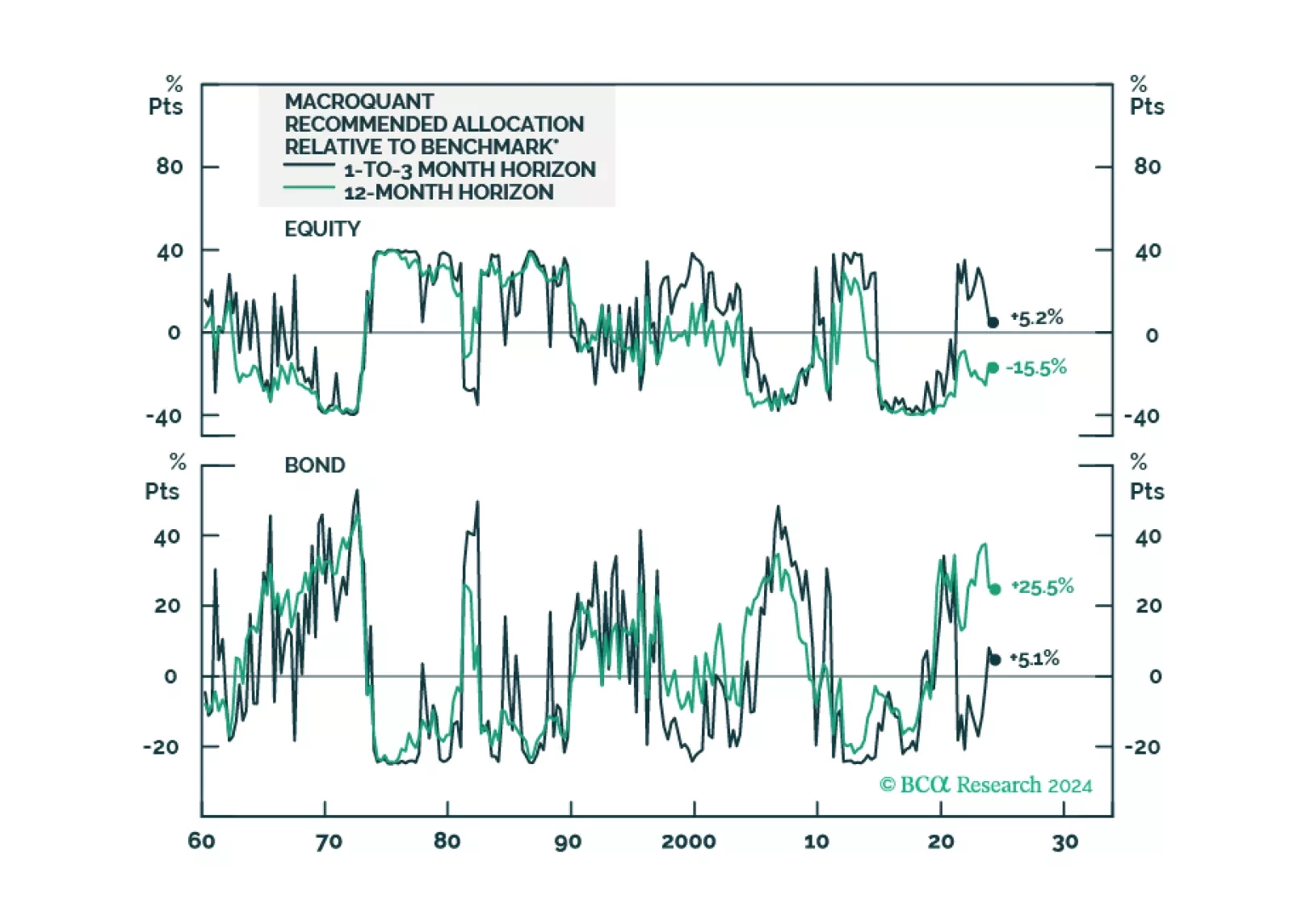
Following the release of the white paper yesterday, today we are sending you the inaugural issue of the MacroQuant Monthly, a report summarizing the output of our next-generation MacroQuant 2.0 model.
BCA Research’s Global Investment Strategy service has officially launched its MacroQuant 2.0 Model. The platform consists of a variety of modules, all of which communicate with each other to produce economically sensible and internally consistent…
According to BCA Research’s European Investment Strategy service, European sovereign bonds in the periphery offer more upside than high-yield (HY) corporate bonds. Many question the outlook for peripheral bonds in Europe due to the ECB’s shrinking balance…