Sorry, you need to enable JavaScript to visit this website.
Skip to main content

China

President Trump’s announcement this week of a new deployment of aid to U.S. farmers, to offset China’s retaliation to steeper tariffs, highlights that agriculture has been the sacrificial lamb in the U.S.’s hawkish trade policy. The $15 billion announcement follows last year’s $12 billion disbursement, and suggests that the path to a trade agreement with China remains fraught. Although China and the U.S. continue to negotiate, and President Trump has indicated that “maybe something will happen” within a “three or four week” timeframe, last week’s events indicate that a resolution is far from guaranteed. Both positive and negative trade war news will dominate the near term evolution of ag prices – stay on the sidelines as negotiations will sway markets. Highlights Energy: Overweight. Crude oil prices are up ~2% since the beginning of the week on escalating tensions in the Middle East, as expected. Two Saudi oil-pumping stations were targeted in a drone attack on Tuesday. This follows attacks on four oil tankers – including two Saudi ships – off the coast of the United Arab Emirates. These events highlight the increased risk of supply outages since the U.S. decision not to extend waivers on Iran sanctions.1 Base Metals: Neutral. The recent escalation in Sino-U.S. trade tensions pushed LMEX prices down 2% since the beginning of last week. Nevertheless, we believe that in the medium term Chinese authorities will manage to offset the negative economic impact on metals by ramping up fiscal-and-credit stimulus.2 Precious Metals: Gold’s geopolitical risk premium is rising amid escalating trade tensions. Gold rallied ~2% since May 3, amid declining global equities. Our gold trade is up 5.3% since inception. Ags/Softs: Underweight. Sino-U.S. trade tensions are weighing heavily on agriculture commodities. The grains and oilseed index is down 9% since the beginning of the year. Continued trade war uncertainty will keep risks elevated in the ags space (see below). Feature Several factors – including dollar strength and bearish fundamentals – have come together to drive down ag prices so far this year. However, the latest plunge highlights that trade risks remain a real threat to ag markets. This is in line with the sharp cutback in Chinese imports of U.S. ags, which make up a large share of Chinese imports from the U.S. and have been hit hard by tariffs (Chart of the Week). Soybeans in particular have become the poster child of the dispute. Uncertainty has taken their prices down to 10 year lows. In 2017, they accounted for $12.4 worth, or 9.3%, of U.S. exports to China. However, since the onset of the dispute, American soybean farmers have been struggling to market their crops. U.S. exports to China are down more than 80% y/y since 2H18 (Chart 2), and while there have been efforts to find other markets, they have yet to offset the impact of lower trade with China (Chart 3). Chart 1 Chart 2Soybeans Are The Poster Child Of The Conflict Soybeans Are The Poster Child Of The Conflict Soybeans Are The Poster Child Of The Conflict Chart 3 A long-term solution is necessary to support the agriculture industry and prices of grains and oilseeds. In fact, the Chinese tariffs add to ongoing trade disputes between the U.S. and some of its other major ag markets (Charts 4A & 4B). Canada, Mexico, and the EU have placed tariffs on a range of U.S. agricultural goods in response to the Section 232 tariffs on steel and aluminum. Chart 4 Chart 4 As such, American farmers are suffering the brunt of the trade war’s burden. Chinese retaliation comes at a time when U.S. ag stockpiles are already elevated (Chart 5). Inflation-adjusted farm income had been deteriorating prior to the trade dispute, falling to about half its 2013 level (Chart 6). The trade dispute has only reinforced this trend. In its most recent Ag Credit Survey, the Kansas City Fed found the pace of decline in farm loan repayment rates increased, while carry-over debt increased for many borrowers, ultimately causing a deterioration in ag credit conditions. Given that exports account for 20% of U.S. farm income, according to USDA estimates, a long-term solution is necessary to support the agriculture industry and prices of grains and oilseeds. Otherwise, tariffs will simply be another constraint on U.S. ag exports, which have been losing global market share since the mid-1990s (Chart 7). Chart 5U.S. Stocks Are Relatively Elevated U.S. Stocks Are Relatively Elevated U.S. Stocks Are Relatively Elevated Chart 6Farmers Suffering The Brunt Of The Burden Farmers Suffering The Brunt Of The Burden Farmers Suffering The Brunt Of The Burden Chart 7U.S. Agriculture Losing Global Market Share U.S. Agriculture Losing Global Market Share U.S. Agriculture Losing Global Market Share Even though China briefly resumed some purchases of U.S. ags this year as a goodwill gesture during negotiations, these purchases stand significantly below those of previous years. They resulted from one-time purchases by Chinese state-owned enterprises, and barriers to trade remain in place. Such ad hoc attempts at reconciliation will not be sufficient to support a distrustful market going forward. The trade war is just one facet of a broader strategic U.S.-China conflict. This means a reso­lution would be only a cyclical improvement in an ongoing structural deterioration in relations. A number of potential outcomes can result from the ongoing negotiations: Most bearish: China raises the tariff rate on U.S. ag exports even further. A situation in which a fallout in the negotiations leads to strategic tensions – a scenario to which BCA’s geopolitical strategists attribute a 50% chance – could result in further ratcheting up of tariffs by China. Given that Chinese imports of U.S. ags are approaching zero, there is limited significant further downside even in this most pessimistic scenario. However, unless the U.S. is able to smoothly market its crops in other regions, upside will also be limited for some time. Since trade tariffs have already been initiated with many of the U.S.’s major ag consumers, securing reliable alternative markets may prove a challenge. Especially since Trump’s hawkish foreign policy raises risks and uncertainties for America’s trade partners. Bearish: Tariffs remain at current levels. Similar to the most bearish scenario, given that the U.S. is already having a difficult time marketing its crops abroad, significant further downside from current levels is also limited. However, any premium priced on the expectation of a resolution of the trade conflict will be eliminated. Again, as in the most bearish scenario, the loss of the Chinese market may be mitigated by an expansion of alternative markets, but challenges will remain. Bullish: Tariffs are cut back to pre-trade war levels. In this scenario, the tariffs imposed since the onset of the trade war will be unwound. This would once again raise the competitiveness of American crops in Chinese markets, and would entail higher ag prices as demand channels are re-established. Most Bullish: Tariffs fall to equalized levels. One of Trump’s key complaints is that U.S. and Chinese tariffs are not “reciprocal in nature and value” (Chart 8). Given that Chinese tariffs are above those of the U.S., this would entail a reduction in Chinese tariffs to below trade war levels (Table 1). Chart 8 Table 1... And They Have Gone Up American Farmers Caught In The Crosshairs Of Sino-U.S. Brinkmanship American Farmers Caught In The Crosshairs Of Sino-U.S. Brinkmanship A lasting trade deal will likely include measures to close the bilateral trade deficit, which in 2018 stood at $379 billion. Last year Trump called on Beijing to reduce this deficit by $200 billion over two years. If we make the overly simplistic assumption that the share of imports remains unchanged, such a reduction would lead to an additional $19 billion in soybeans, $0.54 billion in wheat, and $0.23 billion in corn imports. This back of the envelope calculation implies a doubling of these U.S. exports to China, relative to 2017 levels. As we highlighted in our March ags update, investors had become overly optimistic with their expectation of a swift resolution of the trade war.3 In fact, according to BCA’s geopolitical strategists, the trade war is just one facet of a broader strategic U.S.-China conflict. This means a resolution would be only a cyclical improvement in an ongoing structural deterioration in relations. They assign only 40% odds that a deal will be finalized by year-end, with 30% odds that the frictions will escalate into strategic tensions. In the meantime, Trump’s palliatives – which include a “trade relief” program, an EU promise to purchase more U.S. soybeans, and last week’s suggestion of government purchases for humanitarian aid – are unlikely to lift ag prices. Bottom Line: The U.S.-China trade war has weighed on American ag exports. The impact on farmers – in terms of lower incomes, and higher stockpiles – has been significant. Granting that odds of a resolution this year are no greater than 40%, we recommend a cautious stance on ag markets. However, a trade deal that entails Chinese promises to import U.S. ags – either through more favorable tariff rates or commitments to purchase large volumes – would provide a buying opportunity. In any case, we suspect that prices are near the bottom, but will require a significant catalyst – in the form of a trade deal – to begin to climb materially. No Relief From Fundamentals, Either With spring planting underway, the recent escalation in trade tensions comes at a busy time of year for U.S. farmers. According to the USDA’s annual Prospective Planting Report, released at the end of March, the planted area of corn will likely increase by 4% in 2019, while soybean and wheat will fall 5% y/y and 4% y/y, respectively. If realized, the planting area that farmers intend to dedicate to wheat will be the lowest on record – that is, since 1919 (Chart 9). However, farms in the Midwest were hit by a “bomb cyclone” in March, which has damaged crops and delayed planting. Inundated fields mean farmers are forced to push back their schedule. The latest Weekly Crop Progress Report from the USDA, indicates that farmers have fallen behind relative to typical progress at this time of year (Table 2). Although farmers’ current lack of headway is cause for concern, they may still be able to catch up and attain their targeted acreage. Chart 9Record Low Wheat Acreage Record Low Wheat Acreage Record Low Wheat Acreage Table 2Flooding Has Delayed Spring Planting American Farmers Caught In The Crosshairs Of Sino-U.S. Brinkmanship American Farmers Caught In The Crosshairs Of Sino-U.S. Brinkmanship Given that stockpiles are full, due to years of surplus, the impact of the flooding is unlikely to move international ag prices. Nevertheless, planting delays raise the possibility that corn farmers will switch to soybeans, which can be planted later in the season. In the May update of the World Supply And Demand Estimates – which includes the first estimates for the 2019/20 crop year — the USDA projected a decline in U.S. soybean ending stocks on the back of lower production and a pickup in exports. The switch in planting intentions towards soybeans at the expense of corn may at least partially reverse this expectation, raising global soybean inventories which are expected to remain unchanged (Chart 10). In addition to trade war, the African swine fever has hit pig herds in China – the main consumers of soybeans. According to China’s official statistics, more than a million pigs have been culled, and Chinese pork production is expected to be slashed by between a quarter and a half this year. This will depress demand for soybeans, further weighing on prices. So far this year the greenback has been a source of bearishness toward ags. Since the epidemic has spread to other Asian neighbors including Hong Kong and Vietnam, soybean demand from Asia will be reduced, regardless of the outcome of the trade war. This will also weigh on other major producers such as Brazil and Argentina, which have so far benefited from China’s shunning of the American crop. South American producers are also at risk if a positive outcome emerges from the negotiations. Chart 10No Change In Soybean Inventories Expected In The Coming Crop Year No Change In Soybean Inventories Expected In The Coming Crop Year No Change In Soybean Inventories Expected In The Coming Crop Year Chart 11Preliminary Projections Of Uptick In 2019/20 Wheat Inventories Preliminary Projections Of Uptick In 2019/20 Wheat Inventories Preliminary Projections Of Uptick In 2019/20 Wheat Inventories On the other hand, according to the latest USDA estimates, both global and U.S. year-end wheat inventories are expected to pick up in the 2019/2020 crop year (Chart 11). Greater European production will add to already elevated supplies. While global corn inventories are projected to come down, U.S. inventories will likely rise amid greater production and weaker exports. However, these acres are at risk given the flood delays (Chart 12). In addition to these supply-demand fundamentals, U.S. financial conditions – especially the U.S. dollar – will remain a key driver of ag prices. So far this year the greenback has been a source of bearishness toward ags. Ag prices have an inverse relationship with the U.S. trade-weighted dollar (Chart 13). While in our earlier report we had expected the dollar to peak by mid-year, the May 5 escalation in the trade war poses a risk to this view by threatening the global trade and growth outlook and spurring risk-off sentiment. Chart 12Another Deficit Expected ##br##For Corn Another Deficit Expected For Corn Another Deficit Expected For Corn Bottom Line: Farmers in the U.S. Midwest facing inundated fields are behind schedule in their spring planting. This poses a risk that a greater number of soybeans will be planted at the expense of corn – weighing down on an already depressed soybean market and potentially requiring the USDA to revise down its U.S. bean ending stocks in its next WASDE report. Chart 13U.S. Financial Conditions Continue To Weigh On Ags U.S. Financial Conditions Continue To Weigh On Ags U.S. Financial Conditions Continue To Weigh On Ags What is more, the African swine fever, which is spreading across East Asia, is reducing demand for animal feed there. Unless the trade conflict is resolved, we expect corn and wheat to outperform the soybean market.   Roukaya Ibrahim, Editor/Strategist Commodity & Energy Strategy RoukayaI@bcaresearch.com   Footnotes 1      Please see BCA Research’s Commodity & Energy Strategy Special Report titled “U.S.-Iran: This Means War?” dated May 3, 2019, available at ces.bcaresearch.com. 2      Please see BCA Research’s Commodity & Energy Strategy Weekly Report titled “Expanded Sino-U.S. Trade War Could Be Bullish For Base Metals,” dated May 9, 2019, available at ces.bcaresearch.com. 3      Please see BCA Research’s Commodity & Energy Strategy Weekly Report titled “Financial Conditions, Trade War Continue To Dominate Ag Market,” dated March 28, 2019, available at ces.bcaresearh.com. Investment Views and Themes Recommendations Strategic Recommendations Tactical Trades TRADE RECOMMENDATION PERFORMANCE IN 2019 Q1 Image Commodity Prices and Plays Reference Table   Trades Closed in 2019 Summary of Closed Trades Image

While we remain bullish on global equities and other risk assets over 12 months, we went tactically short the S&P 500 last Friday following the market’s complacent reaction to the Trump Administration’s further tariffs increases on Chinese imports. While a moderate trade war would still produce more economic damage than standard economic models imply, this would be greatly mitigated by significant Chinese economic stimulus and a Fed that is in no hurry to raise rates and could even cut rates. Barring any further major developments, we recommend investors start increasing risk exposure if the S&P 500 falls to 2711. A dip in global bourses would also create an opportunity to go overweight EM/European equities. Favor gold over government bonds as a low-cost hedge against trade war risks for now.

Highlights The trade war escalation is just the catalyst and not the cause of the market correction. This year’s absolute double-digit returns have most likely already been made during the early-2019 star alignment of near-perfect conditions for investors. The remainder of the year is likely to be a much tougher going for all the major asset-classes. Short a 30:60:10 portfolio of equities, bonds, and oil, setting the profit target and stop-loss at 3 percent. In the second half of the year, the big story will be sector rotation. Healthcare is likely to flip from underperformer to outperformer versus technology. Given their sector skews, it follows that European equities are likely to outperform Chinese equities. Feature A star alignment of near-perfect conditions lifted the entire financial market complex in the early part of the year. For investors, pretty much everything that could go right did go right! (Chart of the Week). Chart of the WeekIn Near-Perfect Conditions, European Equities Performed Very Well... But Chinese Equities Performed Even Better In Near-Perfect Conditions, European Equities Performed Very Well... But Chinese Equities Performed Even Better In Near-Perfect Conditions, European Equities Performed Very Well... But Chinese Equities Performed Even Better The Federal Reserve stopped hiking interest rates; the ECB and other major central banks also pivoted to dovish; Brexit was delayed; the Italy versus Brussels spat over fiscal policy de-escalated; the drag from new emissions standards on German auto production eased; the trade war threat seemed to recede; and crucially, economic activity accelerated sharply (more about this later). A Rare Star Alignment… Which Cannot Last There was another rare star alignment: equities, bonds, and crude oil generated simultaneous strong rallies (Chart I-2). Such a star alignment is almost unheard of, because there are no set of economic circumstances that should benefit all three asset-classes at the same time. For example, if the oil price surge is inflationary – or at least less deflationary – then it should hurt bonds; if the surge is deflationary on real demand, then it should hurt equities. Equities, bonds, and oil should not surge together. Equities, bonds, and oil should not surge together, and on the extremely rare occasions they do, the simultaneous rally soon breaks down. Consider a €100 investment portfolio consisting of €30 equities, €60 long-dated bonds, and €10 crude oil. At the start of this year, the portfolio returned 10 percent in just three months. This is extremely rare, and has happened on only two other occasions in the past 25 years, in 2009 and 2016 (Chart I-3). Chart I-2A Rare Star Alignment:##br## Equities, Bonds, And Oil Surged ##br##Simultaneously A Rare Star Alignment: Equities, Bonds, And Oil Surged Simultaneously A Rare Star Alignment: Equities, Bonds, And Oil Surged Simultaneously Chart I-3A Rare Star Alignment: A 30:60:10 Portfolio of Equities: Bonds: Oil Gained 10 Percent In 3 Months A Rare Star Alignment: A 30:60:10 Portfolio of Equities: Bonds: Oil Gained 10 Percent In 3 Months A Rare Star Alignment: A 30:60:10 Portfolio of Equities: Bonds: Oil Gained 10 Percent In 3 Months On both previous occasions, the simultaneous rally broke down, and the portfolio went on to lose a large chunk of its 10 percent gain. Hence, at our quarterly webcast last week, we initiated a new investment recommendation: to short a 30:60:10 portfolio of equities, bonds, and oil, setting the profit target and stop-loss at 3 percent.1 When conditions are perfect, they are vulnerable to the tiniest setback. But the vulnerability emanates from the fragility of the perfect conditions, and not the precise setback. As an analogy, visualize a tree bedecked in its beautiful foliage in the autumn, and imagine you gently shake the tree. The gentlest of shakes will make the leaves collapse. At first glance, your shake caused the collapse, but in truth, your shake was just the catalyst; the underlying cause was the fragility of the autumnal foliage. Another catalyst, say a puff of wind, could have equally triggered the same collapse. When conditions are perfect, they are vulnerable to the tiniest setback. The re-escalation of the trade war has dominated the recent column inches and investment analyst missives. But just like the gentle shake of the tree, it is just a catalyst for the market correction. The underlying cause was that the simultaneous and strong rallies in all financial assets, based on a star alignment of near-perfect conditions, was vulnerable to the first blemish to the perfection. And the blemish could have been anything. Economic Activity Has Undoubtedly Accelerated… One of the things that drove up equity markets was the acceleration in economic activity. This acceleration is beyond doubt: euro area GDP prints show that growth picked up to 1.6 percent in the first quarter of 2019 from a low of 0.6 percent in the third quarter of 2018 (Chart I-4). Given the openness of the euro area economy, it is inconceivable that this growth pick-up does not reflect a more generalized acceleration in global activity.2 Chart I-4Euro Area GDP Growth Accelerated To 1.6 Percent Euro Area GDP Growth Accelerated To 1.6 Percent Euro Area GDP Growth Accelerated To 1.6 Percent The trouble is that we do not receive these GDP prints in real-time. From the mid-point of the quarter to which the GDP prints refer to their release date around one month after the quarter end, there is a two and a half month delay. To proxy activity in real-time, we must look at current activity indicators (CAIs) which gauge GDP growth, but are available without much of a delay. While several such indicators exist, we have found that the ZEW economic sentiment indicator (not to be confused with the current situation indicator) does the job extremely well in real-time. Current activity indicators do not help equity investors. Having said that, current activity indicators do not help equity investors. The simple reason is that the equity market is a current activity indicator itself, and it would be absurd to expect one CAI to predict another CAI! In fact, the best current activity indicator is not the equity market taken as a whole. This is because the aggregate equity market can move as a result of drivers other than current economic activity, most notably central bank policy. Therefore, it turns out that the very best current activity indicator is found within the equity market: specifically, the performance of economically sensitive equity sectors – such as industrials and financials – relative to the aggregate market (Chart I-5 and Chart I-6). Both this and the ZEW economic sentiment indicator confirm that economic activity has accelerated sharply since late last year, but has suffered a slight setback in the last month. Chart I-5The Best Current Activity Indicator Is The Relative Performance Of Economically Sensitive Equity Sectors The Best Current Activity Indicator Is The Relative Performance Of Economically Sensitive Equity Sectors The Best Current Activity Indicator Is The Relative Performance Of Economically Sensitive Equity Sectors Chart I-6The Best Current Activity Indicator Is The Relative Performance Of Economically Sensitive Equity Sectors The Best Current Activity Indicator Is The Relative Performance Of Economically Sensitive Equity Sectors The Best Current Activity Indicator Is The Relative Performance Of Economically Sensitive Equity Sectors …But Can The Acceleration In Economic Activity Continue? To be crystal clear, let’s repeat the crucial point. Economically sensitive investments do not move on the level of GDP growth; economically sensitive investments move on the real-time change in GDP growth. The simple reason is that profits growth is highly leveraged to economic growth. Hence when GDP growth picks up, the embedded ‘g’ used to calculate the present value of the investment rises very sharply, which means that today’s price also rises very sharply; and vice versa when GDP growth declines. But once GDP growth stabilizes, even at a high level, there is no further meaningful change in ‘g’, or in the price. For any remaining sceptics, Chart I-7 shows that for many years, the big moves in the Euro Stoxx 50 have resulted from the changes in euro area GDP growth.   Chart I-7The Euro Stoxx 50 Moves On Changes In GDP Growth The Euro Stoxx 50 Moves On Changes In GDP Growth The Euro Stoxx 50 Moves On Changes In GDP Growth   It follows that what investors really need is not a current activity indicator, but a future activity indicator (FAI). If investors could reliably predict the change in economic activity, then they could also reliably allocate between economically sensitive and defensive investments, as well as to the equity market as a whole.   We have found that a future activity indicator for Europe would contain three components: The domestic 6-month credit impulse. The international 6-month credit impulse, and specifically the 6-month credit impulse in China given the large volume of European exports that head to the largest emerging economy. The crude oil price 6-month impulse, where a price decline constitutes a positive impulse given Europe’s dependence on energy imports. Chart I-8The Drivers Of Europe's Future Activity Indicator Are Losing Momentum The Drivers Of Europe's Future Activity Indicator Are Losing Momentum The Drivers Of Europe's Future Activity Indicator Are Losing Momentum Today, we find that the 6-month credit impulse both in the euro area and in China have lost momentum; meanwhile, given the rebound in the oil price, the crude oil price 6-month impulse has clearly faded (Chart I-8). Hence, our future activity indicator suggests that in the second half of this year, euro area GDP growth is unlikely to accelerate much from the current 1.5-2 percent clip.  For investors, this means that this year’s absolute double-digit returns have most likely already been made during the early-2019 star alignment of near-perfect conditions. And the remainder of the year is likely to be much tougher going for all the major asset-classes.  Still, there are always double-digit returns to be found somewhere in the investment landscape. In the second half of the year, the big story will be sector rotation. For example, in recent reports, we highlighted that healthcare is likely to flip from underperformer to outperformer versus technology. Given their sector skews, it follows that European equities are likely to outperform Chinese equities. Fractal Trading System* This week’s recommended trade is based on an oddity. While the majority of stock markets have suffered corrections, New Zealand’s NZX 50 has escaped relatively unscathed so far, making it vulnerable to a corrective underperformance one way or another. Hence, short the NZX 50 versus the FTSE100, and set the profit target and stop-loss at 2 percent. In other trades, short China versus Japan quickly achieved its profit target. Long Nikkei 225 versus Hang Seng was also closed in profit at the end of the 65 day maximum holding period. Against these two profitable trades, long SEK/NOK was closed at its stop-loss. This leaves the Fractal Trading System with four open positions. For any investment, excessive trend following and groupthink can reach a natural point of instability, at which point the established trend is highly likely to break down with or without an external catalyst. An early warning sign is the investment’s fractal dimension approaching its natural lower bound. Encouragingly, this trigger has consistently identified countertrend moves of various magnitudes across all asset classes. Chart I-9 NZX 50 VS. FTSE100 NZX 50 VS. FTSE100 The post-June 9, 2016 fractal trading model rules are: When the fractal dimension approaches the lower limit after an investment has been in an established trend it is a potential trigger for a liquidity-triggered trend reversal. Therefore, open a countertrend position. The profit target is a one-third reversal of the preceding 13-week move. Apply a symmetrical stop-loss. Close the position at the profit target or stop-loss. Otherwise close the position after 13 weeks. Use the position size multiple to control risk. The position size will be smaller for more risky positions. *  For more details please see the European Investment Strategy Special Report “Fractals, Liquidity & A Trading Model,” dated December 11, 2014, available at eis.bcaresearch.com. Dhaval Joshi, Chief European Investment Strategist dhaval@bcaresearch.com Footnotes 1 The precise mix of the portfolio is 29% MSCI World $, 29% German 30-year bund, 29% U.S. 30-year T-bond, 13% WTI. Please see a replay of the webcast ‘From Sweet Spot to Weak Spot’ available at eis.bcaresearch.com. 2  Quarter-on-quarter real GDP growth at annualized rates. Fractal Trading System Recommendations Asset Allocation Equity Regional and Country Allocation Equity Sector Allocation Bond and Interest Rate Allocation Currency and Other Allocation Closed Fractal Trades Trades Closed Trades Asset Performance Currency & Bond Equity Sector Country Equity Indicators Bond Yields Chart II-1Indicators To Watch - Bond Yields Indicators To Watch - Bond Yields Indicators To Watch - Bond Yields Chart II-2Indicators To Watch - Bond Yields Indicators To Watch - Bond Yields Indicators To Watch - Bond Yields Chart II-3Indicators To Watch - Bond Yields Indicators To Watch - Bond Yields Indicators To Watch - Bond Yields Chart II-4Indicators To Watch - Bond Yields Indicators To Watch - Bond Yields Indicators To Watch - Bond Yields   Interest Rate Chart II-5Indicators To Watch - Interest Rate Expectations Indicators To Watch - Interest Rate Expectations Indicators To Watch - Interest Rate Expectations Chart II-6Indicators To Watch - Interest Rate Expectations Indicators To Watch - Interest Rate Expectations Indicators To Watch - Interest Rate Expectations Chart II-7Indicators To Watch - Interest Rate Expectations Indicators To Watch - Interest Rate Expectations Indicators To Watch - Interest Rate Expectations Chart II-8Indicators To Watch - Interest Rate Expectations Indicators To Watch - Interest Rate Expectations Indicators To Watch - Interest Rate Expectations  
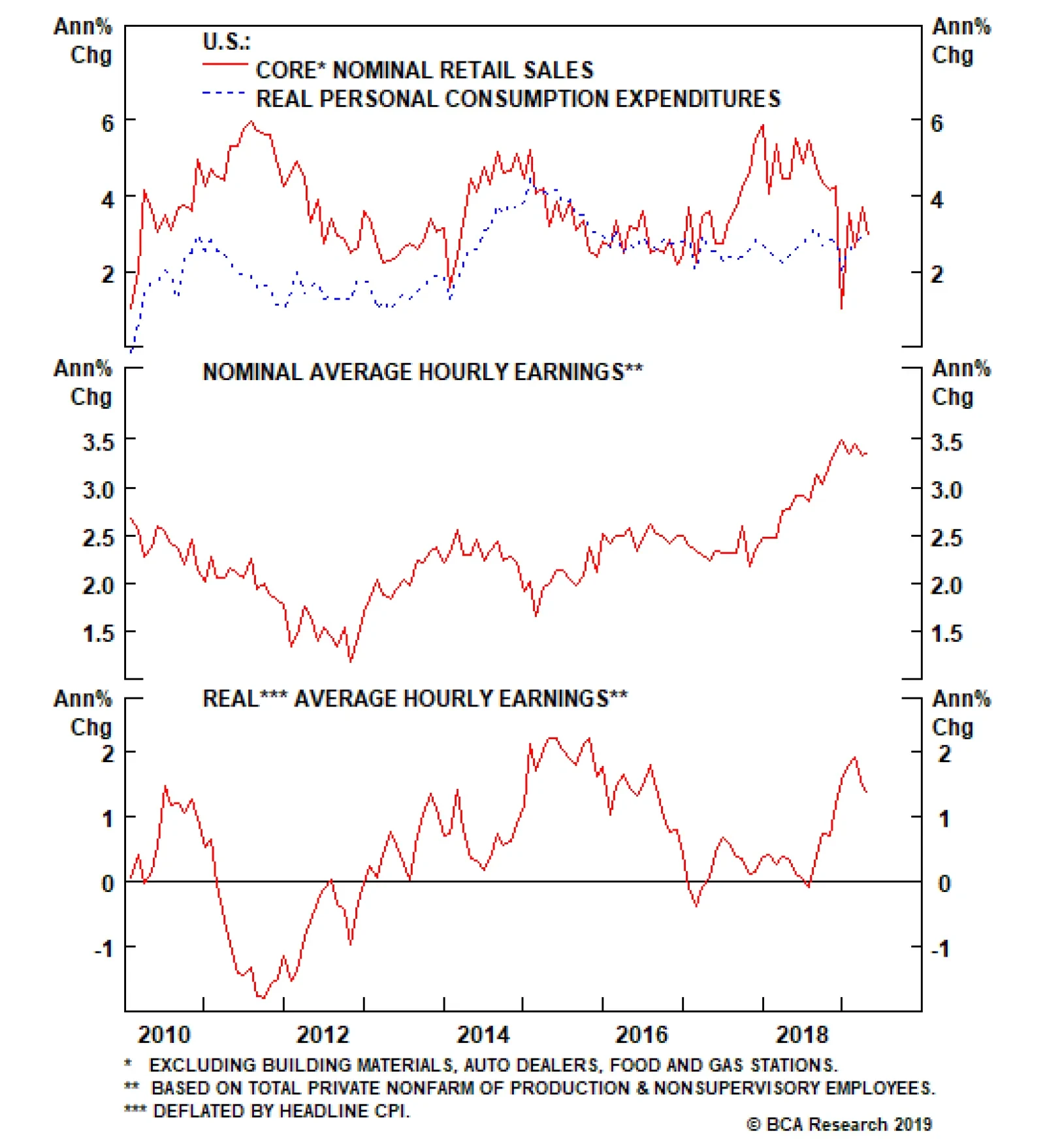
Overnight Chinese data was poor. Fixed asset investment, industrial production and retail sales all decelerated significantly. Meanwhile, U.S. April retail sales slowed meaningfully, and the monthly contraction in industrial production pushed capacity…
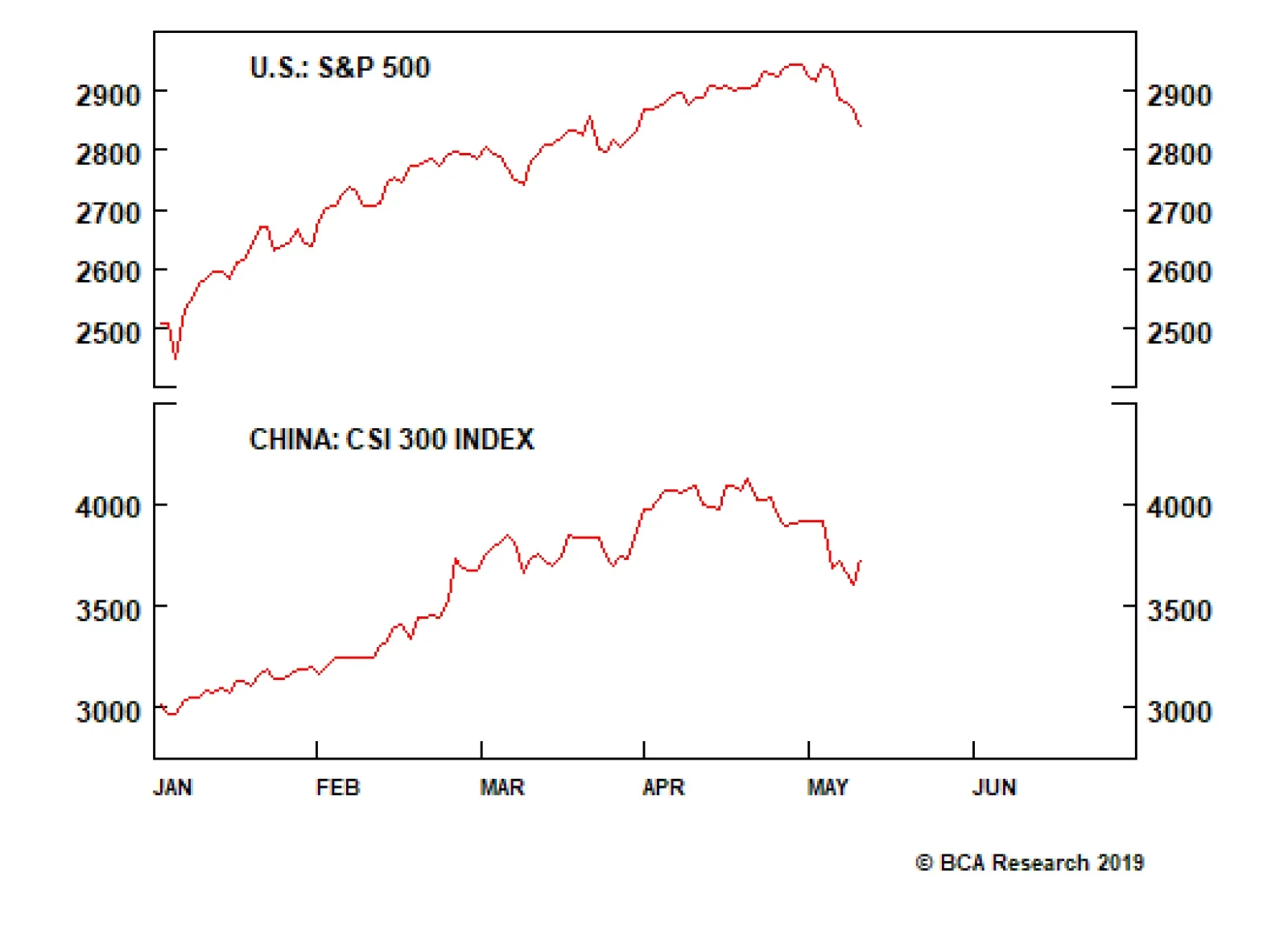
Highlights Looking past the day-to-day noise of trade-related announcements, we view the underlying odds of an actual trade agreement this year to have fallen below 50%. For the purposes of investment strategy, China-exposed investors should now simply assume that the U.S. proceeds with 25% tariffs on all imports from China. Given this, investors should stop focusing strictly on the odds of trade war, and should instead start focusing on the likely net impact of the tariff shock and China’s inevitable policy response. Simulated and empirical estimates of the impact of a 25% increase in tariffs affecting all U.S.-China trade suggest that economic conditions in China are likely to deteriorate to 2015/2016-like levels. This implies that a 2015/2016-style policy response will again be required in order for policymakers to be confident that the shock will be overcome. The preference of policymakers is to prevent another significant episode of releveraging, but the constraints facing policymakers suggest that one is unlikely to be avoided. We see a meaningful chance that this tension will be resolved by a classic market “riot” over the coming 3 months as financial markets force reluctant policymakers to capitulate. We would not recommend a long position in Chinese stocks, either in absolute terms or relative to the global benchmark, for investors with a time horizon of less than 3 months. However, over a strictly cyclical (i.e. 6-12 month) time horizon, we would recommend staying long/overweight on the basis that policymakers will ultimately respond as needed. We recommend investors hedge the inherent RMB exposure from a long US$ cyclical position in Chinese stocks by opening a long USD-CNH trade. Feature U.S. and Chinese negotiators failed last week to secure an agreement deferring the threatened increase in the second round tariff rate.1 The tariffs increased on Thursday at midnight for goods not already in transit to the U.S. (effectively doubling the existing tariffs), which was followed by the inevitable retaliation by China on Monday (scheduled to take effect on June 1). The retaliation, coupled with President Trump’s earlier warning that China should not do so, was taken by investors as a sign that 25% tariffs on all goods imported from China will soon be in place. As we go to press, the S&P 500, Hang Seng China Enterprises Index, and the CSI 300 are down 3.5%, 7%, and 6.9%, respectively, since President Trump’s May 5 tweet (Chart 1). Chart 1Investors Are Starting To Price In 25% Tariffs Affecting All U.S.-China Trade Investors Are Starting To Price In 25% Tariffs Affecting All U.S.-China Trade Investors Are Starting To Price In 25% Tariffs Affecting All U.S.-China Trade Stimulus Minus Shock Holding all else equal, the events of the past two weeks are strictly negative for Chinese economic growth and would thus justify a decisively bearish outlook for Chinese stock prices after the rally that has taken place over the past six months. However, all is not equal, because a substantial deterioration in the export outlook will invariably cause a response from Chinese policymakers. Over the coming few weeks, global investors are likely to remain highly focused on developments and announcements related to the trade conflict. But at this point, our geopolitical team believes that the conclusion of an actual trade agreement this year is now only a 40% probability. This underscores that China-exposed investors should, for the purposes of investment strategy, simply assume that the U.S. proceeds with 25% tariffs on all imports from China, and should broaden their focus to the outcome of a simple formula that describes the potential net outcome of this event. Two simple scenarios concerning this formula are outlined below: Scenario 1 (Bullish): Stimulus – Shock > 0 Scenario 2 (Bearish): Stimulus – Shock ≤ 0 In scenario 1, the impact of China’s reflationary efforts more than offsets the negative shock to aggregate demand from the sharp decline in exports to the U.S. In this scenario, investors should actually have a bullish cyclical outlook for China-related assets, even if the near-term outlook is deeply negative. Scenario 2 denotes a bearish outcome where China’s reflationary response is not larger than the magnitude of the shock, which includes a circumstance where the impacts are exactly offsetting (because of the higher uncertainty, and thus risk premium, that this would entail). “Solving” The Formula In order to “solve” this formula, investors need answers to the following three questions: What is the size and disposition of the likely shock to China’s economy in a full-tariff scenario? What kind of reflationary response is required in order to offset this shock? What are the odds that policymakers will deliver the required response? Simulated and empirical estimates of a 25% increase in tariffs affecting all U.S.-China trade suggest a sizeable economic impact. Charts 2 & 3 provide the IMF’s perspective on the first question. The charts show the simulated impact of a 25% increase in tariffs affecting all U.S.-China trade, and they estimate the near-term impact for China to be -1.25% for real GDP (-0.5% over the long-run) and -3.5% for real exports (-4.5% to -5.5% over the long run). Chart 2 Chart 3   A recent IMF working paper came up with a more benign estimate of the first year impact, but a sizeable second year impact and a similar estimate of the long-term ramifications of tariff increases.2 Using a dataset with wide time and country coverage, the aggregate results of the study imply that Chinese output is only likely to fall about 0.2% in the year following the tariff increase. However, the cumulative shock to output increased sharply to roughly 1.6% in the second year of the tariff increase, with a negative yearly impact to output persisting for 5 years (with an average annual impact of -0.6% over the whole period, somewhat higher than the estimates shown in Charts 2 & 3). At the 90% confidence interval, the author’s estimates show that a tariff increase of this magnitude would imply a -1.7% average impact on output per year in the first two years following the increase. Chart 4The IMF's Shock Estimates Suggest A Serious Hit To China's Economy The IMF's Shock Estimates Suggest A Serious Hit To China's Economy The IMF's Shock Estimates Suggest A Serious Hit To China's Economy In order to answer the second question, investors need to have some sense of the relative magnitude of the estimates noted above. Chart 4 provides some perspective and highlights that the estimates above, were they to materialize, would do two things: Taking Chinese real GDP data at face value, it would cause the largest deceleration in China’s real GDP growth rate since 2012, when the economy slowed significantly and authorities responded forcefully. Based on the most recent data for Chinese real export growth, a 3.5% deceleration in export volume would push its growth rate to its lowest level since the global financial crisis. In practice, we doubt that China’s reported real GDP growth rate accurately reflects what occurred in 2015, and it is very possible that a similar deceleration happened in that year. However, economic similarity to the 2015/2016 episode implies that a similar policy response may also be required, a proposition that is supported by our MSCI China Index earnings recession model. Table 1 shows a set of earnings recession probabilities, based on a model that we presented in two recent reports.3 The scenarios express the odds as a function of new credit to GDP and our calculation of China’s export weighted exchange rate, and assume a substantial decline in the new export orders component of the official manufacturing PMI, and flat momentum in forward earnings. Table 1Our Earnings Recession Model Suggests That A 2015/2016 Style Response Is Needed To Counter This Shock Simple Arithmetic Simple Arithmetic The table clearly highlights that a significant further acceleration in new credit to GDP, coupled with a meaningful decline in the exchange rate, is needed in order to stabilize the earnings outlook. We have previously related stability in the outlook for earnings to stability in the economy itself, given the close correlation between Chinese investment-relevant economic activity and the earnings cycle (Chart 5). Given that new credit to GDP peaked at 31.5% during the 2015/2016 episode, it seems reasonable to conclude that a 2015/2016-style policy response will again be required in order for policymakers to be confident that the shock will be overcome. Policymaker Preferences Vs. Constraints This brings us to our third question: What are the odds that policymakers will deliver the stimulus required to confidently overcome the upcoming shock? It seems reasonable to conclude that a 2015/2016-style policy response will again be required in order for policymakers to be confident that the shock will be overcome. If the answer was only dependent on the preferences of policymakers, the odds would be low. China has relied heavily on credit to stimulate its economy over the past decade, and Chart 6 highlights that this has come at a high cost. The BIS’ estimate of the debt service ratio of China’s private non-financial sector is already extraordinarily high relative to other countries, and another round of meaningful re-leveraging will just make this problem even worse. Chart 5Earnings Stability = Economic ##br##Stability Earnings Stability = Economic Stability Earnings Stability = Economic Stability Chart 6Further Leveraging Will Undoubtedly Make A Big Problem Even Worse Further Leveraging Will Undoubtedly Make A Big Problem Even Worse Further Leveraging Will Undoubtedly Make A Big Problem Even Worse   We documented in detail how this has created the risk of a debt trap for China’s state-owned enterprises in an August Special Report,4 and have presented evidence arguing that China’s policymakers appear to have good economic reasons to try and shift China’s economy away from extremely high rates of investment towards more consumption.5 This implies that restraining credit growth to avoid further leveraging has been a reasonable policy objective during periods of relative economic stability. However, policy decisions cannot be made in a vacuum, and this is true even in the case of China. As such, instead of preferences, investors should be focused on policymaker constraints in judging likely policy actions. Given the potential for second round effects, Chinese policymakers need to calibrate their policy response to ensure a positive net impact of the stimulus minus the shock. In our view, three factors point to the conclusion that Chinese policymakers face serious economic constraints in setting their policy response: Charts 2-4 highlighted that 25% tariffs on all U.S.-China trade would constitute a meaningful shock, but it is also the case that this shock would be coming at a time when Chinese economic momentum is already relatively weak. This suggests that policymakers will have to act quickly and decisively to put a floor under economic activity. Charts 7 & 8 suggest that there are meaningful second round effects on Chinese domestic investment from external sector shocks, which raises the possibility that the impact on Chinese economic activity may be larger than Charts 2-4 suggest. Chart 7 shows that while the contribution to official real GDP growth from net exports is small, Chart 8 shows that past changes in net export contribution are reasonably correlated with subsequent changes in the contribution to growth from gross capital formation. While it is possible that this relationship is not actually causal, taking it at face value implies that the IMF’s estimate of the impact on output could be exceeded if the contribution to growth from net exports declines by 0.4% or more (holding the contribution to growth from final consumption expenditure constant). Since 2018’s change in net export contribution declined by three times this amount (1.2%), the downside risks to domestic investment from effectively quadrupling U.S. import tariffs are clear. China does not have a flexible labor market, and its political system is highly sensitive to significant job losses. Chart 9 shows that the employment situation has already seriously deteriorated in lockstep with actual economic activity, further underscoring the need for policymakers to act urgently. Chart 7 Chart 8 Chart 9The Employment Situation Is Already Deteriorating, And Will Do So Further The Employment Situation Is Already Deteriorating, And Will Do So Further The Employment Situation Is Already Deteriorating, And Will Do So Further We are open to the idea that policymakers may be able to devise a stimulative response of similar reflationary magnitude to the 2015/2016 episode without resorting to a major credit overshoot, but we are currently unable to articulate what it might be. This is an area of ongoing research for BCA’s China Investment Strategy service, but for now we assume that a credit overshoot remains the ultimate line of defense for China’s policymakers that will be deployed if the pursuit of alternative strategies fail to quickly stabilize economic activity. Investment Strategy Conclusions In our view, focusing on policymaker constraints rather than their preferences is much more likely to guide investors towards the right strategy conclusions over a 6-12 month time horizon. However, in the near-term, policy mistakes can occur, and are much more likely to occur if policymakers react to the imposition of constraints rather than anticipate their arrival. Over the coming three months, we see meaningful odds that Chinese policymakers remain reluctant to allow another episode of significant releveraging in the economy. If we are correct in our assessment of the damage that the tariff shock is likely to cause, this would set up a classic market “riot”, where policymakers are forced by financial markets to capitulate and respond forcefully to the seriousness of the economic situation. Further RMB weakness is likely. Investors should hedge their exposure and go long USD-CNH. Chart 10Investors Have A Green Light To Bet On A Lower RMB Investors Have A Green Light To Bet On A Lower RMB Investors Have A Green Light To Bet On A Lower RMB Given this, we would not recommend a long position in Chinese stocks, either in absolute terms or relative to the global benchmark, for investors with a time horizon of less than 3 months. However, over a cyclical (i.e. 6-12 month) time horizon, we would recommend staying long/overweight on the basis that policymakers will ultimately deliver the stimulus required to more than offset the upcoming shock to external demand. This means that our long MSCI China Index, MSCI China A onshore index, and MSCI China Growth index trades relative to the global benchmark are explicitly cyclical in orientation, and may suffer meaningful further losses over the coming few months before ultimately recovering. As a final point, Table 1 highlighted that a meaningful decline in the exchange rate is likely required in order to stabilize the earnings outlook. Chart 10 shows that currency weakness persisted well past the trough in relative Chinese investable equity performance during the 2015/2016 episode, and we would expect a similar result in the current environment given the nature of the shock. As such, we recommend investors hedge the inherent RMB exposure from a long US$ cyclical position in Chinese stocks by opening a long USD-CNH trade today, with high odds of a break above 7 in the coming weeks. Jonathan LaBerge, CFA, Vice President Special Reports jonathanl@bcaresearch.com Footnotes 1 The first, second, third “round” of tariffs reference the $50/$200/$300 billion tranches of imported goods subject to U.S. tariff announcements since last summer. 2 IMF Working Paper WP/19/9, “Macroeconomic Consequences of Tariffs”, by Davide Furceri, Swarnali A. Hannan, Jonathan D. Ostry, and Andrew K. Rose. 3 Please see China Investment Strategy Special Report “Six Questions About Chinese Stocks,” dated January 16, 2019, and Weekly Report “A Gap In The Bridge,” dated January 30, 2019 available at cis.bcaresearch.com. 3 Please see China Investment Strategy Special Report “Chinese Policymakers: Facing A Trade-Off Between Growth And Leveraging,” dated August 29, 2018, available at cis.bcaresearch.com. 4  Please see China Investment Strategy Weekly Report “Is China Making A Policy Mistake?,” dated October 31, 2018, available at cis.bcaresearch.com.   Cyclical Investment Stance Equity Sector Recommendations

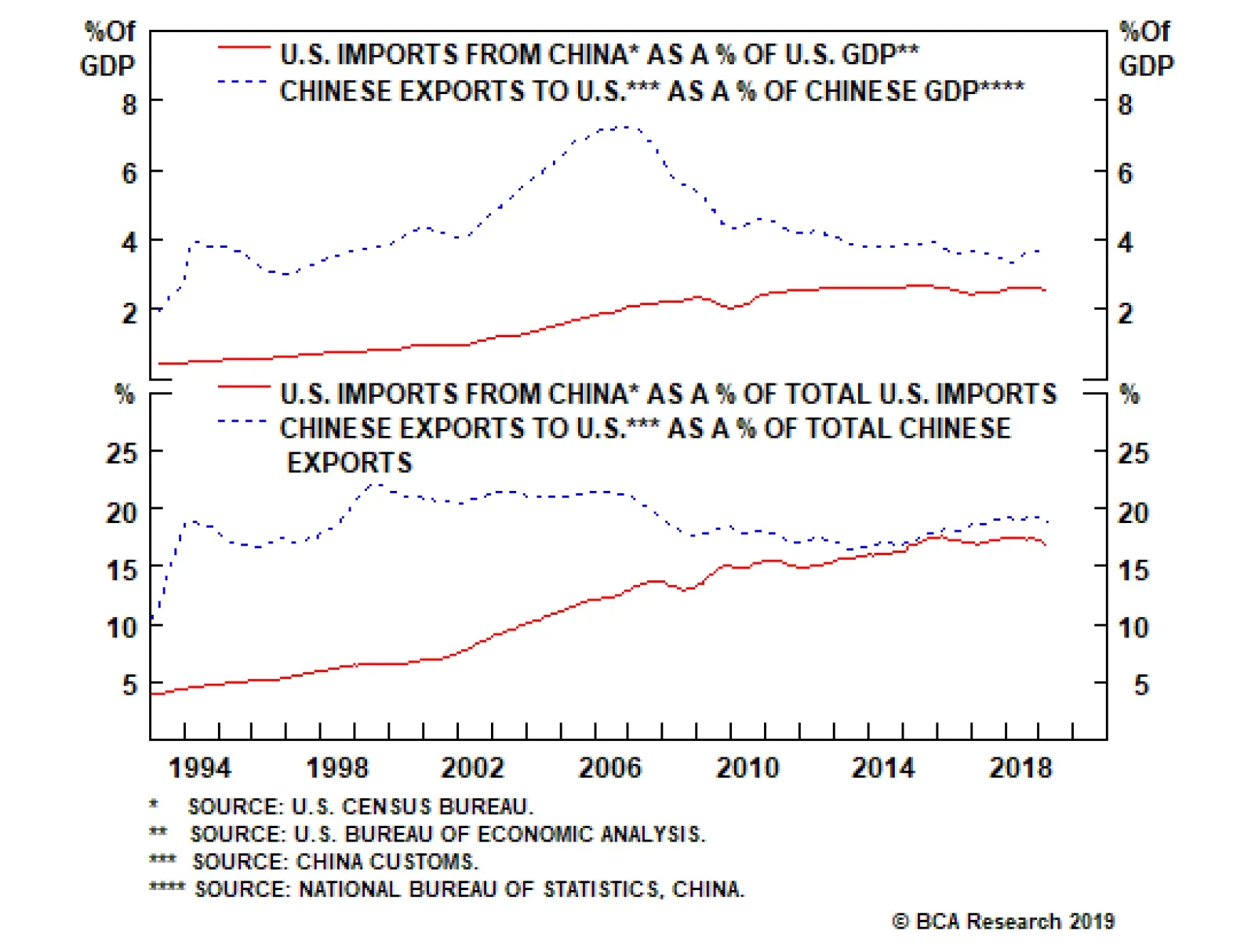
Since the onset of 2018, the U.S. has slapped various tariffs on China, the most important of which was 10% on $200 billion worth of Chinese goods. Assume for the sake of argument that only China and the U.S. were trading partners. The U.S. currently imports…
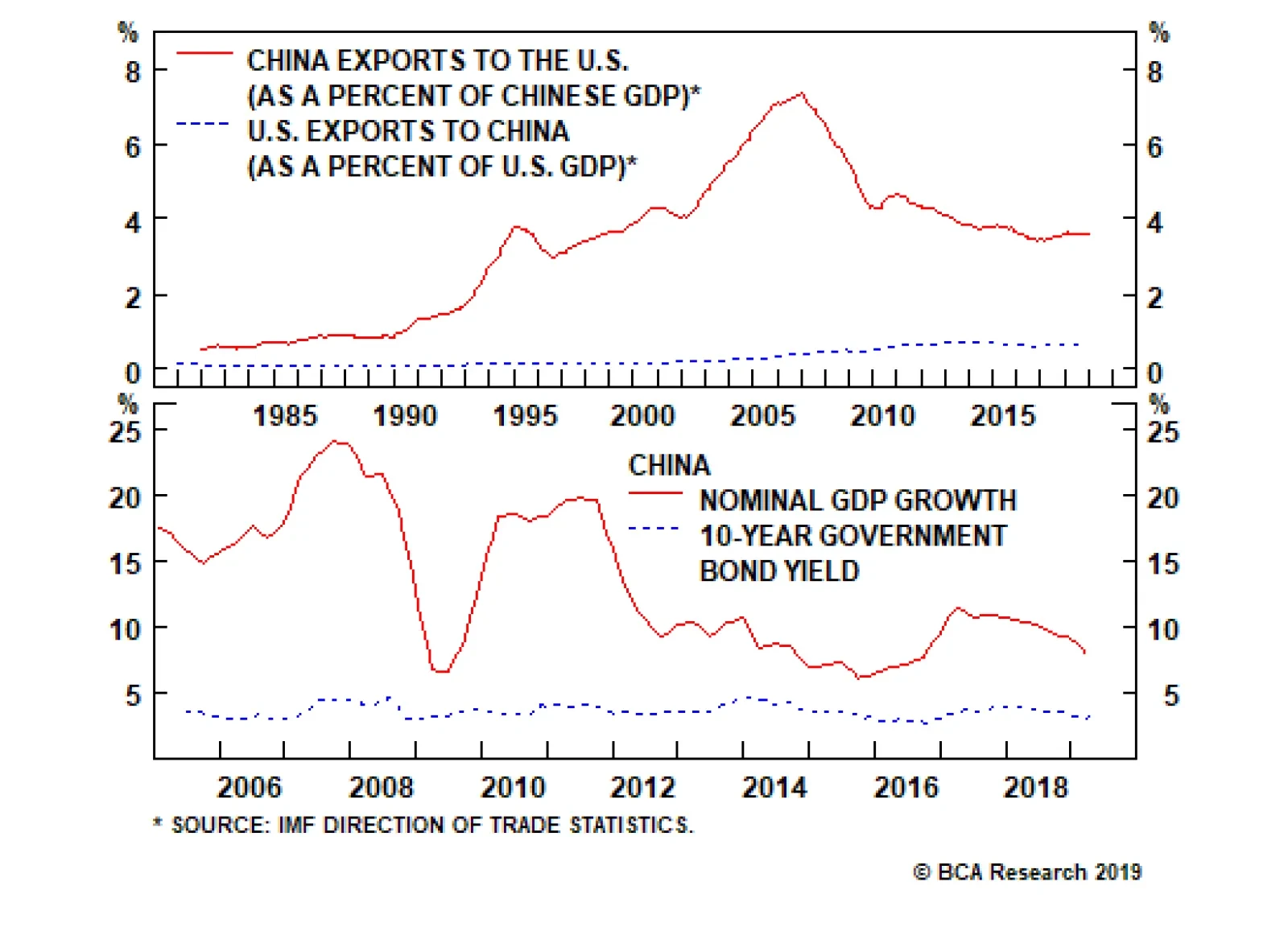
A trade war would hurt China, however, it is no longer as dependent on trade as it once was. Chinese exports to the U.S. account for only 3.6% of GDP, down from 7.3% of GDP in 2006. China also has plenty of tools to support the economy in the event of a…
Despite President Trump’s claim that the tariffs paid to the U.S. Treasury were “mostly borne by China,” the evidence suggests that close to 100% of the tariffs were, in fact, borne by U.S. companies and consumers. The tariffs were absorbed by U.S.…
There are many reasons why markets may have remained stable in the face of what was very bad news overnight. Chinese trade negotiators are still in Washington, keeping a glimmer of hope alive within investors that the tariffs could be resolved fast.…
The breakdown of the sources of funding for Chinese real estate developers are the following: Funding from property sales, including deposits, advance payments and mortgages assumed by property buyers, contributes nearly half of the sources of…