Sorry, you need to enable JavaScript to visit this website.
Skip to main content

Economy

The January 2025 ECB bank lending survey saw a net tightening of credit standards in Q4 2024. Credit standards were tightened for business and consumer lending, and were roughly unchanged for home mortgage loans. Banks expect further tightening across all…
The January Conference Board Consumer Confidence index missed estimates, decreasing to 104.1 from an upwardly-revised 109.5 in December. The decrease was driven by both the present situation and expectations subcomponents. The labor differential, the…
Our China Investment Strategy team explored how the costs of higher tariffs might be distributed among foreign suppliers, US importers, and consumers. The inflationary impact of new US tariffs is likely to remain modest unless President Trump imposes…
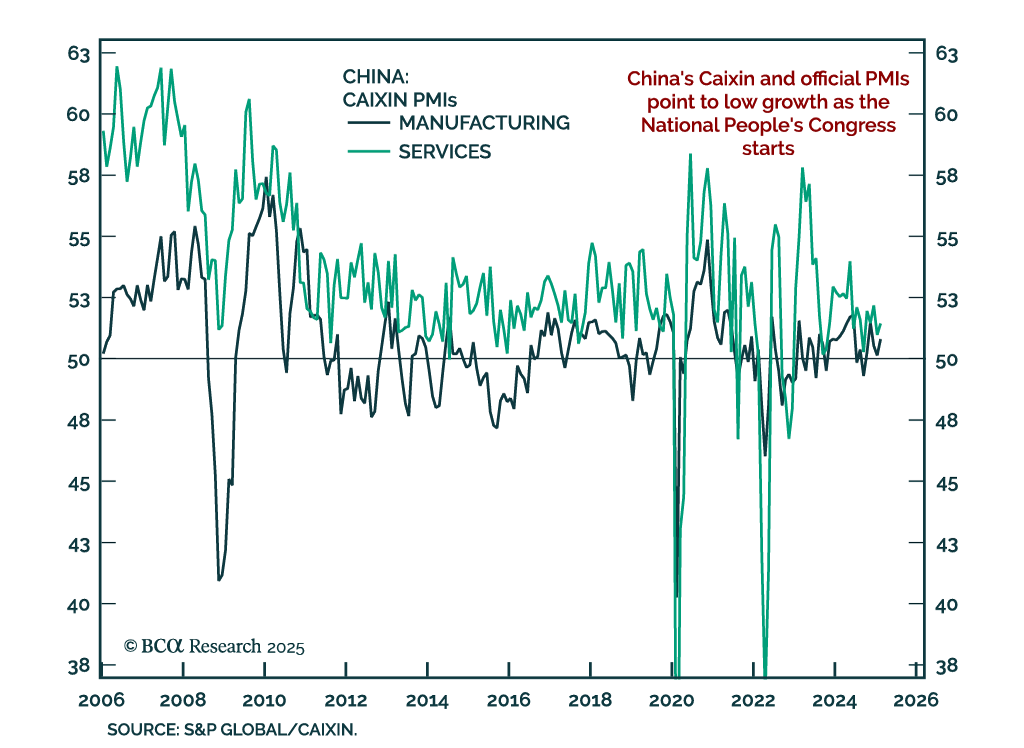
China’s official January PMIs disappointed, with the composite ticking down to 50.1 from 52.2. The decrease was driven by both the manufacturing and non-manufacturing components, with the former indicating contraction, and the latter showing very low…
The January Ifo Business Climate index for Germany beat estimates, increasing to 85.1 vs. 84.7 in December. The increase came from the survey’s current assessment component, which increased a full point, as the expectations component missed estimates and…
News of a cheaper Chinese-developed AI model sent a tremor through markets, with a selloff in the S&P 500, NASDAQ, and leading tech names associated with AI. The narrative on Monday was that the eye-watering sums spent on AI capex by mega-cap tech…

Global risk assets are engulfed in a wave of euphoria, which is pulling Europe higher along the way. However, risks still abound. How should investors adjust their allocation to Europe under these highly uncertain conditions?
 

The Bank of Japan hiked rates by 25 bps as expected to 0.50%, or a 17-year high. The BoJ is currently the only G10 central bank in a hiking cycle, as the hot labor market creates sustained domestic price pressures.  Additionally, the BoJ signaled a…
January’s flash PMIs for the major developed markets showed that manufacturing contracted at a slower pace and service activity continues to display significant regional differences. Moreover, the performance gap between the US and its DM peers…

While the US economy could remain upright on the tightrope for a while longer, it will inevitably fall, leading to a major bear market in stocks. We will be looking to our MacroQuant model for guidance on when to turn fully defensive. We are not there yet.