Economy

The Bank of Japan’s Economy Watchers Survey – a gauge of sentiment among business owners – disappointed in September. The Current Conditions and the Outlook indices deteriorated from 49.0 to 47.8 and from 50.3 to 49.7, below expectations of an…
The Chicago Fed National Activity Index (CFNAI) – a summary statistic of US economic data releases – increased to 0.12 from -0.42, suggesting that the US economy improved in August. Details, however, do not point to a broad-based acceleration since…
The Sentix Investor Confidence index unexpectedly improved in October from -15.4 to -13.8. A notable improvement in Expectations (from -8.0 to -3.8) drove the overall index higher, while the Current Situation subcomponent declined for a fourth consecutive…
At its October meeting, the Reserve Bank Of New Zealand (RBNZ) cut the Official Cash Rate by 50 bps to 4.75%. The decision was not accompanied by an updated economic forecast or press conference and the latest forecast in August expected inflation to fall to…
According to BCA Research’s US Political Strategy service, the important election takeaway for investment strategy comes from the Senate. The Senate is highly likely to fall to Republicans. They are nearly certain to win West Virginia and very likely to…
The NFIB Small Business Optimism index was mostly flat in September, ticking a mere 0.3 points higher to 91.5 in September, below expectations of a more meaningful improvement to 92.0. The NFIB Small Business Optimism has oscillated in a tight range since…
Consumer credit growth slowed in August, rising by USD 8.9 bn (to USD 5,097.6 bn outstanding) from USD 26.6 bn, disappointing expectations of a USD 12 bn monthly increase. Notably, revolving credit (which includes credit cards) declined by USD 1.4 bn over the…
Regular readers are familiar with our expectations for a global recession over the cyclical investment timeframe. A global downturn is overwhelmingly bearish for oil demand. The supply side, on the other hand, is simultaneously facing the threat of supply…
In the fifth installment of a BCA Special Report series on nuclear energy, our colleagues argue that US nuclear energy dominance is decaying. Though still the world’s leader in generation and capacity, the US will not hold the mantle indefinitely given high…
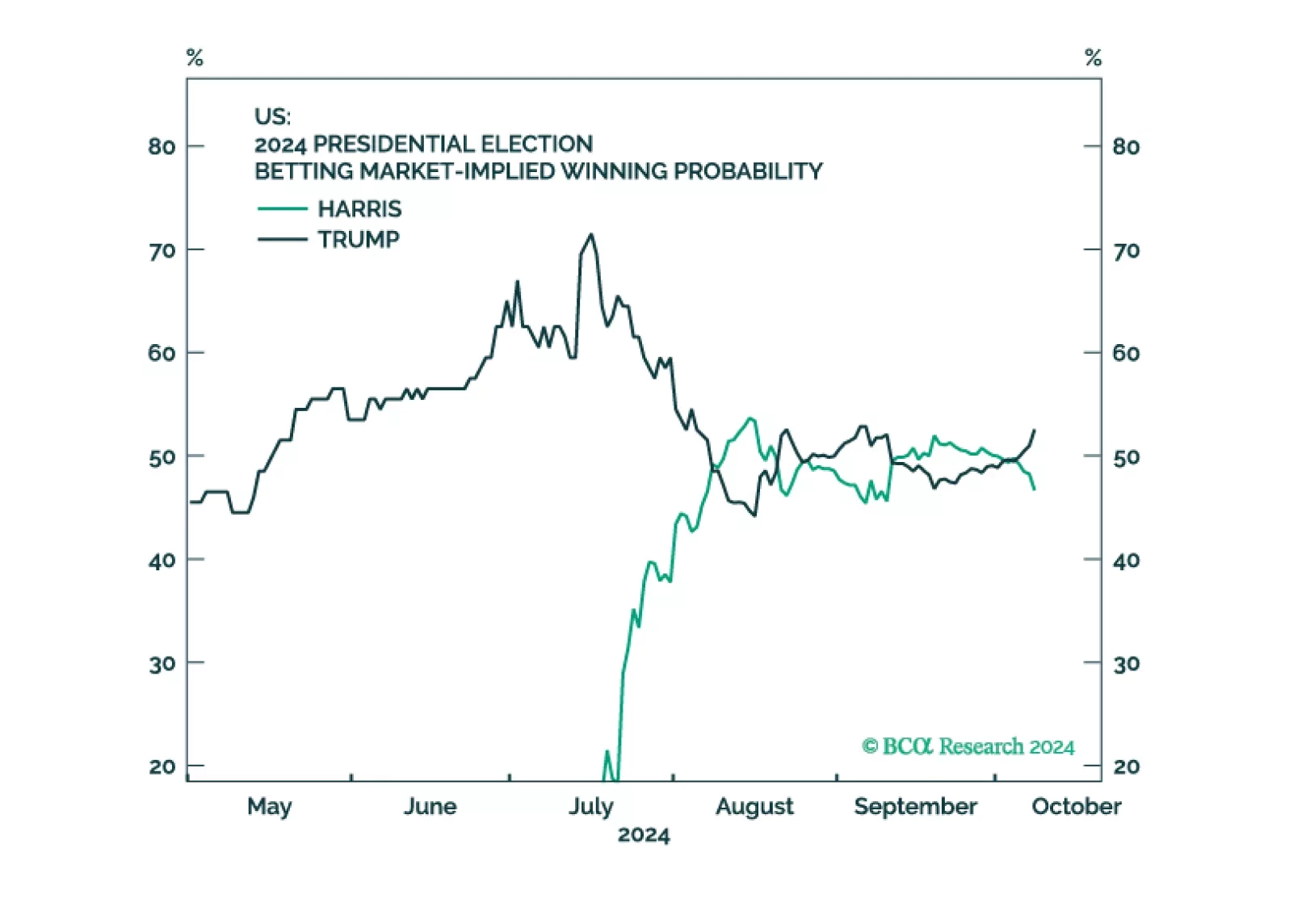
The month of October ahead of a US general election tends to be a volatile month with negative outcome for equities. As such, it is prudent to remain on the sidelines until after the election.