Europe

Dear Client, In lieu of our regular report next week, I will be hosting a webcast on Wednesday, December 18th at 10:00 AM EST, where I will discuss the major investment themes and views I see playing out for 2020. This will be the last Global Investment Strategy report of 2019, with publication resuming early next year. On behalf of the entire Global Investment Strategy team, I would like to wish you a Merry Christmas, Happy Holidays, and a Healthy New Year! Best regards, Peter Berezin, Chief Global Strategist Overall Investment Strategy: Global growth should accelerate in 2020. Favor stocks over bonds. A more defensive stance will be appropriate starting in late 2021. Equities: Upgrade non-US equities to overweight at the expense of their US peers. Cyclical stocks, including financials, will outperform defensives. Fixed Income: Central banks will stay dovish, but bond yields will nevertheless rise modestly thanks to stronger global growth. Favor high-yield corporate credit over investment grade and sovereigns. Currencies: The US dollar will weaken in 2020 against EUR, GBP, CAD, AUD, and most EM currencies. The dollar will be flat against the yen and the Swiss franc. Commodities: Oil and industrial metals prices will move higher. Gold prices will be range-bound next year, but should rally in 2021 once inflation finally breaks out. GIS View Matrix
Strategy Outlook – 2020 Key Views: Full Speed Ahead
Strategy Outlook – 2020 Key Views: Full Speed Ahead
I. Global Macro Outlook Stronger Global Growth Ahead We turned bullish on global equities last December after temporarily moving to the sidelines in the summer of 2018. Last month, we increased our procyclical bias by upgrading non-US stocks within our recommended equity allocation at the expense of their US peers. The decision to upgrade non-US equities stems from our expectation that global growth will strengthen in 2020. Global financial conditions have eased sharply this year, largely due to the dovish pivot by many central banks. Monetary policy affects the economy with a lag. This is one reason why the net number of central banks cutting rates has historically led global growth by about 6-to-9 months (Chart 1). Chart 1The Effects Of Easing Monetary Policy Should Soon Trickle Down To The Economy
The Effects Of Easing Monetary Policy Should Soon Trickle Down To The Economy
The Effects Of Easing Monetary Policy Should Soon Trickle Down To The Economy
In addition, there is mounting evidence that the global manufacturing cycle is bottoming out (Chart 2). The “official” Chinese PMI produced by the National Bureau of Statistics rose above 50 in November for the first time since May. The private sector Caixin manufacturing PMI has been improving for five consecutive months. The euro area manufacturing PMI increased over the prior month, led by gains in Germany and France. Chart 2A Fairly Regular Three-Year Manufacturing Cycle
A Fairly Regular Three-Year Manufacturing Cycle
A Fairly Regular Three-Year Manufacturing Cycle
Chart 3The Auto Sector Is Showing Signs Of Life (I)
The Auto Sector Is Showing Signs Of Life (I)
The Auto Sector Is Showing Signs Of Life (I)
The PMI data for the US has been mixed. The ISM manufacturing index weakened in November. In contrast, the Markit PMI rose to a seven-month high. Despite its shorter history, we tend to give the Markit PMI more credence. It is based on a larger sample of companies and has sector weights that closely match the actual composition of US output. As such, the Markit PMI is better correlated with hard data on manufacturing production, employment, and factory orders. The auto sector has been particularly hard hit during this manufacturing downturn. Fortunately, the industry is showing signs of life. The Markit euro area auto sector PMI has rebounded, with the new orders-to-inventory ratio moving back into positive territory for the first time since the autumn of 2018. US banks stopped tightening lending standards for auto loans in the third quarter. They are also reporting stronger demand for vehicle financing (Chart 3). In China, vehicle production and sales are improving on a rate-of-change basis (Chart 4). Both automobile ownership and vehicle sales in China are still a fraction of what they are in most other economies, suggesting further upside for sales (Chart 5). Chart 4The Auto Sector Is Showing Signs Of Life (II)
The Auto Sector Is Showing Signs Of Life (II)
The Auto Sector Is Showing Signs Of Life (II)
Chart 5China: Structural Outlook For Autos Is Bright
China: Structural Outlook For Autos Is Bright
China: Structural Outlook For Autos Is Bright
Trade War Uncertainty The trade war remains the biggest risk to our sanguine view on global growth. As we go to press, rumors are swirling that the US and China have reached a “Phase One” trade deal that would cancel the scheduled December 15th tariff hike and roll back as much as half of the existing tariffs. If this were to occur, it would be consistent with our expectation of a trade truce. Nevertheless, it is impossible to be certain about how things will unfold from here. The best we can do is think through the incentives that both sides face and assume they will act in their own self-interest. For President Trump, the key priority is to get re-elected next year. Trump generally gets poor grades from voters on most issues. The one exception is the economy. Rightly or wrongly, the majority of voters approve of his handling of the economy (Chart 6). An escalation of the trade war would hurt the US economy, especially in a number of Midwestern states that Trump needs to win to remain president (Chart 7). Chart 6Trump Gets Reasonably High Marks On His Handling Of The Economy, But Not Much Else
Strategy Outlook – 2020 Key Views: Full Speed Ahead
Strategy Outlook – 2020 Key Views: Full Speed Ahead
Chart 7Economic Health Of The US Midwest Matters For Trump
Economic Health Of The US Midwest Matters For Trump
Economic Health Of The US Midwest Matters For Trump
A resurgence in the trade war would also hurt Trump’s credibility. The point of the tariffs was not simply to raise revenue; it was to get China to the negotiating table. As a self-described master negotiator, President Trump now has to produce a “great” deal for the American people. If he had finalized an agreement with China a year or two ago, he would currently be on the hook for showing that it resulted in a smaller trade deficit. But with the presidential election only a year away, he can semi-credibly claim that the trade balance will only improve after he is re-elected. For their part, the Chinese would rather grapple with Trump now than face him after the election when he will no longer be constrained by re-election pressures. China would also like to avoid facing someone like Elizabeth Warren or Bernie Sanders, who may insist on including stringent environmental and human rights provisions in any trade deal. At least with Trump, the Chinese know that they are getting someone who is focused on commercial issues. Contrary to most media reports, there is a fair amount of overlap between what Trump wants and what the Chinese themselves would like to achieve. For example, as China has moved up the technological ladder, many Chinese companies have begun to complain about intellectual theft by their domestic rivals. Thus, strengthening intellectual property protection has become a priority for Chinese officials. Along the same vein, China aspires to transform the RMB into a reserve currency. A country cannot have a reserve currency unless it also has an open capital account. Hence, financial market liberalization must be part of China’s long-term reform strategy. These mutual interests between the US and China could provide the basis for a trade truce. The Changing Nature Of Chinese Stimulus Chart 8China: Credit Growth Is Only A Few Percentage Points Above Nominal GDP Growth
China: Credit Growth Is Only A Few Percentage Points Above Nominal GDP Growth
China: Credit Growth Is Only A Few Percentage Points Above Nominal GDP Growth
If a détente in the trade war is reached, will this prompt China to go back to its deleveraging campaign? We do not think so. For one thing, there can be no assurance that a trade truce will last. Thus, China will want to maintain enough stimulus as an insurance policy. In addition, credit growth is currently running only a few percentage points above nominal GDP growth (Chart 8). With the ratio of credit-to-GDP barely rising, there is little need to bring credit growth down much from current levels. This does not mean that the Chinese authorities will allow credit growth to increase significantly further. Instead, the authorities will continue shifting the composition of credit growth from the riskier shadow banking sector to the safer formal banking sector, while increasingly leaning on fiscal policy to buttress growth. One of the developments that has gone largely unnoticed by investors this year is that China’s general government deficit has climbed from around 3% of GDP in mid-2018 to 6.5% of GDP at present (Chart 9). Some of this stimulus has been used to finance tax cuts for households. Some of it has also been used to finance infrastructure spending, which requires imports of raw materials and capital goods. As a result of this fiscal easing, the combined Chinese credit/fiscal impulse has risen to a two-year high. It leads global growth by about nine months (Chart 10). Chart 9China Has Been Stimulating, Fiscally
China Has Been Stimulating, Fiscally
China Has Been Stimulating, Fiscally
Chart 10Chinese Stimulus Should Boost Global Growth
Chinese Stimulus Should Boost Global Growth
Chinese Stimulus Should Boost Global Growth
Europe On The Upswing Chart 11Euro Area Growth: The Good, The Bad, And The Ugly
Euro Area Growth: The Good, The Bad, And The Ugly
Euro Area Growth: The Good, The Bad, And The Ugly
Chart 12German Economy: Some Green Shoots
German Economy: Some Green Shoots
German Economy: Some Green Shoots
The weakness in euro area growth this year has been concentrated in Germany and Italy. France and Spain have actually grown at a trend-like pace (Chart 11). Germany should benefit from stronger global growth and a recovery in automobile production next year. The recent rebound in the German PMI, as well as improvements in the expectations components of the IFO, ZEW, and Sentix surveys are all encouraging in this regard (Chart 12). Italy should also gain from an easing in financial conditions and receding political risks (Chart 13). The Italian 10-year government bond yield has fallen from a high of 3.69% in October 2018 to 1.23% at present. Chart 13Easing Financial Conditions And Less Political Uncertainty Will Help Italy
Easing Financial Conditions And Less Political Uncertainty Will Help Italy
Easing Financial Conditions And Less Political Uncertainty Will Help Italy
Chart 14Euro Area Fiscal Thrust
Euro Area Fiscal Thrust
Euro Area Fiscal Thrust
Fiscal policy across the euro area is also turning more stimulative. The fiscal thrust in the euro area rose to 0.4% of GDP this year mainly due to a somewhat larger budget deficit in France (Chart 14). The thrust should remain positive in 2020. Even in Germany, fiscal policy should loosen. Faster wage growth in Germany is eroding competitiveness relative to the rest of the euro area (Chart 15). That could force German policymakers to ratchet up fiscal stimulus in order to support demand. Already, the Social Democrats are responding to poor electoral performance by adopting a more proactive fiscal policy, hoping to stop the loss of votes to the big spending Greens. Chart 15Germany: Faster Wage Growth Eroding Competitiveness Relative To The Rest Of The Euro Area
Germany: Faster Wage Growth Eroding Competitiveness Relative To The Rest Of The Euro Area
Germany: Faster Wage Growth Eroding Competitiveness Relative To The Rest Of The Euro Area
Chart 16Boris Johnson Won't Pursue A No-Deal Brexit
Boris Johnson Won't Pursue A No-Deal Brexit
Boris Johnson Won't Pursue A No-Deal Brexit
The UK economy should start to recover next year as Brexit uncertainty fades and fiscal policy turns more stimulative. Exit polls suggest that the Conservatives will command a majority government following today's election. There is not enough appetite within the Conservative party for a no-deal Brexit (Chart 16). As such, today's victory will allow Prime Minister Boris Johnson to push his proposed deal through Parliament. It will also allow him to fulfill his pledge to pass a budget that boosts spending. Japan: Own Goal Japan has been hard hit by the global growth slowdown, given its close ties to its Asian neighbors, namely China. Add on a completely unnecessary consumption tax hike, and it is no wonder the economy has been faltering. Despite widespread weakness, there have been some very preliminary signs of improvement of late: The manufacturing PMI ticked up in November, while the services PMI rose back above 50. Consumer confidence also moved up to the highest level since June. Furthermore, Prime Minister Abe announced a multi-year fiscal package worth approximately 26 trillion yen. The headline number grossly overstates the size of the stimulus because it includes previously announced measures as well as items such as land acquisition costs that will not directly benefit GDP. Nevertheless, the package should still boost growth by about 0.5% next year, offsetting part of the drag from higher consumption taxes. US: Chugging Along Despite the slowdown in global growth, a stronger dollar, and the trade war, US real final demand is on track to grow by 2.5% this year (Chart 17). This is above the pace of potential GDP growth of 1.7%-to-2%. Chart 17Underlying US Growth Remains Above Trend
Strategy Outlook – 2020 Key Views: Full Speed Ahead
Strategy Outlook – 2020 Key Views: Full Speed Ahead
The Fed’s 75 basis points of rate cuts has moved monetary policy even further into accommodative territory. Not surprisingly, residential housing – the most interest rate-sensitive part of the economy – has responded favorably (Chart 18). While the tailwind from lower mortgage rates will dissipate by next summer, we do not anticipate much weakness in the housing market. This is because the inventory levels and vacancy rates remain near record-low levels (Chart 19). The shortage of homes should buttress both construction and prices. Chart 18US Housing: On Solid Ground (I)
US Housing: On Solid Ground (I)
US Housing: On Solid Ground (I)
Chart 19US Housing: On Solid Ground (II)
US Housing: On Solid Ground (II)
US Housing: On Solid Ground (II)
Strong labor and housing markets will support consumer spending, which represents nearly 70% of the economy. Business capital spending should also benefit from lower rates, receding trade tensions, and rising wages which are making firms increasingly eager to automate. II. Financial Markets Global Asset Allocation We argued in the section above that global growth should rebound next year thanks to easier financial conditions, an upturn in the global manufacturing cycle, a detente in the trade war, and modest Chinese stimulus. Chart 20 shows that stocks usually outperform bonds when global growth is accelerating. This occurs partly because corporate earnings tend to rise when growth picks up. BCA’s US equity strategy team expects S&P 500 EPS to increase by 5% next year if global growth merely stabilizes. An acceleration in global growth would surely lead to even stronger earnings growth. On the flipside, investors also tend to price out rate cuts (or price in rate hikes) when growth is on the upswing, resulting in lower bond prices (Chart 21). Chart 20Stocks Usually Outperform Bonds When Global Growth Is Accelerating
Stocks Usually Outperform Bonds When Global Growth Is Accelerating
Stocks Usually Outperform Bonds When Global Growth Is Accelerating
Chart 21Improving Global Growth Boosts Earnings Growth...And Expectations Of Rate Hikes
Improving Global Growth Boosts Earnings Growth...And Expectations Of Rate Hikes
Improving Global Growth Boosts Earnings Growth...And Expectations Of Rate Hikes
Relative valuations also favor stocks over bonds. Despite the stock market rally this year, the MSCI All-Country World Index currently trades at a reasonable 15.8-times forward earnings. This is below the forward PE ratio of 16.7 reached in January 2018 and even below the forward PE ratio of 16.4 hit in May 2015. Analysts expect global EPS to increase by 10% next year, below the historic 12-month expectation of 15% (Chart 22). In contrast to most years when analyst forecasts prove to be wildly overoptimistic, the current EPS forecast is likely to be met. Chart 22Analyst Expectations Are Not Wildly Optimistic
Analyst Expectations Are Not Wildly Optimistic
Analyst Expectations Are Not Wildly Optimistic
Chart 23Equity Risk Premium Remains Quite Elevated
Equity Risk Premium Remains Quite Elevated
Equity Risk Premium Remains Quite Elevated
If one inverts the PE ratio, one can calculate an earnings yield for global equities of 6.3%. One can then calculate the implied equity risk premium (ERP) by subtracting the real long-term bond yield from the earnings yield. As Chart 23 illustrates, the ERP remains quite elevated by historic standards. Some observers might protest that the ERP is elevated mainly because bond yields are so low. If low bond yields are discounting very poor economic growth prospects, perhaps today’s PE ratio should be lower than it actually is? The problem with this argument is that growth prospects are not so bad. The IMF estimates that global growth will be slightly above its post-1980 average over the next five years (Chart 24). While trend growth is falling in both developed and emerging economies, the rising share of faster-growing emerging markets in global GDP is helping to prop up overall growth. Chart 24The Trend In Global Growth Has Remained Steady Thanks To Faster-Growing EM
The Trend In Global Growth Has Remained Steady Thanks To Faster-Growing EM
The Trend In Global Growth Has Remained Steady Thanks To Faster-Growing EM
Sector And Regional Equity Allocation US stocks have outperformed their overseas peers by 10% year-to-date and by 137% since 2008. About half of the outperformance of US equities since the Great Recession was due to faster sales-per-share growth, a third was due to stronger margin growth, and the rest was due to relative PE expansion (Chart 25). Chart 25Faster Sales Growth, Rising Margins, And Relative PE Expansion Helped Drive US Outperformance Over The Past Decade
Strategy Outlook – 2020 Key Views: Full Speed Ahead
Strategy Outlook – 2020 Key Views: Full Speed Ahead
It is worth noting that the outperformance of US stocks is a fairly recent phenomenon. Between 1970 and 2008, European equity prices and EPS actually rose slightly faster than in the US (Chart 26). EM stocks also outperformed the US in the decade leading up to the Global Financial Crisis. Chart 26US Earnings Have Not Always Outpaced Their Peers
US Earnings Have Not Always Outpaced Their Peers
US Earnings Have Not Always Outpaced Their Peers
We expect US stocks to rise in 2020 by about 5%-to-10%, but to lag their foreign peers in common-currency terms. There are four reasons for this: Sector skews favor non-US equities. Cyclical stocks tend to outperform defensives when global growth is strengthening and the US dollar is weakening (Chart 27). Cyclical sectors are overrepresented outside the US. We would include financials in our definition of cyclicals. Faster global growth next year will lift long-term bond yields. Since central banks are unlikely to raise rates, yield curves will steepen. Steeper yield curves will boost net interest margins, thus helping bank shares (Chart 28). European banks are more dependent on the spread between lending and borrowing rates than US banks, since the latter derive more of their profits from fees. Non-US stocks are quite a bit cheaper than their US peers. The forward PE for US equities currently stands at 18.1, well above the forward PE of 13.6 for non-US equities. Other valuation measures reveal an even bigger premium on US stocks (Chart 29). Differences in sector weights account for about a quarter of the valuation gap between the US and the rest of the world. The rest of the gap is due to cheaper valuations within sectors. Financials, for example, are notably less expensive in the rest of the world, particularly in Europe (Chart 30). The valuation gap between the US and the rest of the world is even starker if we compare earnings yields with bond yields. Since bond yields are lower outside the US, the implied equity risk premium is significantly higher for non-US stocks. Profit margins have less scope to rise in the US than in the rest of the world. According to MSCI data, net operating margins currently stand at 10.3% in the US compared to 7.9% abroad. Unlike in the US, margins in Europe and EM are still well below their pre-recession peaks (Chart 31). While US margins are unlikely to fall next year thanks to stronger global growth, rising wage growth will negatively impact profits in some labor-intensive industries. Labor slack is generally greater abroad, which should limit cost pressures. Uncertainty over the US election is likely to limit the gains to US equities. All of the Democratic frontrunners have pledged to roll back the 2017 Tax Cuts and Jobs Act to one degree or another. A full repeal of the Act would reduce S&P 500 EPS by about 10%. While such a dramatic move is far from guaranteed – for starters, it would require that the Democrats gain control of both the White House and the Senate – it does pose a risk to investors. The same goes for increased regulatory actions, which Senators Sanders and Warren have both vocally championed. Chart 27Cyclicals Do Well Versus Defensives When Global Growth Is Strengthening And The US Dollar Is Weakening
Cyclicals Do Well Versus Defensives When Global Growth Is Strengthening And The US Dollar Is Weakening
Cyclicals Do Well Versus Defensives When Global Growth Is Strengthening And The US Dollar Is Weakening
Chart 28Steeper Yield Curves Help Financials
Steeper Yield Curves Help Financials
Steeper Yield Curves Help Financials
Chart 29US Equities Are More Expensive Than Stocks Abroad
US Equities Are More Expensive Than Stocks Abroad
US Equities Are More Expensive Than Stocks Abroad
Chart 30European Financials Trade At A Substantial Discount To Their US Peers
European Financials Trade At A Substantial Discount To Their US Peers
European Financials Trade At A Substantial Discount To Their US Peers
Chart 31Profit Margins Have Less Scope To Rise In The US Than In The Rest Of The World
Profit Margins Have Less Scope To Rise In The US Than In The Rest Of The World
Profit Margins Have Less Scope To Rise In The US Than In The Rest Of The World
Within the non-US universe, euro area stocks have the most upside potential. In contrast, we see less scope for Japanese stocks to outperform the global benchmark because of uncertainties over the impact of the consumption tax hike on domestic demand. In addition, a weaker trade-weighted yen next year will annul the currency translation gains that unhedged equity investors can expect to receive from other non-US stock markets. Lastly, the passage of a new investment law that requires investors wishing to “influence management” to receive prior government approval could cast a pall over recent efforts to improve corporate governance in Japan. Fixed Income Chart 32Inflation Excluding Shelter Has Been Muted
Inflation Excluding Shelter Has Been Muted
Inflation Excluding Shelter Has Been Muted
Chart 33Long-Term Bond Yields Will Move Higher As Faster Growth Pushes Up Estimates Of The Neutral Rate
Long-Term Bond Yields Will Move Higher As Faster Growth Pushes Up Estimates Of The Neutral Rate
Long-Term Bond Yields Will Move Higher As Faster Growth Pushes Up Estimates Of The Neutral Rate
Central banks will remain on the sidelines next year. Inflation is still running well below target in most economies. Even in the US, where slack has largely been absorbed and wage growth has risen, core inflation excluding housing has averaged only 1.2% over the past five years (Chart 32). Nevertheless, long-term bond yields will still move higher next year as investors revise up their estimate of the neutral rate in response to faster growth (Chart 33). On a regional basis, BCA’s fixed-income experts favor low-beta bond markets (Chart 34). Japanese bonds have a very low beta to the overall Barclays Global Treasury index because inflation expectations are quite depressed and the Bank of Japan will actively intervene to prevent yields from rising. On a USD currency-hedged basis, the Japanese 10-year yield stands at a relatively decent 2.38%, above the yield of 1.79% on comparable maturity US Treasurys (Table 1). Chart 34Favor Lower-Beta Government Bond Markets In 2020
Favor Lower-Beta Government Bond Markets In 2020
Favor Lower-Beta Government Bond Markets In 2020
Table 1Bond Markets Across The Developed World
Strategy Outlook – 2020 Key Views: Full Speed Ahead
Strategy Outlook – 2020 Key Views: Full Speed Ahead
In contrast to Japan, the beta of US Treasurys to the overall global bond index is relatively high, implying that Treasurys will underperform other sovereign bond markets in a rising yield environment. The beta for Germany, UK, Australia, and Canada lie somewhere between Japan and the US. Consistent with our bullish view on global equities, we expect corporate bonds to outperform sovereign debt in 2020 (Chart 35). Despite the weakness in manufacturing, US banks further eased terms on commercial and industrial loans in Q3, according to the Fed’s Senior Loan Officer Survey. Chart 35Stronger Growth Causes Corporate Spreads To Tighten
Stronger Growth Causes Corporate Spreads To Tighten
Stronger Growth Causes Corporate Spreads To Tighten
At the US economy-wide level, neither interest coverage nor debt-to-asset ratios are particularly stretched (Chart 36). Admittedly, the picture looks less flattering if we focus solely on high-yield issuers (Chart 37). That said, a wave of defaults is very unlikely to occur in 2020, so long as the Fed is on hold and economic growth is on the upswing. Chart 36Corporate Debt: A Benign Top-Down View
Corporate Debt: A Benign Top-Down View
Corporate Debt: A Benign Top-Down View
Chart 37Corporate Debt: More Concerning Picture Among High-Yield Issuers
Corporate Debt: More Concerning Picture Among High-Yield Issuers
Corporate Debt: More Concerning Picture Among High-Yield Issuers
Chart 38US Corporates: Focus On High-Yield Credit
HY Spread Targets US Corporates: Focus On High-Yield Credit
HY Spread Targets US Corporates: Focus On High-Yield Credit
Moreover, despite narrowing this year, high-yield spreads still remain above our fixed-income team’s estimate of fair value (Chart 38). They recommend moving down the credit curve and increasing the weight in Caa-rated bonds. These have underperformed this year largely because of technical factors such as their large exposure to the energy sector and relatively short duration. As oil prices rise next year, energy sector issuers will feel some relief. Moreover, unlike this year, rising long-term government bond yields in 2020 should also make shorter-duration credit more attractive. In contrast to high-yield spreads, investment-grade spreads have gotten quite tight. Investors seeking high-quality bond exposure should shift towards Agency MBS, which still carry an attractive spread relative to Aa- and A-rated corporate bonds. European IG bonds should also outperform their US peers thanks to faster growth in Europe next year and ongoing support from the ECB’s asset purchase program. Looking beyond the next 12-to-18 months, there is a strong chance that inflation will increase materially from current levels. The unemployment rate across the G7 has fallen to a multi-decade low, while the share of developed economies reaching full employment has hit a new cycle high (Chart 39). Chart 39ADeveloped Markets: Unemployment Rates Keep Trending Lower... And Full Employment Reaching New Cycle Highs
Developed Markets: Unemployment Rates Keep Trending Lower... And Full Employment Reaching New Cycle Highs
Developed Markets: Unemployment Rates Keep Trending Lower... And Full Employment Reaching New Cycle Highs
Chart 39BDeveloped Markets: Unemployment Rates Keep Trending Lower... And Full Employment Reaching New Cycle Highs
Developed Markets: Unemployment Rates Keep Trending Lower... And Full Employment Reaching New Cycle Highs
Developed Markets: Unemployment Rates Keep Trending Lower... And Full Employment Reaching New Cycle Highs
Chart 40The Phillips Curve Is Alive And Well
The Phillips Curve Is Alive And Well
The Phillips Curve Is Alive And Well
For all the talk about how the Phillips curve is dead, wage growth remains well correlated with labor market slack (Chart 40). Rising wages will boost real disposable incomes, leading to more spending. If economies cannot increase supply to meet higher demand, prices will rise. It simply does not make sense to argue that the price of apples will increase if the demand for apples exceeds the supply of apples, but that overall prices will not increase if the demand for all goods and services exceeds the supply of all goods and services. It will take at least until mid-2021 for inflation to rise above the Fed’s comfort zone. It will take even longer for rates to reach restrictive territory, and longer still for tighter monetary policy to make its way through the economy. However, at some point in 2022, the interest-rate sensitive sectors of the US economy will buckle, setting off a global economic downturn and a deep bear market in equities and credit. Enjoy it while it lasts. Currencies And Commodities The US dollar is a countercyclical currency, meaning that it usually moves in the opposite direction of the global business cycle (Chart 41). This countercyclicality stems from the fact that the US, with its large service sector and relatively small manufacturing base, is a “low beta economy.” Strong global growth does help the US, but it benefits the rest of the world even more. Thus, capital tends to flow out of the US when global growth strengthens, which puts downward pressure on the dollar. As global growth picks up in 2020, the dollar will weaken. EUR/USD should increase to around 1.15 by end-2020. GBP/USD will rise to 1.40. USD/CNY will move to 6.8. The Australian and Canadian dollars, along with most EM currencies, will strengthen as well. However, the Japanese yen and Swiss franc are likely to be flat-to-down against the dollar, reflecting the defensive nature of both currencies. Today's rally in the pound has raised the return on our short EUR/GBP trade to 10.5%. For now, we would stick with this position. Chart 42 shows that the pound should be trading near 1.30 against the euro based on real interest rate differentials, which is still well above the current level of 1.20. Chart 41The Dollar Is A Countercyclical Currency
The Dollar Is A Countercyclical Currency
The Dollar Is A Countercyclical Currency
Chart 42Interest Rate Differentials Suggest More Upside For The Pound
Interest Rate Differentials Suggest More Upside For The Pound
Interest Rate Differentials Suggest More Upside For The Pound
The trade-weighted dollar will continue to depreciate until late-2021, and then begin to strengthen again as the Fed turns more hawkish and global growth starts to falter. Commodity prices tend to closely track the global growth/dollar cycle (Chart 43). Industrial metal prices will fare well next year. Oil prices will also move up. Globally, the last of the big projects sanctioned prior to the oil-price collapse in late 2014 are coming online in Norway, Brazil, Guyana, and the US Gulf. Our commodity strategists expect incremental oil supply growth to slow in 2020, just as demand reaccelerates. Gold is likely to be range-bound for most of next year reflecting the crosswinds from a weaker dollar on the one hand (bullish for bullion), and receding trade war risks and rising bond yields on the other hand. Gold will have its day in the sun starting in 2021 when inflation finally breaks out. Our key market charts are shown on the following page. Peter Berezin Chief Global Strategist peterb@bcaresearch.com Chart 43Dollar Weakness Is A Boon For Commodities
Dollar Weakness Is A Boon For Commodities
Dollar Weakness Is A Boon For Commodities
Key Financial Market Forecasts
Strategy Outlook – 2020 Key Views: Full Speed Ahead
Strategy Outlook – 2020 Key Views: Full Speed Ahead
MacroQuant Model And Current Subjective Scores
Strategy Outlook – 2020 Key Views: Full Speed Ahead
Strategy Outlook – 2020 Key Views: Full Speed Ahead
Strategic Recommendations Closed Trades
The 2019 UK General Election result offers four possible medium-term outcomes for UK exposed investments: Conservatives win 340 seats or more: This comfortable majority for the Conservatives is medium-term positive for UK exposed investments, as prime minister Johnson would not be dependent on the 20 or so hard Brexit extremists to pass any free trade deal (FTA) through parliament. Albeit the markets are already pricing the Conservatives to win 337-343 seats. Conservatives win 320-340 seats: This marginal majority for the Conservatives is medium-term risky for UK exposed investments, because the hard Brexit extremists would have disproportionate influence and leverage, keeping open the possibility of a hard Brexit on WTO terms after the standstill transition period ends on December 31 2020. Conservatives win 310-320 seats: This ‘marginally hung’ parliament is medium-term risky for UK exposed investments, as it is essentially no change from the current gridlocked parliament. Conservatives win less than 310 seats: This ‘comfortably hung’ parliament is medium-term positive for UK exposed investments, as it creates the possibility of the softest (or no) Brexit under a Labour-led minority government. At the same time, a minority government would be unable to pass its most contentious and supposedly ‘market unfriendly’ policies. If the result is 2. the marginal majority, and the market does not appreciate the risk, then it presents a sell opportunity. Conversely, if the result is 4. the comfortably hung parliament, and the market does not appreciate the upside, then it presents a buy opportunity. Fourth Time Lucky For The UK Pollsters? The 2019 UK General Election is the fourth major UK vote since 2015 in which the UK/EU relationship has featured front and centre. The first was the 2015 General Election, in which then prime minister David Cameron promised a referendum on EU membership, subject to the Conservative party winning an outright parliamentary majority, which it duly did. The second was the subsequent 2016 in/out EU referendum in which the UK voted to leave the EU. The third was the 2017 General Election called by prime minister May to bolster her Brexit negotiating position. But May’s plan backfired. She managed to lose the Conservative majority, her party’s Brexit negotiating position, and ultimately her job. So here we are at the fourth major UK vote in little over four years. Significantly, the pollsters got the 2015, 2016, and 2017 UK votes very wrong. In 2015, they predicted a hung parliament; but the actual outcome was a comfortable majority for the Conservatives, forcing Cameron to deliver his promise of an EU referendum. In the ensuing 2016 referendum, the pollsters predicted a narrow win for remain; the actual outcome was a narrow win for leave. Then in 2017, the pollsters predicted a very healthy vote share win for the Conservatives – and the spread betting markets priced the party to win 364-370 seats in the 650 seat UK parliament; but the actual outcome was 317 seats and a hung parliament – because the pollsters had underestimated the Labour vote by five percentage points. Today, just as in 2017, the pollsters are predicting a healthy vote share win and comfortable parliamentary majority for the Conservatives. At the time of writing (election eve) the spread betting markets are pricing the Conservative party to win 337-343 seats. When the election day exit poll comes out at 10pm UK time, we will get a good idea whether it is fourth time lucky for the pollsters. But irrespective of whether they are right or wrong, the immediate market reaction might still offer some medium-term investment opportunities. The Key Numbers… And Where The Immediate Market Reaction Could Be Wrong The Conservatives need a working majority – because having burnt their bridges with the DUP (Northern Ireland unionists), no other party is likely to support prime minister Johnson’s EU withdrawal agreement. Given that the speaker, deputy speakers, and Sinn Fein (Northern Ireland republicans) do not vote in the UK parliament, and depending on the number of seats that Sinn Fein win, the threshold for a working majority will be around 320 seats. This creates four potential outcomes for the markets: Conservatives win 340 seats or more: This comfortable majority for the Conservatives is medium-term positive for UK exposed investments, as Johnson would not be dependent on the 20 or so hard Brexit extremists to pass any free trade deal (FTA) through parliament. But as noted above, the markets are already pricing the Conservatives to win 337-343 seats. Conservatives win 320-340 seats: This marginal majority for the Conservatives is medium-term risky for UK exposed investments, because the hard Brexit extremists would have disproportionate influence and leverage, keeping open the possibility of a hard Brexit on WTO terms after the standstill transition period ends on December 31 2020. Conservatives win 310-320 seats: This ‘marginally hung’ parliament is medium-term risky for UK exposed investments, as it is essentially no change from the current gridlocked parliament. Conservatives win less than 310 seats: This ‘comfortably hung’ parliament is medium-term benign for UK exposed investments, as it creates the possibility of the softest (or no) Brexit under a Labour-led minority government. At the same time, a minority government would be unable to pass its most contentious and supposedly ‘market unfriendly’ policies. Of these four possibilities, if the immediate market reactions to 2. the marginal majority, or 4. the comfortably hung parliament do not appreciate the risk and upside respectively, then they will create sell and buy opportunities for UK exposed investments. What Are The UK Exposed Investments? The most obvious UK exposed investment is the pound, which is still trading at a near 10 percent discount versus the euro and the dollar, based on the pre-referendum relationship with real interest rate differentials (Chart I-1 and Chart I-2). However, the extent to which that discount can narrow depends on how much worse off (if at all) the UK economy finds itself in its new trading relationships with the EU and the rest of the world compared with full membership of the EU. Chart I-1The Pound Is Cheap Versus The Euro
The Pound Is Cheap Versus The Euro
The Pound Is Cheap Versus The Euro
Chart I-2The Pound Is Cheap Versus The Dollar
The Pound Is Cheap Versus The Dollar
The Pound Is Cheap Versus The Dollar
In this regard, the best outcomes are a rapidly negotiated and maximally-aligned FTA with the EU, or the softest (or no) Brexit. Meaning that the aforementioned possibilities 1. or 4. – a comfortable Conservative win or a comfortably hung parliament – are the best outcomes for the UK economy, and therefore for the pound. To the extent that the Bank of England policymakers recognise this, the same conclusion applies to the direction of UK gilt yields, and therefore inversely to UK gilt prices. Turning to the stock market, the FTSE100 is categorically not a UK exposed investment – because it comprises multinationals with minimal exposure to the UK economy. If anything, the FTSE100 is an anti-UK exposed investment. This is because sales and profits are denominated in international currencies, and if these non-pound currencies weaken versus the pound (meaning the pound strengthens) it weighs down the pound-denominated FTSE100 versus other markets (Chart I-3). In fact, the ‘real’ UK stock market is the more UK focussed FTSE250 (Chart I-4), or the FTSE Small Cap index (Chart I-5). Chart I-3When The Pound Strengthens, The FTSE 100 Underperforms
When The Pound Strengthens, The FTSE 100 Underperforms
When The Pound Strengthens, The FTSE 100 Underperforms
Chart I-4The 'Real' UK Stock Market Is The FTSE 250, Not The FTSE 100
The 'Real' UK Stock Market Is The FTSE 250, Not The FTSE 100
The 'Real' UK Stock Market Is The FTSE 250, Not The FTSE 100
Chart I-5Small Caps Are Exposed To The UK Economy
Small Caps Are Exposed To The UK Economy
Small Caps Are Exposed To The UK Economy
In terms of equity sectors, the least exposed to the UK economy are the multinationals with international currency earnings. As well as the obvious oil and gas, resources, and healthcare sectors, it includes the global banks and clothing and apparel (Chart I-6). Chart I-6Clothing Is Not Exposed To The UK Economy
Clothing Is Not Exposed To The UK Economy
Clothing Is Not Exposed To The UK Economy
The sectors most exposed to the UK economy are the homebuilders (Chart 7), real estate (Chart 8), and general retailers (Chart 9). All of these, plus the FTSE250 and FTSE Small Cap, and of course the pound, can outperform in the medium term in the aforementioned possibilities 1. and 4. – a comfortable win for the Conservatives or a comfortably hung parliament. But they will face pressure in possibilities 2. and 3. – a marginal win for the Conservatives or a marginally hung parliament. Chart I-7Homebuilders Are Exposed To The UK Economy
Homebuilders Are Exposed To The UK Economy
Homebuilders Are Exposed To The UK Economy
Chart I-8Real Estate Is Exposed To The UK Economy
Real Estate Is Exposed To The UK Economy
Real Estate Is Exposed To The UK Economy
Chart I-9General Retailers Are Exposed To The UK Economy
General Retailers Are Exposed To The UK Economy
General Retailers Are Exposed To The UK Economy
Fractal Trading System* This week's recommended trade is long nickel / short gold, the reverse of the successful trade we recommended on October 3. Back then the nickel price had become technically extended due to scares about an Indonesian export ban. And as predicted, the price subsequently collapsed (by 30 percent) to the point where the price has now become technically depressed. Accordingly, this week's recommendation is long nickel / short gold setting a profit target of 10 percent with a symmetrical stop-loss. The rolling 1-year win ratio stands at 64 percent.
A UK Election Special (Again)
A UK Election Special (Again)
When the fractal dimension approaches the lower limit after an investment has been in an established trend it is a potential trigger for a liquidity-triggered trend reversal. Therefore, open a countertrend position. The profit target is a one-third reversal of the preceding 13-week move. Apply a symmetrical stop-loss. Close the position at the profit target or stop-loss. Otherwise close the position after 13 weeks. Use the position size multiple to control risk. The position size will be smaller for more risky positions. * For more details please see the European Investment Strategy Special Report “Fractals, Liquidity & A Trading Model,” dated December 11, 2014, available at eis.bcaresearch.com. Dhaval Joshi Chief European Investment Strategist dhaval@bcaresearch.com Fractal Trading Model
A UK Election Special (Again)
A UK Election Special (Again)
A UK Election Special (Again)
A UK Election Special (Again)
Cyclical Recommendations Structural Recommendations
A UK Election Special (Again)
A UK Election Special (Again)
A UK Election Special (Again)
A UK Election Special (Again)
A UK Election Special (Again)
A UK Election Special (Again)
A UK Election Special (Again)
A UK Election Special (Again)
Trades Closed Trades Asset Performance Currency & Bond Equity Sector Country Equity Indicators Bond Yields Chart II-1Indicators To Watch - Bond Yields
Indicators To Watch - Bond Yields
Indicators To Watch - Bond Yields
Chart II-2Indicators To Watch - Bond Yields
Indicators To Watch - Bond Yields
Indicators To Watch - Bond Yields
Chart II-3Indicators To Watch - Bond Yields
Indicators To Watch - Bond Yields
Indicators To Watch - Bond Yields
Chart II-4Indicators To Watch - Bond Yields
Indicators To Watch - Bond Yields
Indicators To Watch - Bond Yields
Interest Rate Chart II-5Indicators To Watch - Interest Rate Expectations
Indicators To Watch - Interest Rate Expectations
Indicators To Watch - Interest Rate Expectations
Chart II-6Indicators To Watch - Interest Rate Expectations
Indicators To Watch - Interest Rate Expectations
Indicators To Watch - Interest Rate Expectations
Chart II-7Indicators To Watch - Interest Rate Expectations
Indicators To Watch - Interest Rate Expectations
Indicators To Watch - Interest Rate Expectations
Chart II-8Indicators To Watch - Interest Rate Expectations
Indicators To Watch - Interest Rate Expectations
Indicators To Watch - Interest Rate Expectations
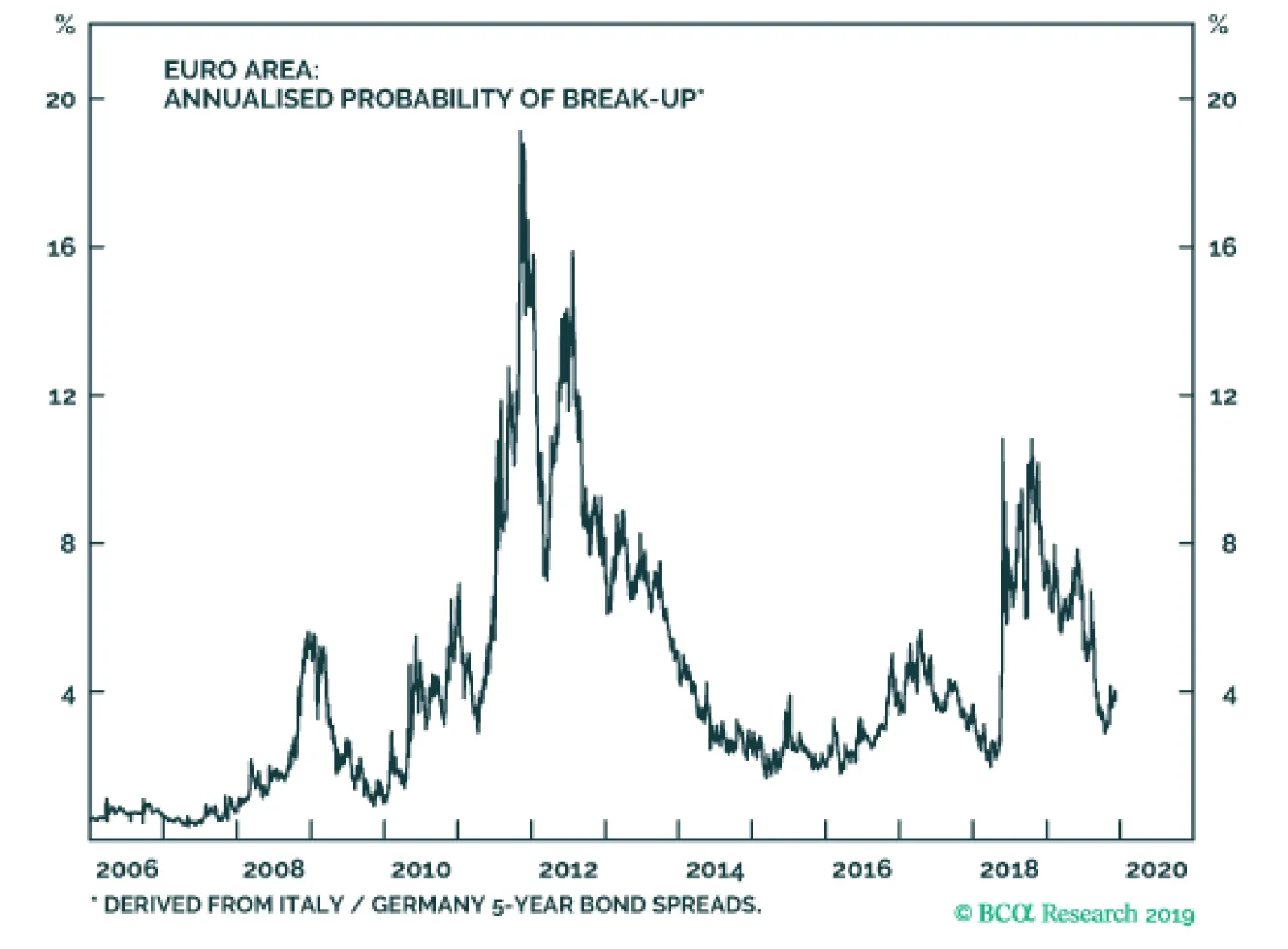
If Chinese growth can stabalize, then Europe’s economy can recover and European political risk will be a “red herring” in 2020, as it was in 2019. Euro Area break-up risk has subsided after a series of challenges in the wake of the sovereign debt…
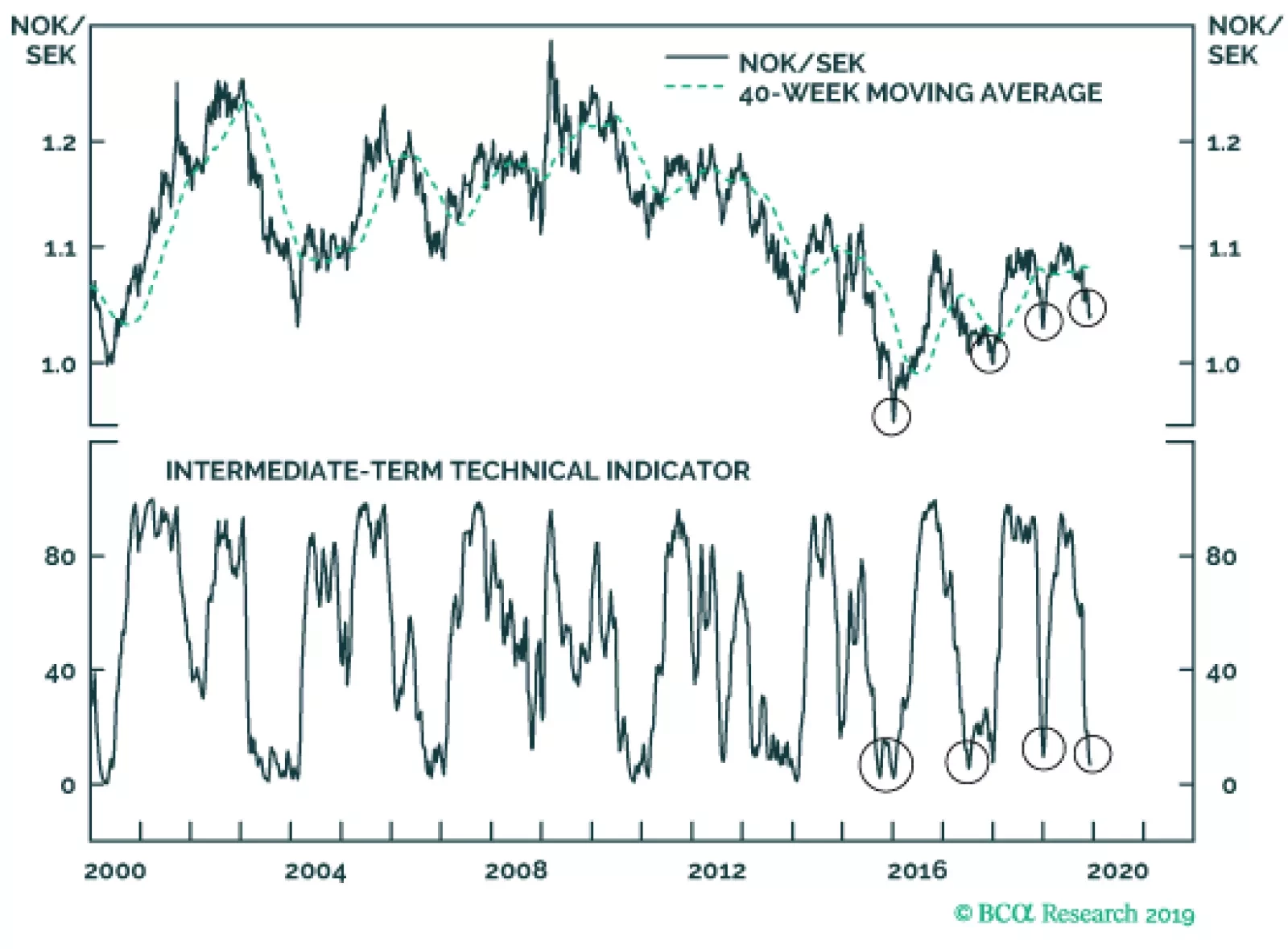
We remain oil bulls on the back of a pickup in global demand and OPEC production discipline. This should lead to the outperformance of energy stocks, supporting inflows into Norway. Interest rate differentials continue to favor NOK over SEK. The Riksbank…
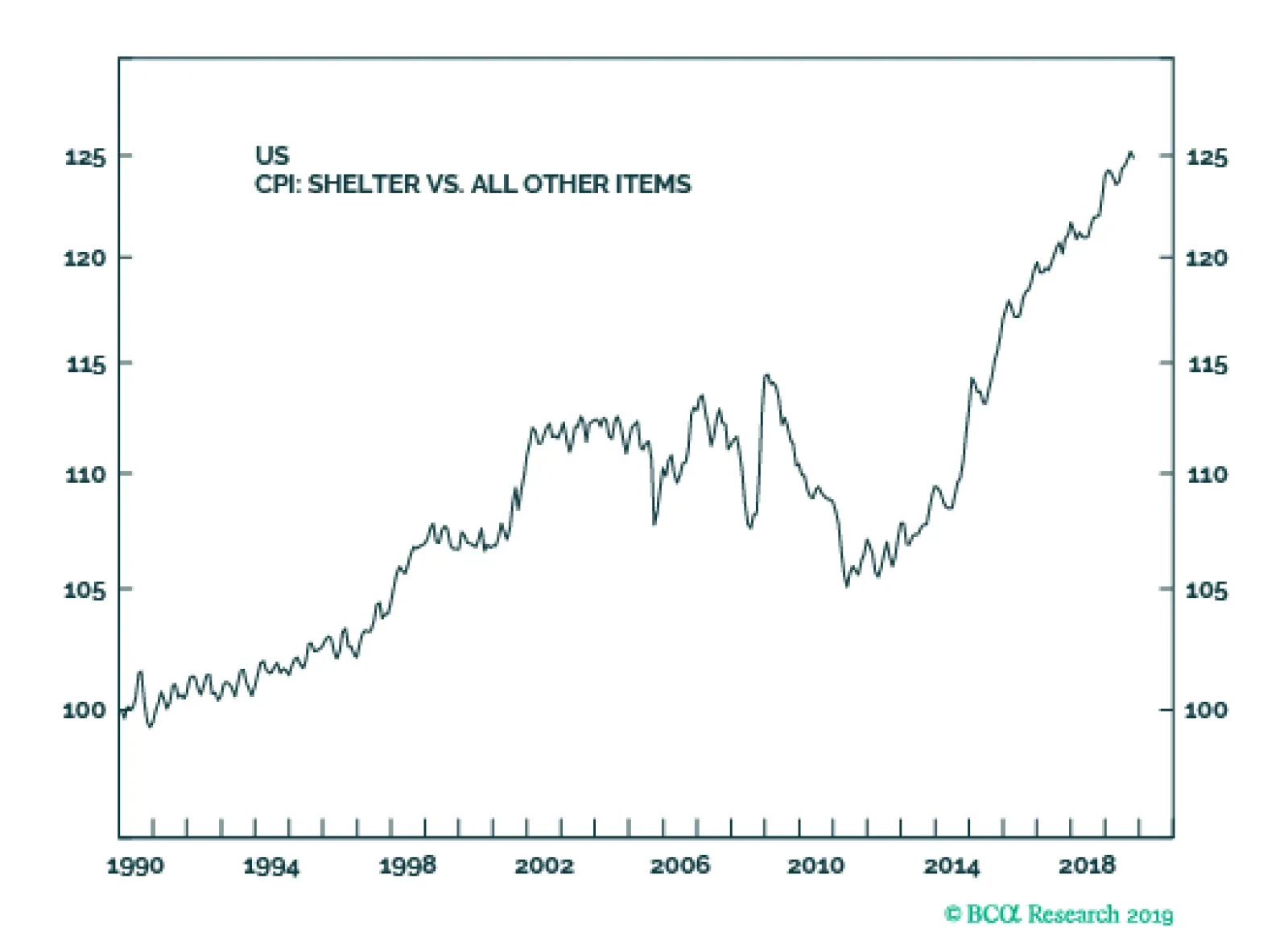
Since 2015, American inflation has outperformed European inflation for one reason: owner equivalent rents have surged by almost 20 percent relative to other prices. The historic evidence suggests that such a pace of outperformance is unsustainable…
Highlights Structurally overweight US T-bonds versus core European bonds. Our preferred expression is long T-bonds versus Swiss bonds. US yields can fall a lot more than European yields, and European yields can rise a lot more than US yields. Structurally underweight the overvalued dollar versus undervalued European currencies. Our preferred expression is long SEK/USD. Structurally underweight price-sensitive European export sectors. Undervalued European currencies cannot fall much further, and those European exporters that depend on price competitiveness will struggle to outperform. But structurally overweight soft luxuries. Despite President Trump’s threat to tariff French products, soft luxuries retain very strong pricing power and sustainable long term demand growth from rising female labour participation rates globally. Fractal trade: The 65-day fractal structure of global equities suggests that they are vulnerable to a near-term countertrend move. Feature Chart of the WeekLike-For-Like, Structural Inflation Is Lower In the US Than In Europe
Like-For-Like, Structural Inflation Is Lower In the US Than In Europe
Like-For-Like, Structural Inflation Is Lower In the US Than In Europe
A seemingly trivial disagreement between Europeans and Americans on how to measure inflation turns out to be the culprit for three major distortions in the world right now: Deeply divergent monetary policies across the developed economies. Huge valuation anomalies in the foreign exchange markets. President Trump’s threat of a trade war to counter the huge trade surpluses that Europe and China are running against the US. The inflation measurement disagreement wouldn’t really matter if inflation were running in the mid-single digits. But when inflation is near zero, the seemingly trivial difference in inflation measurement methodologies has ended up generating massive distortions. European And American Inflation Are Not The Same European inflation excludes the maintenance and upkeep costs associated with owning your home, whereas US inflation includes these costs at a hefty 25 percent weighting, making owner occupied housing by far the largest single item in the US inflation basket. By omitting the largest item in the US inflation basket, European inflation is subtly yet crucially different to American inflation. The European statisticians argue that unlike all the other items in the inflation basket, there is no independent market price for the ongoing cost of home ownership, and therefore this cost should be excluded. The American statisticians argue that the ongoing cost of home ownership is the single largest expense for most people and, as such, it should be ‘imputed’ from a concept known as ‘owner equivalent rent’ – essentially, asking homeowners how much it would cost to rent their own home. Different definitions of inflation will trigger very different policy responses from central banks. Both the European and American approaches have their merits and drawbacks, and it is not our intention to endorse one approach over the other. Our intention is simply to point out that the two approaches can give very different results for inflation – and therefore trigger very different policy responses from inflation-targeting central banks, with their consequent economic and political repercussions. If Americans used the European definition of inflation, then headline inflation in the US today would be running at the same sub-par rate as in the euro area, 1 percent, and well below the Fed’s 2 percent target (Chart I-2 and Chart I-3). More important, the five year annualised rate of inflation – let’s call it US structural inflation – would have been stuck below 1 percent since 2016 (Chart I-1 and Chart I-4). Under these circumstances, it would have been impossible for the Fed to hike the funds rate eight times, as it did through 2017-18. Chart I-2Like-For-Like, Headline Inflation Is Identical In The US And The Euro Area...
Like-For-Like, Headline Inflation Is Identical In The US And The Euro Area...
Like-For-Like, Headline Inflation Is Identical In The US And The Euro Area...
Chart I-3...And Core Inflation Is ##br##Very Similar
...And Core Inflation Is Very Similar
...And Core Inflation Is Very Similar
Chart I-4Using The European Definition Of Inflation, The Fed Couldn't Have Hiked Rates
Using The European Definition Of Inflation, The Fed Couldn't Have Hiked Rates
Using The European Definition Of Inflation, The Fed Couldn't Have Hiked Rates
Instead, what if Europeans used the American definition of inflation? European inflation does not include owner equivalent rent, but it does include housing rent for those that do rent their homes. In the US, these two items tend to move in lockstep (Chart I-5). If we assume the same for Europe, we can deduce that a US type weighting for owner equivalent rent would have boosted the headline inflation rate in the euro area by 0.3-0.4 percent through 2014-16, and by a possible 0.5 percent in Sweden through 2013-15 (Chart I-6 and Chart I-7). Under these circumstances, it would have been very difficult for the ECB and Riksbank to take and maintain policy rates deeply in negative territory, as they did through 2015-19. Chart I-5Owner Equivalent Rent Tracks ##br##Housing Rent
Owner Equivalent Rent Tracks Housing Rent
Owner Equivalent Rent Tracks Housing Rent
Chart I-6Using The American Definition Of inflation, Euro Area Inflation Would Have Been Higher...
Using The American Definition Of inflation, Euro Area Inflation Would Have Been Higher...
Using The American Definition Of inflation, Euro Area Inflation Would Have Been Higher...
Chart I-7...And Swedish Inflation Would Have Been Much Higher
...And Swedish Inflation Would Have Been Much Higher
...And Swedish Inflation Would Have Been Much Higher
The Different Definitions Of Inflation Have Created Dangerous Distortions If Europeans and Americans were using the same definition of inflation then, one way or the other, their monetary policies would not be as deeply divergent as they are now. One important implication is that European currencies would not be as undervalued as they are now. If Europeans and Americans were using the same definition of inflation then their monetary policies would not be as deeply divergent as they are now. Based on the ECB’s own analysis, the euro area is over-competitive versus its top 19 trading partners – meaning the euro is undervalued – by at least 10 percent. Moreover, the ECB admits that this sizable undervaluation only appeared after the ECB and Fed started taking their monetary policies in opposite directions in 2015 (Chart I-8). Chart I-8The Euro Is Undervalued By More Than 10 Percent
The Euro Is Undervalued By More Than 10 Percent
The Euro Is Undervalued By More Than 10 Percent
Put the other way, the dollar would not be as overvalued as it is now. In turn, the stronger dollar has created its own dangerous spill-overs. As we explained last week in The Hidden Sales Recession Of 2015… And Why It Matters Now, the surging dollar in 2015 could not have come at a worse time for China. Given that the Chinese economy was already slowing sharply, and the yuan was pegged to the dollar, the resulting loss of Chinese competitiveness just exacerbated the slump. Forcing China to loosen the dollar peg in August 2015. All of which brings us neatly to the hot topic of 2019, and likely 2020 too – President Trump’s threat of a trade war to counter the huge trade imbalances that Europe and China are running against the US. As it happens, President Trump has a good point. Trade wars almost always stem from trade imbalances; and trade imbalances almost always stem from exchange rate manipulations or, at least, exchange rate distortions that advantage one economy to the detriment of another. The euro's undervaluation only happened after monetary policies diverged in 2015. Most of the euro area’s €150 billion trade surplus with the US appeared after 2015, so it cannot be a structural issue. In fact, the evolution of the trade imbalance has tracked relative monetary policy between the Fed and ECB almost tick for tick (Chart I-9), via the exchange rate channel and the over-competitiveness of the euro which the ECB fully admits. Chart I-9Excessively Divergent Monetary Policies Caused The Euro Area's Huge Trade Surplus With The US
Excessively Divergent Monetary Policies Caused The Euro Area's Huge Trade Surplus With The US
Excessively Divergent Monetary Policies Caused The Euro Area's Huge Trade Surplus With The US
Of course, neither the ECB nor the Fed are deliberately targeting trade or the exchange rate; they are targeting inflation. But to repeat, they are targeting different definitions of inflation. Crucially, with a backdrop of near zero inflation, small definitional differences in inflation can generate huge economic and financial distortions, with dangerous political consequences. The Compelling Structural Opportunities The definitional difference between European and American inflation explain many of the economic and financial distortions we are witnessing now, as well as the dangerous political consequences. The main counterargument is that the inflation definitions are what they are; neither the ECB nor the Fed are likely to change them anytime soon. Nevertheless, there are compelling structural opportunities. Since 2015, American inflation has outperformed European inflation for one reason and one reason only: owner equivalent rents have surged by almost 20 percent relative to other prices (Chart I-10 and Chart I-11). The historic evidence suggests that such a pace of outperformance is unsustainable structurally and, absent this tailwind, US and European headline inflation rates have to converge, one way or the other. Chart I-10An Unsustainable Surge In US Owner Equivalent Rent...
An Unsustainable Surge In US Owner Equivalent Rent...
An Unsustainable Surge In US Owner Equivalent Rent...
Chart I-11...Has Lifted US Headline ##br##Inflation
...Has Lifted US Headline Inflation
...Has Lifted US Headline Inflation
In this inevitable convergence, the asymmetric starting point of bond yields favours a long US T-bonds, short core European bonds structural position. Because, if the inflation convergence is downwards, T-bond yields will fall much further than European yields; whereas if the inflation convergence is upwards, European yields will likely rise more than T-bond yields. Our preferred structural expression is: long US T-bonds, short Swiss bonds. For currencies it is the opposite message. The overvalued dollar is likely to underperform, at least versus other developed market currencies. Given that Swedish inflation has been the most understated by the exclusion of owner equivalent rents, combined with the Riksbank’s intention to exit negative interest rate policy imminently, our preferred structural expression is: long SEK/USD. American inflation has outperformed European inflation for one reason and one reason only: owner equivalent rents have surged by almost 20 percent relative to other prices. Lastly, European export growth – even in Germany – has been heavily reliant on a cheapening euro (Chart I-12). Undervalued European currencies cannot fall much further, and those European exporters that depend on price competitiveness will struggle to outperform. Even those multinationals that sell their products in dollars will lose out in the accounting translation back into a strengthening domestic currency. Hence, structurally underweight price-sensitive European export sectors. Chart I-12Without A Weaker Euro, Most European Exporters Will Struggle To Outperform
Without A Weaker Euro, Most European Exporters Will Struggle To Outperform
Without A Weaker Euro, Most European Exporters Will Struggle To Outperform
The one exception to this is the soft luxuries sector. Despite President Trump’s threat to tariff French products, soft luxuries retain very strong pricing power and sustainable long term demand growth from rising female labour participation rates globally. Stay structurally overweight soft luxuries. Fractal Trading System* The 65-day fractal structure of global equities suggests that they are vulnerable to a near-term countertrend move. Accordingly, this week’s recommended trade is to short the MSCI All Country World versus the global 10-year bond (simple average of US, euro area, and China), setting a profit target and symmetrical stop-loss at 2.5 percent. In other trades, long NZD/JPY and long SEK/JPY both achieved their profit targets of 3 percent and 1.5 percent respectively. Against this, long Poland versus World reached its 4 percent stop-loss. The rolling 1-year win ratio now stands at 65 percent. Chart I-13MSCI All-Country World Vs. Global 10-Year Bond
MSCI All-Country World Vs. Global 10-Year Bond
MSCI All-Country World Vs. Global 10-Year Bond
When the fractal dimension approaches the lower limit after an investment has been in an established trend it is a potential trigger for a liquidity-triggered trend reversal. Therefore, open a countertrend position. The profit target is a one-third reversal of the preceding 13-week move. Apply a symmetrical stop-loss. Close the position at the profit target or stop-loss. Otherwise close the position after 13 weeks. Use the position size multiple to control risk. The position size will be smaller for more risky positions. * For more details please see the European Investment Strategy Special Report “Fractals, Liquidity & A Trading Model,” dated December 11, 2014, available at eis.bcaresearch.com. Dhaval Joshi Chief European Investment Strategist dhaval@bcaresearch.com Fractal Trading System
How Low Inflation Has Distorted The World
How Low Inflation Has Distorted The World
How Low Inflation Has Distorted The World
How Low Inflation Has Distorted The World
Cyclical Recommendations Structural Recommendations
How Low Inflation Has Distorted The World
How Low Inflation Has Distorted The World
How Low Inflation Has Distorted The World
How Low Inflation Has Distorted The World
How Low Inflation Has Distorted The World
How Low Inflation Has Distorted The World
How Low Inflation Has Distorted The World
How Low Inflation Has Distorted The World
Trades Closed Trades Asset Performance Currency & Bond Equity Sector Country Equity Indicators Bond Yields Chart II-1Indicators To Watch - Bond Yields
Indicators To Watch - Bond Yields
Indicators To Watch - Bond Yields
Chart II-2Indicators To Watch - Bond Yields
Indicators To Watch - Bond Yields
Indicators To Watch - Bond Yields
Chart II-3Indicators To Watch - Bond Yields
Indicators To Watch - Bond Yields
Indicators To Watch - Bond Yields
Chart II-4Indicators To Watch - Bond Yields
Indicators To Watch - Bond Yields
Indicators To Watch - Bond Yields
Interest Rate Chart II-5Indicators To Watch - Interest Rate Expectations
Indicators To Watch - Interest Rate Expectations
Indicators To Watch - Interest Rate Expectations
Chart II-6Indicators To Watch - Interest Rate Expectations
Indicators To Watch - Interest Rate Expectations
Indicators To Watch - Interest Rate Expectations
Chart II-7Indicators To Watch - Interest Rate Expectations
Indicators To Watch - Interest Rate Expectations
Indicators To Watch - Interest Rate Expectations
Chart II-8Indicators To Watch - Interest Rate Expectations
Indicators To Watch - Interest Rate Expectations
Indicators To Watch - Interest Rate Expectations

Prime Minister Boris Johnson’s Conservative Party has seen a tremendous rally in opinion polls, although it has stalled at a level comparable to its peak ahead of the last election in June 2017. Another hung parliament or weak Tory coalition is possible. …
GAA DM Equity Country Allocation Model Update The GAA DM Equity Country Allocation model is updated as of November 29, 2019. The model has not made any directional change in its allocations this month. In terms of magnitude, however, the underweight of the US and the UK are both reduced slightly at the expense of other countries, as shown in Table 1. As shown in Table 2 and Charts 1, 2 and 3, the overall model underperformed the MSCI World benchmark in November by 22 bps, caused by the underperformance from both the Level 1 (11 bps) and the Level 2 (27 bps) models. Four out of the five underweights worked well, especially the large underweight in Japan. However, none of the seven overweights panned out, especially the large overweight in Spain and Italy. Since going live, the overall model has outperformed by 51 bps, with 237 bps of outperformance by the Level 2 model, offset by 58 bps of underperformance from the Level 1. Table 1Model Allocation Vs. Benchmark Weights
GAA Quant Model Updates
GAA Quant Model Updates
Table 2Performance (Total Returns In USD %)
GAA Quant Model Updates
GAA Quant Model Updates
Chart 1GAA DM Model Vs. MSCI World
GAA DM Model Vs. MSCI World
GAA DM Model Vs. MSCI World
Chart 2GAA U.S. Vs. Non U.S. Model (Level 1)
GAA U.S. Vs. Non U.S. Model (Level 1)
GAA U.S. Vs. Non U.S. Model (Level 1)
For more on historical performance, please refer to our website http://gaa.bcaresearch.com/trades/allocation_performance. For more details on the models, please see Special Report, “Global Equity Allocation: Introducing The Developed Markets Country Allocation Model,” dated January 29, 2016, available at https://gaa.bcaresearch.com. Please note that the overall country and sector recommendations published in our Monthly Portfolio Update and Quarterly Portfolio Outlook use the results of these quantitative models as one input, but do not stick slavishly to them. We believe that models are a useful check, but structural changes and unquantifiable factors need to be considered as well when making overall recommendations. Chart 3GAA Non U.S. Model (Level 2)
GAA Non U.S. Model (Level 2)
GAA Non U.S. Model (Level 2)
GAA Equity Sector Selection Model The GAA Equity Sector Model (Chart 4) is updated as of November 29, 2019. The model’s relative tilts between cyclicals and defensives have changed compared to last month. The global growth proxies used in our model have turned slightly bearish, reflecting concerns about the rebound. This in turn led the model to reverse a few of the overweights it had instated last month on sectors such as Industrials and Consumer Discretionary. The valuation component remains muted across all sectors except Energy. The model is now overweight three sectors in total, one cyclical versus two defensive sectors. These are Consumer Staples, Health Care, and Information Technology. Chart 4Overall Model Performance
Overall Model Performance
Overall Model Performance
Table 3Overall Model Performance
GAA Quant Model Updates
GAA Quant Model Updates
For more details on the model, please see the Special Report “Introducing the GAA Equity Sector Selection Model”, dated July 27, 2016, as well as the Sector Selection Model section in the Special Alert “GAA Quant Model Updates”, dated March 1, 2019 available at https://gaa.bcaresearch.com. Table 4Current Model Allocations
GAA Quant Model Updates
GAA Quant Model Updates
Xiaoli Tang Associate Vice President xiaoliT@bcaresearch.com Amr Hanafy Research Associate amrh@bcaresearch.com
Feature Recommended Allocation
Monthly Portfolio Update: How To Position For The End Game
Monthly Portfolio Update: How To Position For The End Game
In late November, BCA Research published its 2020 Outlook titled Heading Into The End Game, an annual discussion between BCA’s managing editors and the firm’s longstanding clients Mr. and Ms X.1 We recommend GAA clients read that document for a full analysis of the macro and investment environment we expect in 2020. In this Monthly Portfolio Outlook, we focus on portfolio construction: how we would recommend positioning a global multi-asset portfolio for the 12-month investment horizon in light of that analysis. First, a brief summary of the BCA macro outlook. We believe the global manufacturing cycle is starting to bottom out, partly because of its usual periodicity of 18 months from peak to trough, and also because of easier financial conditions, and some moderate fiscal and credit stimulus from China (Chart 1). Central banks will remain dovish next year despite accelerating growth. The Fed, in particular, worries that inflation expectations have become unanchored (Chart 2) and, moreover, will be reluctant to raise rates ahead of the US presidential election. This environment implies a moderate rise in long-term interest rates, with the US 10-year Treasury yield rising to 2.2-2.5%. Chart 1Reasons To Expect A Rebound
Reasons To Expect A Rebound
Reasons To Expect A Rebound
Chart 2Unanchored Inflation Expectations Worry The Fed
Unanchored Inflation Expectations Worry The Fed
Unanchored Inflation Expectations Worry The Fed
For an asset allocator, this combination of an improving manufacturing cycle and easy monetary policy looks like a very positive environment for risk assets (Chart 3). We, therefore, remain overweight equities and underweight fixed income. We have discussed over the past few months the timing to turn more risk-on and pro-cyclical in our recommendations.2 Since we are increasingly confident about the probability of the manufacturing cycle turning up, this is the time to make that change. Consequently, the shifts we are recommending in our global portfolio, shown in the Recommended Allocation table and discussed in detail below, add to its beta (Chart 4). Chart 3A Positive Environment For Risk Assets
A Positive Environment For Risk Assets
A Positive Environment For Risk Assets
Chart 4Raising The Beta Of Our Portfolio
Raising The Beta Of Our Portfolio
Raising The Beta Of Our Portfolio
Chart 5Some Signs Of Risk-On Still Missing
Some Signs Of Risk-On Still Missing
Some Signs Of Risk-On Still Missing
Nonetheless, we still have some concerns. China’s stimulus (particularly credit growth) remains half-hearted compared to previous cyclical rebounds in 2012 and 2016. We expect a “phase one” ceasefire in the trade war. But even that is not certain, and it would not anyway solve the long-term structural disputes. To turn fully risk-on, we would want to see signs of a clear rebound in commodity prices and a depreciation of the US dollar, which have not yet happened (Chart 5). The 2020 Outlook proposed some milestones to monitor whether our scenario is playing out and whether we should turn more or less risk-on. We summarize these milestones in Table 1. Given these uncertainties, to hedge our pro-cyclical positioning we continue to recommend an overweight in cash, and we are instituting an overweight position in gold. Table 1Milestones For 2020
Monthly Portfolio Update: How To Position For The End Game
Monthly Portfolio Update: How To Position For The End Game
Chart 6Recessions Are Caused By Inflation Or Debt
Recessions Are Caused By Inflation Or Debt
Recessions Are Caused By Inflation Or Debt
How will this cycle end? All recessions in modern history have been caused either by a sharp rise in inflation, or by a debt-fueled asset bubble (Chart 6). The Fed will likely fall behind the curve at some point as, after further tightening in the labor market, inflation starts to pick up. How the Fed reacts to that will determine what triggers the recession. If – as is most likely – it lets inflation run, that could blow up an asset bubble (and it was the bursting of such bubbles which caused the 2000 and 2007 recessions); if it decides to tighten monetary policy to kill inflation, the recession would look more like those of the 1970s and 1980s. But it is hard to see either happening over the next 12-18 months. Equities: As part of our shift to a more pro-risk, pro-cyclical stance, we are cutting US equities to underweight, and raising the euro zone to overweight, and Emerging Markets and the UK to neutral. US equities have outperformed fairly consistently since the Global Financial Crisis (Chart 7) – except during the two periods of accelerating global growth, in 2012-13 (when Europe did better) and 2016-17 (when EM particularly outperformed). The US today is expensive, particularly in terms of price/sales, which looks more expensive than the P/E ratio because the profit margin is at a record high level (Chart 8). The upside for US stocks in 2020 is likely to be limited. In 2019 so far, US equities have risen by 29% despite earnings growth close to zero. Multiples expanded because the Fed turned dovish, but investors should not assume further multiple expansion in 2020. Our rough model for US EPS growth points to around 8% next year (sales in line with nominal GDP growth of 4%, margins expanding by a couple of points, plus 2% in share buybacks). Add a dividend yield of 2%, and US stocks might give a total return of 10% or so. Chart 7US Doesn't Always Outperform
US Doesn't Always Outperform
US Doesn't Always Outperform
Chart 8US Equities Are Expensive
US Equities Are Expensive
US Equities Are Expensive
To play the cyclical rebound, we prefer euro zone stocks over those in EM or Japan. Euro zone stocks have a higher weighting in sectors we like such as Financials and Industrials (Table 2). European banks, in particular, look attractively valued (Chart 9) and offer a dividend yield of 6%, something investors should find appealing in this low-yield world. EM is more closely linked to China and commodities prices, which are not yet sending strong positive signals. We worry about the excess of debt in EM (Chart 10), which remains a structural headwind: the IMF and World Bank put total external EM debt at $6.8 trillion (Chart 11). Table 2Equity Sector Composition
Monthly Portfolio Update: How To Position For The End Game
Monthly Portfolio Update: How To Position For The End Game
Chart 9Euro Zone Banks Are Especially Cheap
Euro Zone Banks Are Especially Cheap
Euro Zone Banks Are Especially Cheap
Chart 10EM Debt Remains A Headwind
EM Debt Remains A Headwind
EM Debt Remains A Headwind
Japan is another likely beneficiary of a cyclical recovery. But, before we turn positive, we want to see (1) signs of a stabilization of consumption after the recent tax rise (retail sales fell by 7% year-on-year in October), and (2) clarification of a worrying new investment law (which will require any investor which intends to “influence management” to get prior government approval before buying as little as a 1% stake in many sectors). For an asset allocator this combination of an improving manufacturing cycle and easy monetary policy looks very positive for risk assets. We raise the UK to neutral. The market has been a serial underperformer over the past few years, but this has been due to the weak pound and derating, rather than poor earnings growth (Chart 12). It now looks very cheap and, with the risk of a no-deal Brexit off the table, sterling should rebound further. The UK is notably overweight the sectors we like (Table 2). However, political risk makes us limit our recommendation to neutral. Although the Conservatives look likely to win a majority in this month’s general election, which will allow them to push through the negotiated Brexit deal, subsequent arguments over the future trade relationship with the EU will be divisive. Chart 116.8 Trillion In EM External Debt
$6.8 Trillion In EM External Debt
$6.8 Trillion In EM External Debt
Chart 12The UK Has Been Derated Since 2016
The UK Has Been Derated Since 2016
The UK Has Been Derated Since 2016
Fixed Income: We remain underweight government bonds. Stronger economic growth is likely to push up long-term rates (Chart 13). Nonetheless, the rise in yields should be limited. The Fed looks to be on hold for the next 12 months, but the futures market is not far away from that view: it has priced in only a 60% probability of one rate cut over that time. The gap between market expectations and what the Fed actually does is what our bond strategists call the “golden rule of bond investing”. US inflation is also likely to soften over the next few months due to the lagged effect of this year’s weaker growth and appreciating dollar. We do not expect the 10-year US Treasury to rise above 2.5% – the current FOMC estimate of the long-run equilibrium level of short-term rates (Chart 14). Chart 13Growth Will Push Up Rates...
Growth Will Push Up Rates...
Growth Will Push Up Rates...
Chart 14...But Only As Far As 2.5%
...But Only As Far As 2.5%
...But Only As Far As 2.5%
Within the fixed-income universe, we remain positive on corporate credit. But US investment-grade bond spreads are no longer attractive and so we downgrade them to neutral (Chart 15). Investors looking for high-quality bond exposure should prefer Agency MBS, which trade on an attractive spread relative to Aa- and A-rated corporate bonds. European IG should do better since spreads are not so close to historical lows, risk-free rates should rise less than in the US, and because the ECB is increasing its purchases of corporate bonds. Chart 15US IG Spreads Are Close To Historical Lows
Monthly Portfolio Update: How To Position For The End Game
Monthly Portfolio Update: How To Position For The End Game
Chart 16US Caa Bonds Have Some Catching Up To Do
The Puzzling Case Of Caa-Rated Junk Bonds US Caa Bonds Have Some Catching Up To Do
The Puzzling Case Of Caa-Rated Junk Bonds US Caa Bonds Have Some Catching Up To Do
We continue to like high-yield bonds, both in the US and Europe. But we would suggest moving down the credit curve and increasing the weight in Caa-rated bonds. These have underperformed this year (Chart 16), mainly because of technical factors such as their overweight in the energy sector and relatively smaller decline in duration.3 With a stronger economy and rising oil prices, they should catch up to their higher-rated HY peers in 2020. To play the cyclical rebound, we prefer euro zone stocks over those in EM or Japan. Currencies: Since the US dollar is a counter-cyclical currency (Chart 17), we would expect it to weaken against more cyclical currencies such as the euro, and commodity currencies such as the Australian dollar and Canadian dollar. But it should appreciate relative to the yen and Swiss franc, which are the most defensive major currencies. We expect EM currencies to continue to depreciate. Most emerging markets are experiencing disinflation (Chart 18), which will push central banks to cut rates and inject liquidity into the banking system. This will tend to weaken their currencies. Overall, we are neutral on the US dollar. Chart 17The Dollar Is A Counter-Cyclical Currency
The Dollar Is A Counter-Cyclical Currency
The Dollar Is A Counter-Cyclical Currency
Chart 18Disinflation Will Push EM Currencies Down Further
Disinflation Will Push EM Currencies Down Further
Disinflation Will Push EM Currencies Down Further
Commodities: Industrials metals prices are closely linked to Chinese stimulus (Chart 19). A moderate recovery in Chinese growth should be a positive, and so we raise our recommendation to neutral. But with question-marks still lingering over the strength of the rebound in the Chinese economy, we would not be more positive than that. Oil prices should see moderate upside over the next 12 months, with supply tight and demand growth recovering in line with the global economy. Our energy strategists forecast Brent crude to average $67 a barrel in 2020 (compared to a little over $60 today). Chart 19Metals Prices Depend On China
Metals Prices Depend On China
Metals Prices Depend On China
Chart 20Gold: Short-Term Negatives, But Remains A Good Hedge
Gold: Short-Term Negatives, But Remains A Good Hedge
Gold: Short-Term Negatives, But Remains A Good Hedge
Gold looks a little overbought in the short term, and less monetary stimulus and a rise in rates next year would be negative factors (Chart 20). Nonetheless, we see it as a good hedge against our positive economic view going awry, and against geopolitical risks. If central banks do decide to let economies run hot next year and ignore rising inflation, gold could do particularly well. We, therefore, raise our recommendation to overweight on a 12-month horizon. Garry Evans, Senior Vice President Chief Global Asset Allocation Strategist garry@bcaresearch.com Footnotes 1 Please see "Outlook 2020," dated November 22 2019, available at bcaresearch.com 2 Please see, for example, last month’s GAA Monthly Portfolio Update, “Looking For The Turning-Point,” dated November 1, 2019, available at gaa.bcaresearch.com 3 For a more detailed explanation, please see US Bond Strategy Weekly Report, “Caa-Rated Bonds: Warning Signs Or Buying Opportunity,” dated 26 November 2019, available at usbs.bcaresearch.com GAA Asset Allocation
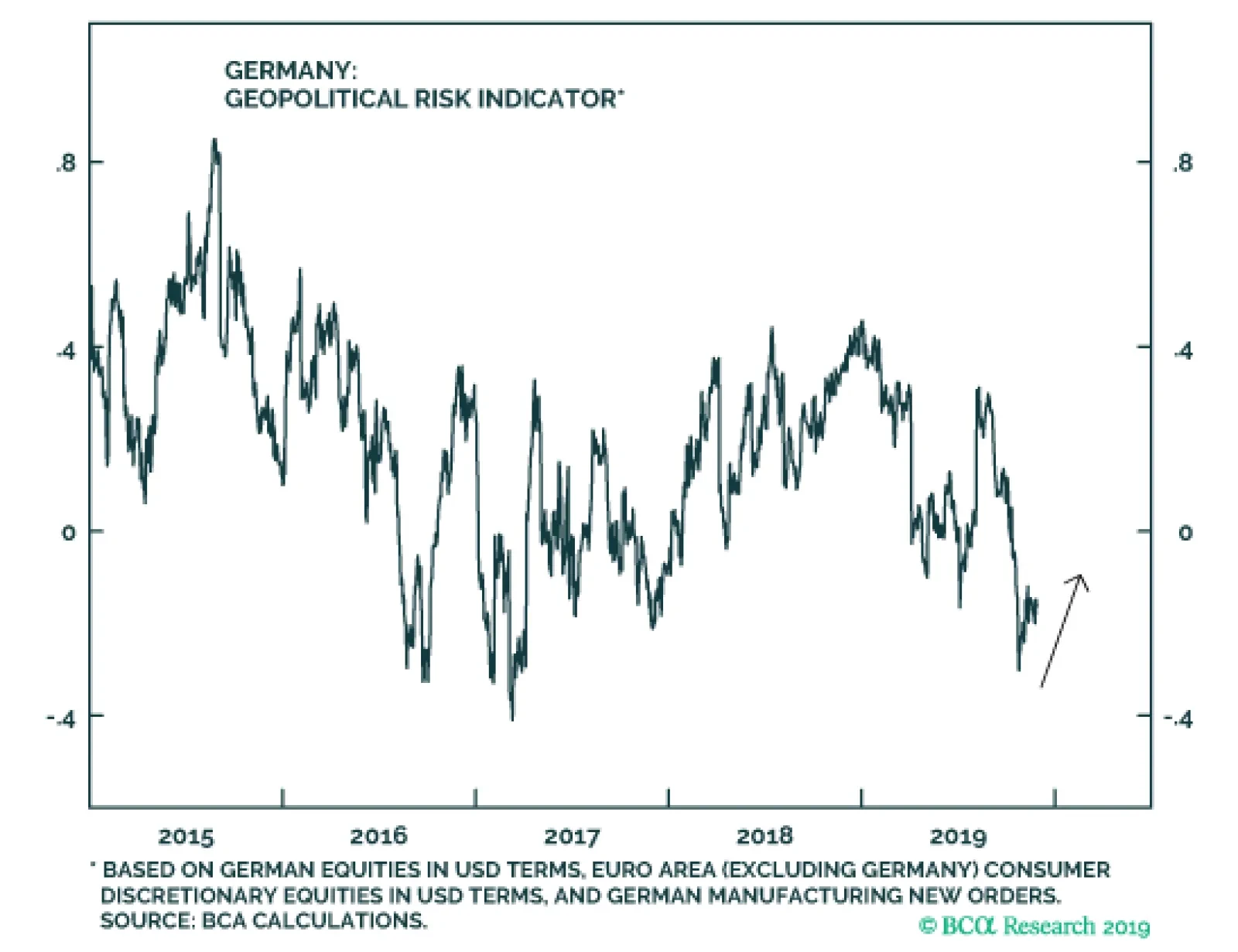
Germany is wading deeper into a period of political risk surrounding Chancellor Angela Merkel’s “lame duck” phase. The federal election of 2021 already looms large. Our indicator is only beginning to price this trend which can last for the next two years. …