Sorry, you need to enable JavaScript to visit this website.
Skip to main content

Monetary

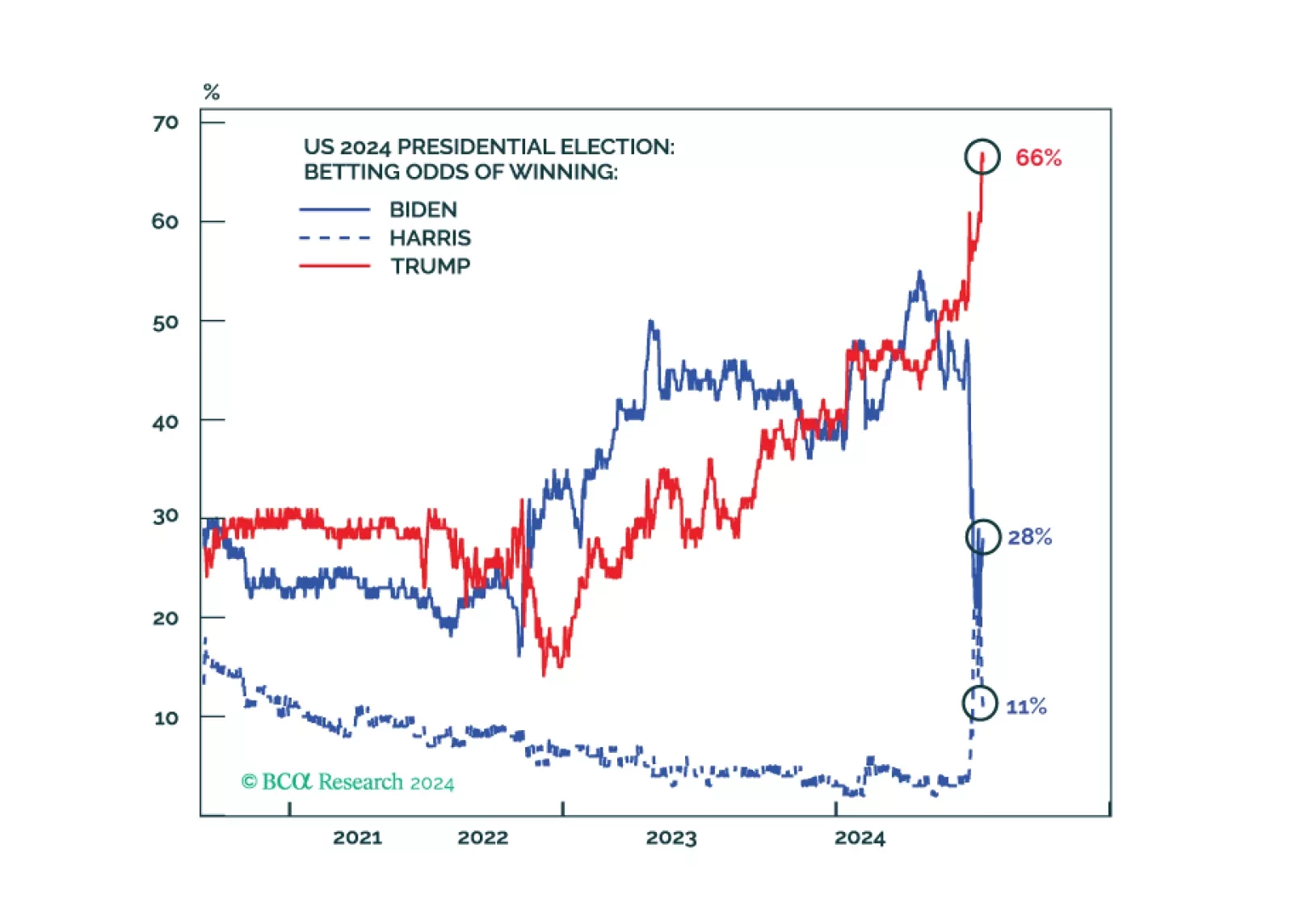
The cyclical economy is slowing today. Republicans are now more likely to win a full sweep, crack down on immigration and trade, and at least modestly stimulate the economy. Uncertainty and volatility will rise.

The conventional wisdom is wrong: Trump is not going to substantially cut taxes once in office; he is going to raise taxes by jacking up tariffs. To the extent that this dampens economic activity, it is bad news for stocks but good news for bonds.

The disinflationary trend in US CPI continued in June as headline CPI dipped to 3% year-over-year, down from 3.3% in May, and core CPI declined by a tick to 3.3%. On a month-over-month basis, headline prices fell by 0.1% and core prices rose by 0.1%. One…
South African stocks, domestic bonds, and currency have all rallied since BCA’s Emerging Markets Strategy team upgraded South African assets last month following the formation of the new national unity government. The rally's persistence, however, will depend…

In light of last week’s employment report and this morning’s CPI, it’s time for the Federal Reserve to cut rates.

US Core CPI inflation has decelerated considerably from its year-over-year peak of 6.6% in September 2022 to 3.4% in May and the consensus expects it remained at 3.4% in June. The year-over-year number has come down continuously, albeit fitfully, over the…
Special Report

We consider the outlook for CPI inflation over the next 12 months. Our baseline forecast calls for core CPI to hit 2.40% during this timeframe and for headline CPI to fall between 1.74% and 2.49%.

The latest release of the Canadian Labour Force Survey indicated further softening of the labor market in the Great White North. The economy experienced a net loss in total employment, shedding 1,400 jobs compared to market expectations of a net creation of…

In this week's report, we review the impact of political developments, as well as incoming fundamental data, on our positioning.

Eurozone headline inflation slowed from 2.6% y/y to 2.5% in June. Germany, its largest economy, saw price pressures ease from 2.4% to 2.2%, below expectations of 2.3% (or from 2.8% to 2.5% on an EU-Harmonized basis). However, Euro Area core inflation…