Sectors

Overweight While housing-related data releases have been slightly weaker than anticipated lately, we deem that this softness is transitory as housing market fundamentals rest on solid foundations. True, affordability has taken a hit both as a result of rising home price inflation and mortgage rates but as long as job certainty remains intact and wage growth picks up steam as we expect, we doubt that the U.S. housing market will suffer a relapse. In that light, we recommend augmenting exposure to overweight in the S&P homebuilding index. While galloping lumber prices were previously a key reason for putting the S&P homebuilding index on our high-conviction underweight list, the recent liquidation, down $300/thousand board feet since the mid-May peak, in lumber prices represents a massive input cost relief for homebuilders (second panel). In addition, the latest Fed Senior Loan Officer survey showed that demand for residential real estate loans ticked higher, while simultaneously bankers remain willing extenders of mortgage credit. The implication is that new home sales will likely reaccelerate in the coming months (third & bottom panels). Bottom Line: A playable opportunity has surfaced to ride the S&P homebuilding index higher. Lift exposure to overweight and see Monday's Weekly Report for more details. The ticker symbols for the stocks in this index are: BLBG: S5HOME - DHI, LEN, PHM.
Look Through The Housing Soft Patch
Look Through The Housing Soft Patch
Highlights Duration: The housing market is the key channel through which monetary policy impacts the economy. As such, it is unlikely that Treasury yields will peak until housing shows meaningful weakness. While residential investment has decelerated in recent quarters, we expect this weakness will prove temporary and that Treasury yields have further cyclical upside. Maintain below-benchmark portfolio duration. Yield Curve: The Fed will maintain its 25 bps per quarter rate hike pace for the time being, but could be forced to pause next year if weak foreign growth migrates to the U.S. via a stronger dollar. We recommend hedging this risk via a long position in the 7-year bullet versus a short position in the 1/20 barbell. Corporate Health: Strong profit growth - both organic and as a result of corporate tax cuts - has led to a significant improvement in corporate balance sheet health during the past few quarters. This improvement will not persist for much longer. We recommend only a neutral allocation to corporate bonds, both investment grade and junk. Feature This time last week the 10-year Treasury yield was bumping up against 3% and money markets were on the cusp of discounting an extra rate hike between now and the end of 2019. Both resistance levels broke during the past seven days. The 10-year yield is now 3.07% and the January 2020 fed funds futures contract is fully priced for four rate hikes (Chart 1). Chart 1Past Resistance Levels
Past Resistance Levels
Past Resistance Levels
With the 10-year yield back above 3%, many investors are once again speculating about where it will ultimately peak for the cycle. Any answer to this question relies on an assumption about the neutral fed funds rate, the level of interest rates above which monetary policy turns restrictive and acts to slow economic growth and inflation. In past reports we have suggested several measures investors can track to help decide whether interest rates are close to breaking above neutral.1 In this week's report we focus on one particularly important indicator - the housing market. In his essential 2007 paper "Housing Is The Business Cycle", Edward Leamer notes that of the ten post-WWII U.S. recessions, eight were preceded by a significant slowdown in residential investment.2 Given that recessions are also typically preceded by tightening monetary policy, it is not a stretch to connect the two. In fact, there is good reason to believe that housing is the main channel through which monetary policy impacts the economy. Since leverage is employed in the acquisition of new homes, interest rates impact the cost of homeownership more directly than other assets. A similar claim could be made about leveraged investment from the corporate sector, but business investment is also beholden to swings in expected future demand. Households can easily postpone the acquisition of a new home if the interest rate environment makes it uneconomical, businesses need to act when the market demands it. But most importantly, Leamer's paper demonstrates that, unlike residential investment, weaker business investment does not consistently provide advance warning of recession. The State Of U.S. Housing Turning to the data, we see that Leamer's claim is validated by the top panel of Chart 2. Residential investment tends to decline in the year preceding a U.S. recession. Housing starts and new home sales display a similar pattern (Chart 2, panels 2 & 3). Chart 2The Housing Market Predicts Recessions
The Housing Market Predicts Recessions
The Housing Market Predicts Recessions
What's worrying is that residential investment has barely grown at all during the past year (Chart 2, bottom panel). If this weakness continues it would signal that interest rates are too high for the housing market, and that we are likely very close to the cyclical peak in bond yields. However, we doubt the current weakness will persist. For one, the recent decline in construction activity has been concentrated in the multi-family sector while single-family construction continues to expand at a steady rate (Chart 3). This could simply reflect a shift in demand away from multi-family toward single-family, reversing the trend witnessed between 2010 and 2012. It's possible that some households who were forced into the rental market in the aftermath of the Great Recession now find themselves able to switch back. But even if we focus on the multi-family sector exclusively, there is little reason to believe that construction will see significantly more downside. The rental vacancy rate remains very low, and the National Multi Housing Council's Survey of Apartment Market Conditions suggests that there is no strong upward or downward pressure on the vacancy rate at the moment (Chart 3, bottom 2 panels). The fact that single-family housing starts have not declined casts some doubt on the notion that higher mortgage rates are to blame for the deceleration in residential investment. This is further borne out by the fact that, while higher mortgage rates have certainly increased the cost of homeownership, mortgage payments as a percent of median income are not stretched compared to history (Chart 4). The demand back-drop for housing also remains robust, with household formation in a clear uptrend (Chart 4, panel 2) and homebuilders as optimistic as ever about future sales activity (Chart 4, bottom panel). Chart 3A Temporary Weakness In Residential Investment
A Temporary Weakness In Residential Investment
A Temporary Weakness In Residential Investment
Chart 4Higher Mortgage Rates Are Not The Culprit
Higher Mortgage Rates Are Not The Culprit
Higher Mortgage Rates Are Not The Culprit
We conclude that interest rates are still too low to meaningfully impact the housing market. Residential investment will re-accelerate in the coming quarters and Treasury yields have plenty of room to rise before reaching their cyclical peak. Bottom Line: The housing market is the key channel through which monetary policy impacts the economy. As such, it is unlikely that Treasury yields will peak until housing shows meaningful weakness. While residential investment has decelerated in recent quarters, we expect this weakness will prove temporary and that Treasury yields have further cyclical upside. Maintain below-benchmark portfolio duration. Hedging Weak Foreign Growth With Steepeners The resilience of the U.S. housing market makes it likely that interest rates will continue to rise for quite some time. However, this does not preclude weak foreign growth - and the resultant dollar strength - from forcing the Fed to slow its 25 basis point per quarter rate hike pace at some point during the next 6-12 months. In fact, we have flagged in recent reports that, since 1993, every time the Global (ex. U.S.) Leading Economic Indicator (LEI) has fallen below zero, the U.S. LEI has eventually followed (Chart 5).3 Unless foreign growth suddenly recovers, it is quite likely that dollar strength will drag the U.S. LEI lower in the first half of next year. At that point, the Fed may be forced to pause its rate hike cycle in order to take some shine off the dollar, allowing the recovery to continue. Chart 5Weak Global Growth Could Bring Down The U.S.
Weak Global Growth Could Bring Down The U.S.
Weak Global Growth Could Bring Down The U.S.
Drops in the U.S. LEI to below zero almost always coincide with a recommendation for easier monetary policy from our Fed Monitor (Chart 5, bottom panel). Although one notable exception did occur in 2005. An examination of the three components of our Fed Monitor reveals that a falling LEI caused the economic growth component of our monitor to decline in 2005 (Chart 6). However, this was offset by an elevated inflation component and extremely easy financial conditions (Chart 6, bottom 2 panels). Chart 6The Three Components Of Our Fed Monitor
The Three Components Of Our Fed Monitor
The Three Components Of Our Fed Monitor
As in 2005, inflation pressures are once again elevated and financial conditions remain accommodative. It follows that it could take a significant deterioration in economic growth before the Fed is forced to pause its 25 bps per quarter rate hike cycle, one that is not yet evident in the data. Nevertheless, we cannot ignore the risk that weak foreign growth will infiltrate the U.S. via a stronger dollar, forcing the Fed to pause. With only two 25 basis point rate hikes currently discounted for 2019, some pause is already in the price. This makes us reluctant to advocate shifting away from below-benchmark portfolio duration. We think a better way to hedge the risk of a Fed pause is through yield curve steepeners. Since short-dated yields are more heavily influenced by the expected near-term pace of rate hikes than long-dated yields, any Fed pause will cause the yield curve to steepen. Steepeners are also very attractively priced at the moment, meaning that they should even perform well in a mild curve flattening environment.4 Our preferred method for implementing a curve steepener is to go long a bullet maturity near the middle of the curve and short a duration-matched barbell consisting of the very short and very long ends of the curve.5 With that in mind, we can determine the best yield curve trade to implement by answering the following two questions: Which bullet over barbell combination offers the most attractive value? Which bullet over barbell combination is most likely to outperform in the "Fed pause" scenario we are trying to hedge? In response to the first question, we consider the 2-year, 3-year, 5-year and 7-year bullet maturities all relative to a duration-matched 1/20 barbell. All of those butterfly spreads offer approximately the same yield pick-up (Chart 7). They also all offer approximately the same yield pick-up relative to our fair value models, which are based on regressions of the butterfly spread versus the 1/20 slope of the curve (Chart 8).6 To answer the second question, we try to identify which of the 2-year, 3-year, 5-year or 7-year yields is likely to decline the most in response to the market pricing-in a pause in Fed rate hikes. To do this we look at the historical correlations between different yield curve slopes and our 12-month Fed Funds Discounter - the change in the fed funds rate that is priced into the market for the next 12 months. The correlations are displayed in Chart 9, and they show that monthly changes in the 7/10 slope are almost always negatively correlated with monthly changes in the 12-month discounter. In other words, when the discounter falls, the 7-year yield falls by more than the 10-year yield. Chart 7Different Bullets, Similar Yield Pick-Up I
Different Bullets, Similar Yield Pick-Up I
Different Bullets, Similar Yield Pick-Up I
Chart 8Different Bullets, Similar Yield Pick-Up II
Different Bullets, Similar Yield Pick-Up II
Different Bullets, Similar Yield Pick-Up II
Chart 9Hedging The "Fed Pause" Scenario
Hedging The "Fed Pause" Scenario
Hedging The "Fed Pause" Scenario
Monthly changes in the 5/7 slope are also usually negatively correlated with changes in the discounter, though the correlation has been closer to zero in recent years. This makes it difficult to say with certainty whether the 5-year or 7-year yield would fall by more in response to a decline in the discounter. Chart 9 also shows that changes in both the 2/3 and 3/5 slopes are positively correlated with changes in the 12-month discounter. This means that when the discounter falls, the 3-year yield falls by more than the 2-year yield and the 5-year yield falls by more than the 3-year yield. In general, we can safely conclude that the 5-year and 7-year bullets are better hedges against a Fed pause than the 2-year or 3-year bullets. The 7-year in particular appears to be a safe bet. Given that the differences in valuation between the different options are miniscule, we are inclined to maintain our current yield curve position: long the 7-year bullet and short the 1/20 barbell. This week we also close our recommendation to favor the 5/30 barbell over the 10-year bullet for a small loss of 2 bps. This trade was designed to hedge the risk of Fed overtightening leading to an inverted yield curve. This trade would underperform in the event of a Fed pause, which we now view as the greater risk. Bottom Line: The Fed will maintain its 25 bps per quarter rate hike pace for the time being, but could be forced to pause next year if weak foreign growth migrates to the U.S. via a stronger dollar. We recommend hedging this risk via a long position in the 7-year bullet versus a short position in the 1/20 barbell. Corporate Balance Sheet Reprieve Last week's release of the second quarter U.S. Financial Accounts (formerly Flow of Funds) allows us to update our indicators of nonfinancial corporate balance sheet health. Overall, there has been a significant improvement in our Corporate Health Monitor (CHM) since the end of 2016. It has fallen from deep in "deteriorating health" territory to close to the "improving health" zone (Chart 10). By far, the biggest driver of the CHM's improvement has been the sharp increase in after-tax cash flows (Chart 10, panel 2). This is partly due to the recent corporate tax cuts, but also reflects a significant rebound in pre-tax cash flows (Chart 10, bottom panel). Despite the rebound in profits, we remain cautious on the outlook for corporate balance sheets going forward. First, our bottom-up samples of firms included in the investment grade and high-yield Bloomberg Barclays bond indexes both show that the median firm's net debt-to-EBITDA has improved in recent quarters, but remains elevated compared to history (Chart 11). Chart 10After-Tax Cash Flows Drive CHM Improvement
After-Tax Cash Flows Drive CHM Improvement
After-Tax Cash Flows Drive CHM Improvement
Chart 11Debt Levels Still High
Debt Levels Still High
Debt Levels Still High
Second, we see increasing headwinds to profit growth going forward. The positive impact from tax cuts is set to wane, while the stronger dollar and faster wage growth will both weigh on pre-tax profits during the next year.7 It is important to note that it will not take much deceleration in pre-tax profits for corporate balance sheets to worsen. Our measure of gross leverage - total debt over pre-tax profits - has only managed to flatten-off during the past few quarters, even as profit growth has surged. This means that the rapid gains in profits have only managed to keep pace with the rate of debt growth. Even a small deceleration in profits will cause leverage to rise, and rising leverage tends to occur alongside an increasing default rate (Chart 12). Chart 12Gross Leverage And Corporate Defaults
Gross Leverage And Corporate Defaults
Gross Leverage And Corporate Defaults
Bottom Line: Strong profit growth - both organic and as a result of corporate tax cuts - has led to a significant improvement in corporate balance sheet health during the past few quarters. This improvement will not persist for much longer. We recommend only a neutral allocation to corporate bonds, both investment grade and junk. Ryan Swift, Vice President U.S. Bond Strategy rswift@bcaresearch.com 1 Please see U.S. Bond Strategy Weekly Report, "Tracking The Two-Stage Treasury Bear", dated August 14, 2018, available at usbs.bcaresearch.com 2http://www.nber.org/papers/w13428 3 Please see U.S. Bond Strategy Weekly Report, "An Oasis Of Prosperity?", dated August 21, 2018, available at usbs.bcaresearch.com 4 Please see U.S. Bond Strategy Portfolio Allocation Summary, "Playing Catch-Up", dated September 11, 2018, available at usbs.bcaresesarch.com 5 For further details on why we prefer this trade construction, please see U.S. Bond Strategy Special Report, "Bullets, Barbells And Butterflies", dated July 25, 2017, available at usbs.bcaresearch.com 6 We calculate the butterfly spread as: the bullet yield minus the yield of the duration-matched barbell. 7 Please see U.S. Bond Strategy Special Report, "Go To Neutral On Spread Product", dated June 26, 2018, available at usbs.bcaresearch.com Fixed Income Sector Performance Recommended Portfolio Specification
Highlights Portfolio Strategy The firming long-term housing demand backdrop, lumber price cost relief, steady new home prices and favorable new home sales expectations, all signal that it is time to buy homebuilders. On the flip side, we do not want to overstay our welcome in the S&P home improvement retail index as a number of leading industry profit indicators have started to wave a yellow flag. Recent Changes Boost the S&P Homebuilding index to overweight today. Trim the S&P Home Improvement Retail index to neutral and lock in gains of 13.3% today. Table 1
Indurated
Indurated
Feature Another week, another SPX all-time high. Investors have refocused their attention on the important macro drivers: solid profits, easing fiscal policy, and still-benign monetary policy with the real fed funds rate barely probing 0%. Trade-related rhetoric has taken the back seat as it has now become obvious that the rest of the world will bear the brunt of President Trump's trade escalation. Our EPS growth models are sniffing this out, with the SPX ticking higher, while our global profit model sinking close to nil (Chart 1). Chart 1Ex-U.S. EPS Will Bear The Brunt Of Trade Wars
Ex-U.S. EPS Will Bear The Brunt Of Trade Wars
Ex-U.S. EPS Will Bear The Brunt Of Trade Wars
Importantly, we are impressed by how thick-skinned the market has become to negative trade-related news. Putting the looming Chinese tariffs into proper perspective is instructive. Assuming a 25% tariff rate on $250bn worth of Chinese manufactured goods and no relief from the renminbi's steep depreciation since April, results in a "tax" of $63bn. The net new "tax" is actually $53bn as an average 3.8%1 import tariff rate already exists on manufactured goods. The consumer and corporations will bear the brunt of this "tax", so it is worth examining the data on household net worth, consumer incomes, and corporate sales. Federal Reserve data show that household net worth increased by $8.1tn in the past year. BEA data reveal that total wage & salary disbursements increased by $400bn, and BCA's projections call for $600bn increase in SPX sales for 2019 (using IBES data for calendar 2019, Chart 2). In other words, it becomes clear that $53bn in a new tariff "tax" will barely eat into net worth, consumer incomes or corporate revenue flows. In addition, according to the IMF, fiscal easing in 2019 will surpass even this year's fiscal expansion in the U.S. The upshot is that over 1% of GDP in fiscal thrust in 2019 thwarts the specter of tariffs, before the fiscal impulse turns negative starting in 2020 (bottom panel, Chart 2). Meanwhile, following up from last week's report when we posited that the current macro backdrop resembles more the mid-2000s than the late-1990s, we are challenging ourselves and asking what if we are wrong in our assessment. Could we actually be replaying a late-1990s episode instead? Revisiting the late-1990s in more detail is in order, refreshing our memory on the sequence of events that led to the climactic LTCM bailout, and highlighting potential signposts that can be helpful in navigating today's macro and equity market maps. In March 1997 the Fed raised rates and pushed the fed funds rate to 5.5%. In hindsight that was a mistake as the Fed then paused the tightening cycle and watched as the Thai baht began to tumble in late-June 1997, eventually gripping all of the emerging world. True, the U.S. stock market modestly pulled back in October 1997 and the VIX spiked to 38. Then, as equities recovered in Q1/1998 and jumped to fresh all-time highs, suddenly the yield curve inverted in May 1998. Undeterred, the S&P 500 hit another peak in July of 1998 before falling roughly 20% in the subsequent month. Finally, once Russia defaulted and the Fed had to bail out the banks due to the LTCM fiasco, the FOMC, late in the game in September 1998, started to ease monetary policy, and engineered a steepening of the yield curve (Chart 3). Chart 2Trade "Tax" A Drop In The Bucket
Trade “Tax” A Drop In The Bucket
Trade “Tax” A Drop In The Bucket
Chart 3Sequence Of Macro Events Matters
Sequence Of Macro Events Matters
Sequence Of Macro Events Matters
The most important signpost from this trip down memory lane is the yield curve. In other words, heed the signal from the bond market: the yield curve inversion correctly predicted a reversal of Fed policy and naturally led the temporary peak in the stock market. Importantly, despite the peak-to-trough near-20% decline in the SPX between July and late-August 1998, if someone had bought the index on Jan 2, 1998 and held through the cathartic LTCM bailout, they remained in the black (bottom panel, Chart 3), and a buy the dip strategy was a winning one. As a last reminder, the SPX jumped another 65% from the August 1998 trough until the March 2000 peak that was preceded, once again, by another yield curve inversion. At the current juncture, were the yield curve to invert we would become overly cautious on the broad equity market as we highlighted in late-June2, and would begin to transition the portfolio away from cyclicals and toward defensives. But, we are not there yet. Thus, we sustain our sanguine broad equity market outlook on a 9-12 month horizon and our SPX target remains 10% higher with EPS doing all the heavy lifting as the multiple moves sideways (for more details, please refer to our April 30th, 2018 Weekly Report titled "Lifting SPX Target"). This week we are taking a deeper dive in housing and housing-related equities and making a subsurface portfolio shift. Look Through The Housing Soft Patch, And... While housing-related data releases have been slightly weaker than anticipated lately, we deem that this softness is transitory as housing market fundamentals rest on solid foundations. On the demand side, first-time home buyers still make only a third of total home sales and the homeownership rate is near generational lows, underscoring that pent up housing demand exists. In fact, the percentage of 18-34 year-olds that live with their parents remains close to 32% a multi-decade high and also represents another source of housing demand that has been dormant because of the Great Recession (Chart 4). Importantly, household formation is still running at a higher clip than housing starts and permits, signaling that the risk of a significant supply/demand imbalance is rising. Historically, this gets resolved via higher prices. Further on the supply side, inventories of existing and new homes for sale remain low and point toward a tight residential housing market (Chart 5). The 98.5% homeowner occupancy rate corroborates the apparent residential real estate market tightness. Chart 4Homeownership Still Well Within Reach
Homeownership Still Well Within Reach
Homeownership Still Well Within Reach
Chart 5Positive Housing Demand/Supply Dynamics
Positive Housing Demand/Supply Dynamics
Positive Housing Demand/Supply Dynamics
True, affordability has taken a hit both as a result of rising home price inflation and mortgage rates. But, putting affordability in historical context reveals that homeownership is still well within reach. Were we to exclude that aberration of the post 2007 surge in affordability owing to the collapse in house prices and all-time lows in mortgage rates, affordability is higher than the 1992-2007 range and only lower than the early 1970s. The reason is largely because of still generationally-low interest rates (Chart 5). While a rising interest rate backdrop and sustained house price inflation will continue to dent affordability, as long as job certainty remains intact and wage growth picks up steam as we expect (please see Chart 4 from last week's publication), we doubt that the U.S. housing market will suffer a relapse. ...Boost Homebuilders To Overweight, But... In that light, we recommend augmenting exposure to overweight in the S&P homebuilding index. With the labor market at full employment and unemployment insurance claims on the verge of breaking below the 200K mark, housing starts should regain their footing (Chart 6) and propel homebuilding profits. In addition, the latest Fed Senior Loan Officer survey showed that demand for residential real estate loans ticked higher, while simultaneously bankers remain willing extenders of mortgage credit. The implication is that new home sales will likely reaccelerate in the coming months (third & bottom panels, Chart 7). Chart 6Homebuilders Rest On Solid Foundations
Homebuilders Rest On Solid Foundations
Homebuilders Rest On Solid Foundations
Chart 7Lumber Input Cost Relief
Lumber Input Cost Relief
Lumber Input Cost Relief
While galloping lumber prices were previously a key reason for putting the S&P homebuilding index on our high-conviction underweight list, the recent liquidation, down $300/thousand board feet since the mid-May peak, in lumber prices represents a massive input cost relief for homebuilders (second panel, Chart 7). With regard to the relative pricing power front, previous price concessions (new home prices compared with existing home prices) are paying off as new home sales are steadily gaining a larger slice of the overall home sales pie (second & third panels, Chart 8). As input cost relief is slated to kick in during the next few months, especially on the framing lumber front, at a time when new home prices have stabilized, homebuilding sales and profits will likely overwhelm (bottom panel, Chart 8). While the latest NAHB/Wells Fargo National Home Market survey showed some softness on the overall housing market index (HMI), keep in mind that both the HMI and the sales expectations subcomponents of the survey are squarely above the 50 boom/bust line and only slightly below the recent cyclical highs (top and second panels, Chart 9). This healthy housing backdrop is also evident in plentiful construction job openings and expanding national house prices (third & bottom panels, Chart 9). Nevertheless, there are two risks to our upbeat S&P homebuilding view. First, interest rates. At the margin, rising mortgage rates can be a source of deficient housing demand especially for first-time home buyers. However, as mentioned earlier, interest rates are generationally low (middle panel, Chart 10) and the job market remains vibrant which should continue to entice first-time home buyers to make one of the largest purchase decisions of their lifetime. Chart 8Price Hikes Should Stick
Price Hikes Should Stick
Price Hikes Should Stick
Chart 9Big Gaps Set To Narrow
Big Gaps Set To Narrow
Big Gaps Set To Narrow
Chart 10Two Risks: Interest Rates & Wages
Two Risks: Interest Rates & Wages
Two Risks: Interest Rates & Wages
Second, industry wage inflation. Construction sector wages are climbing rapidly, as much as 150bps faster than overall average hourly earnings (bottom panel, Chart 10). This is another key input cost for homebuilders that could eat into profit margins, especially if new home price inflation does not stick. In sum, a firming long-term housing demand backdrop, lumber price cost relief, steady new home prices and favorable leading indicators of new home sales will more than offset rising interest rates and industry wage inflation. Bottom Line: A playable opportunity has surfaced to ride the S&P homebuilding index higher. Lift exposure to overweight. The ticker symbols for the stocks in this index are: BLBG: S5HOME - DHI, LEN, PHM. ...Don't Over Stay Your Welcome In Home Improvement Retailers Nevertheless, we do not want to overstay our welcome on the other residential real estate-levered consumer discretionary subgroup, the S&P home improvement retail (HIR) index. We recommend a downgrade to a benchmark allocation for a relative gain of 13.3% since the July 5, 2016 inception. Such a move does not reflect a worsening overall housing view; as we made clear in our analysis above, we remain housing market bulls. Instead, we are concerned that too much euphoria is already priced in HIR equities. Chart 11 shows that fixed residential investment as a percentage of GDP is up 50% from trough to the recent peak (similar to the advance in existing home sales), whereas relative HIR performance is up 170% in the same time frame. Our worry is that optimistic sell side analysts' relative profit forecasts will be hard to attain, let alone surpass (bottom panel, Chart 11). Three main reasons are behind our softening EPS backdrop for home improvement retailers. First, our HIR model has plunged on the back of the wholesale liquidation in lumber prices and rising interest rates (Chart 12). Lumber deflation in particular will prove a profit headwind as building supply Big Box retailers make a set margin on wood products. Chart 11Too Much Euphoria
Too Much Euphoria
Too Much Euphoria
Chart 12Timberrrr!
Timberrrr!
Timberrrr!
Second, household appliance and furniture & durable selling prices have tentatively crested, and represent another source of profit headaches for HIR (bottom panel, Chart 13). Finally, select industry operating metrics suggest that the easy profits are behind HIR. Not only is our productivity growth proxy (sales per employee) on the verge of deflating, but also an inventory surge has sunk the HIR sales-to-inventories ratio into the contraction zone (second & third panels, Chart 13). But there are still some pockets of strength in the home improvement retailing industry that prevent us from turning outright bearish on the S&P HIR index. Despite the aforementioned easing in appliance and furniture wholesale prices, our HIR implicit price deflator has spiked on a short-term rate of change basis, likely owing to firm demand for remodeling activity. Indeed, the latest NAHB remodeling survey remains perched near record highs. The implication is that the recent lull in industry sales growth may reverse (middle and bottom panels, Chart 14). Importantly, a large driver of the previous cycle's remodeling activity was the availability of HELOCs and the stratospheric rise in Mortgage Equity Withdrawal (popularized by Fed economist Dr. James Kennedy). Now that home equity has nearly doubled to near 60% from the depths of the GFC, there are rising odds that homeowners may begin to tap their rebuilt equity and embark upon more renovations (top & middle panels, Chart 15). Tack on rising disposable incomes (bottom panel, Chart 15) and a buoyant labor market and the outlook for remodeling activity brightens further. Chart 13Operational Trouble Brewing...
Operational Trouble Brewing…
Operational Trouble Brewing…
Chart 14...But Offsets...
…But Offsets…
…But Offsets…
Chart 15...Exist
…Exist
…Exist
Netting it out, is it prudent to lock in gains in the S&P HIR index as profit drivers have downshifted at the margin. Bottom Line: Crystalize gains of 13.3% in the S&P HIR index since inception, and downgrade exposure to neutral. The ticker symbols for the stocks in this index are: BLBG: S5HOMI - HD, LOW. Anastasios Avgeriou, Vice President U.S. Equity Strategy anastasios@bcaresearch.com 1 Source: The World Bank, https://data.worldbank.org/indicator/TM.TAX.MANF.SM.FN.ZS?locations=US&name_desc=true 2 Please see BCA U.S. Equity Strategy Weekly Report, "Has The Reward/Risk Tradeoff Changed?" dated June 25, 2018, available at uses.bcaresearch.com. Current Recommendations Current Trades Size And Style Views Favor value over growth Favor large over small caps
Highlights We review last year's "Three Tantalizing Trades" and offer four additional ones: Trade #1: Long June 2019 Fed funds futures contract/short Dec 2020 Fed funds futures contract Trade #2: Long USD/CNY Trade #3: Short AUD/CAD Trade #4: Long EM stocks with near-term downside put protection Feature A Review Of Last Year's "Three Tantalizing Trades" I had the pleasure of speaking at BCA's last Annual Investment Conference on September 25th, 2017, where I presented the following three trade ideas (Chart 1): 1. Short December 2018 Fed funds futures We closed this trade for a profit of 70 basis points. Had we held on, it would be up 92 basis points as of the time of this writing. 2. Long global industrial equities/short utilities We closed this trade on February 1st for a gain of 12%, as downside risks to global growth began to mount. This proved to be a timely decision, as the trade would be up only 6.1% had we kept it on. We would not re-enter this trade at present. 3. Short 20-year JGBs/long 5-year JGBs This trade struggled for much of 2018 but sprung back to life in August. It is up 0.6% since we initiated it. We still like the trade over the long haul. Investors are grossly underestimating the risk that Japanese inflation will move materially higher as an aging population creates a shortage of workers and a concomitant decline in the national savings rate. We also think the government will try to egg on any acceleration in consumer prices in order to inflate away its debt burden. In the near term, however, the trade could struggle if a combination of weaker EM growth and an increase in the value of the trade-weighted yen cause inflation expectations to decline. Four Additional Trades Trade #1: Long June 2019 Fed funds futures contract/short December 2020 Fed funds futures contract Investors expect U.S. short-term rates to rise to 2.38% by the end of 2018 and 2.85% by the end of 2019. The 47 basis points in tightening priced in for next year is less than the 75 basis points in hikes implied by the Fed dots. Investors appear to have bought into Larry Summers' secular stagnation thesis. They are convinced that short rates will not be able to rise above 3% without triggering a recession (Chart 2). Chart 1Revisiting Last Year's Three Tantalizing Trades
Revisiting Last Year's Three Tantalizing Trades
Revisiting Last Year's Three Tantalizing Trades
Chart 2Markets Expect No Fed Hikes Beyond Next Year
Four Tantalizing Trades
Four Tantalizing Trades
Regardless of what one thinks of Summers' thesis, it must be acknowledged that it is a theory about the long-term drivers of the neutral rate of interest. Over a shorter-term cyclical horizon, many factors can influence the neutral rate. Critically, most of these factors are pushing it higher: Fiscal policy is extremely stimulative. The IMF estimates that the U.S. cyclically-adjusted budget deficit will reach 6.8% of GDP in 2019 compared to 3.6% of GDP in 2015. In contrast, the euro area is projected to run a deficit of only 0.8% of GDP next year, little changed from a deficit of 0.9% it ran in 2015 (Chart 3). The relatively more expansionary nature of U.S. fiscal policy is one key reason why the Fed can raise rates while the ECB cannot. Credit growth has picked up. After a prolonged deleveraging cycle, private-sector nonfinancial debt is rising faster than GDP (Chart 4). The recent easing in The Conference Board's Leading Credit Index suggests that this trend will continue (Chart 5). Wage growth is accelerating. Average hourly earnings surprised on the upside in August, with the year-over-year change rising to a cycle high of 2.9%. This followed a stronger reading in the Employment Cost Index in the second quarter. A simple correlation with the quits rate suggests that there is plenty of upside for wage growth (Chart 6). Faster wage growth will put more money into workers pockets who will then spend it. The savings rate has scope to fall. The personal savings rate currently stands at 6.7%, more than two percentage points higher than what one would expect based on the current ratio of household net worth-to-disposable income (Chart 7). If the savings rate were to fall by two points over the next two years, it would add 1.5% of GDP to aggregate demand. Chart 3U.S. Fiscal Policy Is More Expansionary Than The Euro Area
U.S. Fiscal Policy Is More Expansionary Than The Euro Area
U.S. Fiscal Policy Is More Expansionary Than The Euro Area
Chart 4U.S. Private-Sector Nonfinancial Debt Is Rising At Close To Its Historic Trend
U.S. Private-Sector Nonfinancial Debt Is Rising At Close To Its Historic Trend
U.S. Private-Sector Nonfinancial Debt Is Rising At Close To Its Historic Trend
Chart 5U.S. Credit Growth Will Remain Strong
U.S. Credit Growth Will Remain Strong
U.S. Credit Growth Will Remain Strong
Chart 6Quits Rate Is Signaling That There Is Upside For Wage Growth
Quits Rate Is Signaling That There Is Upside For Wage Growth
Quits Rate Is Signaling That There Is Upside For Wage Growth
Chart 7The Personal Savings Rate Has Room To Fall
Four Tantalizing Trades
Four Tantalizing Trades
A back-of-the-envelope calculation suggests that these cyclical factors will permit the Fed to raise rates to 5% by 2020, almost double what the market is discounting.1 A more hawkish-than-expected Fed will bid up the value of the greenback. A stronger dollar, in turn, will undermine emerging markets, which have seen foreign-currency debts balloon over the past six years (Chart 8). The deflationary effects of a stronger dollar and falling commodity prices could temporarily cause investors to price out some hikes over the next few quarters. With that in mind, we recommend shorting the December 2020 Fed funds futures contract, while going long the June 2019 contract. The first leg of the trade captures our expectation that the market will revise up its estimate the terminal rate, while the second leg captures near-term risks to global growth. The gap between the two contracts has widened over the past few days as we have prepared this report, but at 21 basis points, it has plenty of room to increase further (Chart 9). Chart 8EM Dollar Debt Is High
EM Dollar Debt Is High
EM Dollar Debt Is High
Chart 9U.S. Rate Expectations Are Too Low Beyond Mid-2019
U.S. Rate Expectations Are Too Low Beyond Mid-2019
U.S. Rate Expectations Are Too Low Beyond Mid-2019
Trade #2: Long USD/CNY China's economy is slowing, which has prompted the government to inject liquidity into the financial system. The spread in 1-year swap rates between the U.S. and China has fallen from about 3% earlier this year to 0.6% at present, taking the yuan down with it (Chart 10). It is doubtful that China will be willing to match - let alone exceed - U.S. rate hikes. This suggests that USD/CNY will appreciate. China's real trade-weighted exchange rate has weakened during the past four months, but is up 25% over the past decade (Chart 11). U.S. tariffs on $250 billion (and counting) of Chinese imports threaten to erode export competitiveness, making a further devaluation necessary. Chart 10USD/CNY Has Tracked China-U.S. Interest Rate Differentials
USD/CNY Has Tracked China-U.S. Interest Rate Differentials
USD/CNY Has Tracked China-U.S. Interest Rate Differentials
Chart 11The RMB Is Still Quite Strong
The RMB Is Still Quite Strong
The RMB Is Still Quite Strong
President Trump will oppose a weaker yuan. However, just as China's actions earlier this year to strengthen its currency did not prevent the U.S. from imposing tariffs, it is doubtful that efforts by the Chinese authorities to talk up the yuan would appease Trump. Besides, China needs a weaker currency. The Chinese economy produces too much and spends too little. The result is excess savings, epitomized most clearly in a national savings rate of 46%. As a matter of arithmetic, national savings need to be transformed either into domestic investment or exported abroad via a current account surplus. China has concentrated on the former strategy over the past decade. The problem is that this approach has run into diminishing returns. Chart 12 shows that the capital stock has risen dramatically as a share of GDP. As my colleague Jonathan LaBerge has documented, the rate of return on assets among Chinese state-owned companies, which have been the main driver of rising corporate leverage, has fallen below their borrowing costs (Chart 13).2 Chart 12China's Capital Stock Has Grown Alongside Rising Debt Levels
China's Capital Stock Has Grown Alongside Rising Debt Levels
China's Capital Stock Has Grown Alongside Rising Debt Levels
Chart 13China: Rate Of Return On Assets Below Borrowing Costs For State-Owned Companies
China: Rate Of Return On Assets Below Borrowing Costs For State-Owned Companies
China: Rate Of Return On Assets Below Borrowing Costs For State-Owned Companies
Now that the economy is awash in excess capacity, the authorities will need to steer more excess production abroad. This will require a larger current account surplus which, in turn, will necessitate a relatively cheap currency. The dollar is currently working off overbought technical conditions, a risk we flagged in our August 31st report.3 That process should be complete over the next few weeks. Meanwhile, hopes of a massive Chinese stimulus focused on fiscal/credit easing will fade. The combination of these two forces will push up USD/CNY above the psychologically-critical 7 handle by the end of the year. Trade #3: Short AUD/CAD A weaker yuan will raise raw material costs to Chinese firms. This will hurt commodity prices. Industrial metals are much more vulnerable to slower Chinese growth than oil. Chart 14 shows that China consumes close to half of all the copper, nickel, aluminum, zinc, and iron ore produced in the world, compared to only 15% of oil output. Our expectation that developed economy growth will hold up better than EM growth over the next few quarters implies that oil will outperform industrial metals. Oil is also supported by a tighter supply backdrop, particularly given the downside risks to Iranian and Venezuelan crude exports. A bet on oil over metals is a bet on DM over EM growth in general, and the Canadian dollar over the Australian dollar specifically (Chart 15). Canada exports more oil than metals, while Australian exports are dominated by ores and metals. In terms of valuations, the Canadian dollar is still somewhat cheap relative to the Aussie dollar based on our FX team's long-term valuation model (Chart 16). Chart 14China Is A More Dominant Consumer Of Metals Than Oil
China Is A More Dominant Consumer Of Metals Than Oil
China Is A More Dominant Consumer Of Metals Than Oil
Chart 15Oil Over Metals = CAD Over AUD
Oil Over Metals = CAD Over AUD
Oil Over Metals = CAD Over AUD
Chart 16Canadian Dollar Still Somewhat Cheap Versus The Aussie Dollar
Canadian Dollar Still Somewhat Cheap Versus The Aussie Dollar
Canadian Dollar Still Somewhat Cheap Versus The Aussie Dollar
The loonie has been weighed down by ongoing fears that Canada will be left out of a renegotiated NAFTA. However, our geopolitical strategists believe that the Trump administration is trying to focus more on China, against whom the case for unfair trade practices is far easier to make. The U.S. has already negotiated a trade deal with Mexico and an agreement with Canada is more likely than not. If a new deal is struck, the Canadian dollar will rally. We recommended going short AUD/CAD on June 28. The trade is up 3.4%, carry-adjusted, since then. Stick with it. Trade #4: Long EM stocks with near-term downside put protection It is too early to call a bottom in EM assets. Valuations have not yet reached washed-out levels (Chart 17). Bottom fishers still abound, as evidenced by the fact that the number of shares outstanding in the MSCI iShares Turkish ETF has almost tripled since early April (Chart 18). However, at some point - probably in the first half of next year - investors will liquidate their remaining bullish EM bets. During the 1990s, this capitulation point occurred shortly after the collapse of Long-Term Capital Management in September 1998. EM equities fell by 26% between April 21, 1998 and June 15, 1998. After a half-hearted attempt at a rally, EM stocks tumbled again in July, falling by 35% between July 17 and September 10. The second leg of the EM selloff brought down the S&P 500 by 22%. Thanks to a series of well-telegraphed Fed rate cuts, global markets stabilized on October 8th (Chart 19). The S&P 500 surged by 68% over the next 18 months. The MSCI EM index more than doubled in dollar terms over this period. EM stocks outperformed U.S. equities by a whopping 71% between February 1999 and February 2000. Europe also outperformed the U.S. starting in mid-1999. Value stocks, which had lagged growth stocks over the prior six years, also finally gained the upper hand. Chart 17EM Assets: Valuations Not Yet At Washed Out Levels
EM Assets: Valuations Not Yet At Washed Out Levels
EM Assets: Valuations Not Yet At Washed Out Levels
Chart 18EM Bottom Fishers Still Abound
EM Bottom Fishers Still Abound
EM Bottom Fishers Still Abound
Chart 19The ''Great Equity Rotation'' Is Coming: A Roadmap From The 1990s
The ''Great Equity Rotation'' Is Coming: A Roadmap From The 1990s
The ''Great Equity Rotation'' Is Coming: A Roadmap From The 1990s
The "Great Equity Rotation" is coming. All the trades that have suffered lately - overweight EM, long Europe/short U.S., long cyclicals/short defensives, long value/short growth - will get their day in the sun. Investors can prepare for this inflection point by scaling into EM equities today, but guarding against near-term downside risk by buying puts. With that in mind, we are going long the iShares MSCI Emerging Market ETF (EEM), while purchasing March 15, 2019 out-of-the-money puts with a strike price of $41. Peter Berezin, Chief Global Strategist Global Investment Strategy peterb@bcaresearch.com 1 Depending on which specification of the Taylor rule one uses, a one percent of GDP increase in aggregate demand will increase the neutral rate of interest by half a point (John Taylor's original specification) or by a full point (Janet Yellen's preferred specification). Fiscal policy is currently about 3% of GDP too simulative compared to a baseline where government debt-to-GDP is stable over time. Assuming a fiscal multiplier of 0.5, fiscal policy is thus boosting aggregate demand by 1.5% of GDP. Nonfinancial private credit has increased by an average of 1.5 percentage points of GDP per year since 2016. Assuming that every additional one dollar of credit increases aggregate demand by 50 cents, the revival in credit growth is raising aggregate demand by 0.75% of GDP, compared to a baseline where credit-to-GDP is flat. The labor share of income has increased by 1.25% of GDP from its lows in 2015. Assuming that every one dollar shift in income from capital to labor boosts overall spending on net by 20 cents, this would have raised aggregate demand by 0.25% of GDP. Lastly, if the savings rate falls by two points over the next two years, this would raise aggregate demand by 1.5% of GDP. Taken together, these factors are boosting the neutral rate by anywhere from 2% (Taylor's specification) to 4% (Yellen's specification). This is obviously a lot, and easily overwhelms other factors such as a stronger dollar that may be weighing on the neutral rate. 2 Please see China Investment Strategy Special Report, "Chinese Policymakers: Facing A Trade-Off Between Growth And Leveraging," dated August 29, 2018. 3 Please see Global Investment Strategy Weekly Report, "The Dollar And Global Growth: Are The Tables About To Turn?" dated August 31, 2018. Strategy & Market Trends Tactical Trades Strategic Recommendations Closed Trades
The opposing sides of our market- and industry-neutral trade going long the S&P homebuilding index/short the S&P REITs index1 have both been on the receiving end of negative data in the last month. With respect to homebuilders, housing permits, a leading indicator of future starts, fell well short of expectations this week and took the S&P homebuilding index down with it. Meanwhile rising UST yields have been weighing heavily on REIT stocks. The end result is that our trade has given up its early gains. The macro environment tells us that it is too early to throw in the towel on this trade. We continue to believe prices in the residential real estate sector have the upper hand over their commercial real estate (CRE) peers. Existing home inventories have tightened and remain at historically low levels, which should support pricing. On the flip side, our CRE occupancy rate composite is still contracting, warning that already-slowing pricing has further to fall. The divergence in pricing should support homebuilders' returns at the expense of REITs. Bottom Line: We reiterate our long S&P homebuilding/short S&P REITs pair trade. The ticker symbols for the stocks in the S&P homebuilding and S&P REITs indexes are: BLBG: S5HOME - LEN, PHM, DHI and BLBG: S5REITS - IRM, MAA, AMT, BXP, PLD, ESS, CCI, PSA, O, VTR, VNO, WY, EQIX, DLR, EXR, DRE, FRT, WELL, SBAC, HCP, GGP, KIM, EQR, UDR, REG, MAC, HST, SPG, AVB, AIV, SLG, ARE, respectively. 1 Please see BCA U.S. Equity Strategy Special Report, "UnReal Estate Opportunity," dated July 9, 2018, available at uses.bcaresearch.com.
Stick With Homebuilders Over REITs
Stick With Homebuilders Over REITs
Overweight Rail stocks in general, and Union Pacific (UNP) in particular, got a major lift yesterday when UNP announced a plan to implement the principles of Precision Scheduled Railroading (PSR) in its push to improve customer deliveries and profitability. Recall that PSR was developed by Hunter Harrison first at CN Rail, then CP Rail and finally at CSX where its implementation took industry profit laggards to profit leadership. Though his recent passing was untimely, the 9% year-over-year improvement in CSX’s Q2/18 operating ratio is a testament to the success of Mr. Harrison’s strategy. The timing for a renewed approach at UNP could scarcely be better. Both demand and pricing are soaring (second and third panels) and the resulting congestion is threatening profitability. We expect the ongoing supportive macro backdrop, combined with operating improvements such as these, to sustain the operating margin improvement trend of the past two years (bottom panel). Stay overweight, despite the 20% in relative return since inception. The ticker symbols for the stocks in this index are: BLBG: S5RAIL - UNP, CSX, NSC, KSU.
A Plan That Works
A Plan That Works
Highlights The latest round of tariffs on U.S. imports from China confirms that the Trump administration's confrontation with China goes beyond the mid-term elections. Desynchronization between the U.S. and China/EM growth foreshadows dollar appreciation. The latter is the right medicine for the global economy for now. A stronger dollar is required to redistribute growth and inflation away from the U.S. and towards the rest of the world. China needs a weaker currency to offset deflationary pressures stemming from domestic deleveraging and trade tariffs. For EM ex-China, the dollar rally is painful, but it is the right medicine in the long run. It will bring about the unraveling of excesses within their economies. Feature The global economy presently finds itself between two strong and opposing crosscurrents: robust growth and mounting inflationary pressures in the U.S. on the one hand, and weakening Chinese growth on the other. Desynchronization between China/EM and the U.S. has been our theme since April 2017.1 Although this theme has become evident and to a certain degree priced into the markets, we believe it is not yet time to abandon it. Before exploring this analysis in greater depth, we will address the issue of whether strong U.S. demand will reverse the slowdown in the global trade cycle, and update our thoughts on the trade wars. Global Trade And Trade Wars Our leading indicators for global trade do not herald a reversal in the global exports slowdown. Chart I-1 demonstrates that the ratio of risk-on versus safe-haven currencies2 leads global export volumes by several months, and it does not yet flag any improvement. Chart I-1Risk-On / Safe-Haven Currency Ratio As An Indicator Of Global Trade
Risk-On / Safe-Haven Currency Ratio As An Indicator Of Global Trade
Risk-On / Safe-Haven Currency Ratio As An Indicator Of Global Trade
In addition, Taiwanese exports of electronic products lead the global trade cycles by a couple of months, and they are currently pointing to further deceleration in world exports (Chart I-2). It seems extremely robust U.S. domestic demand growth has not prevented a slowdown in global trade in general and EM exports in particular. The reason for this is that many developing countries' shipments to China are larger than their exports to the U.S., as illustrated in Table I-1. Chart I-2Taiwanese Electronics Exports##br## Slightly Lead Global Exports
Taiwanese Electronics Exports Slightly Lead Global Exports
Taiwanese Electronics Exports Slightly Lead Global Exports
Table I-1Many Emerging Economies##br## Sell More To China Than To The U.S.
Desynchronization Compels Currency Adjustments
Desynchronization Compels Currency Adjustments
The latest decision by the U.S. administration to impose a 10% tariff on $200 billion of imports from China and increase this rate to 25% starting January 1, 2019 confirms that the Trump administration's confrontation with China goes beyond the mid-term elections. The true intention of the U.S. is to contain China's geopolitical rise to preserve its global hegemony. These episodes of import tariffs will likely mark the beginning of a much longer and drawn-out geopolitical confrontation. Our colleagues at BCA's Geopolitical Strategy service have been noting for several years that a U.S.-China confrontation is unavoidable.3 In this vein, it is not clear to us why global growth-sensitive and China-leveraged plays in financial markets have rallied in recent days on the new tariff announcement. We can think of two reasons: (1) markets expect China to stimulate domestic demand aggressively to counter tariffs; and (2) gradually rising U.S. import tariffs will boost global trade in the near term, as companies front load their production and shipments before the 25% tariff rate takes hold. On the first point, there has so far been no major new fiscal stimulus announced in China. We detailed fiscal numbers in our August 23 report,4 and there have been no changes since. As to liquidity easing - which has been material - our assessment is that it is likely to be overwhelmed by ongoing regulatory tightening on banks and shadow banking. In short, lingering credit excesses and regulatory tightening will hamper the monetary transmission mechanism from lower interest rates to faster credit growth. So far, money growth in China remains very weak (Chart I-3). Chart I-3China's Narrow Money And EM Stocks
China's Narrow Money And EM Stocks
China's Narrow Money And EM Stocks
On the second point, we cannot rule out a moderate and temporary improvement in global trade due to various technical factors. Yet, any rally rooted in this will prove to be short-lived and fleeting. Bottom Line: Escalating tariffs on U.S. imports from China will reinforce the tectonic macro shifts that have been in place since early this year: it will lift U.S. inflation slightly and weigh on Chinese growth. Rising U.S. Inflation U.S. core inflation is accelerating and moving above the Federal Reserve's soft target of 2%. This will substantially narrow the Fed's maneuvering room to respond to the turmoil in EM and weakening growth outside the U.S. Chart I-4 demonstrates that an equally weighted average of various core consumer inflation measures for the U.S. has been markedly accelerating. The components of this core inflation aggregate are presented in Chart I-5 and include: trimmed mean CPI, trimmed mean PCE, market-based core PCE and median CPI. Besides, the U.S. labor market is super tight, and employee compensation growth will continue to rise. This will put downward pressure on corporate profit margins and will push businesses to consider passing on their rising costs to consumers. Provided wage growth will continue accelerating and the job market and confidence both remain strong, odds are that companies will be able to raise their selling prices. Chart I-4U.S. Inflation Is Rising...
U.S. Inflation Is Rising...
U.S. Inflation Is Rising...
Chart I-5...Based On Various Core Measures
...Based On Various Core Measures
...Based On Various Core Measures
Weakening Chinese Growth Growth continues to weaken in China. In particular: The aggregate freight index (transport by railway, highway, waterway, and aviation) is sluggish and the measure of Air China's freight continues to downshift (Chart I-6). The strength in China's residential property market since 2015 has partially been due to the central bank providing very cheap financing directly to housing via its Pledged Supplementary Lending (PSL) scheme. We have argued in the past that this represents nothing less than monetization of excess housing inventories directly by the People's Bank of China.5 This has boosted property prices and sales, supporting the economy over the past two years. Having met the objective of reducing housing inventories, the PBoC has lately reduced the amount of PSL. Provided changes in PSL flows have led both housing prices and sales volumes, it is reasonable to expect a relapse in new sales in the next six months or so (Chart I-7). Chart I-6China: A Slowdown In Freight Indicators
China: A Slowdown In Freight Indicators
China: A Slowdown In Freight Indicators
Chart I-7China: Housing Sales To Roll Over Soon
China: Housing Sales To Roll Over Soon
China: Housing Sales To Roll Over Soon
Our main theme in China has been and remains shrinking construction activity - both infrastructure and property building. This is the primary rationale for our negative view on commodities prices as well as weakness in mainland aggregate imports. Chart I-8 illustrates property construction activity is already contracting. Headline fixed asset investment in real estate has been held up by booming land purchases, yet equipment purchases as well as construction and installation have been shrinking (Chart I-8). Capital expenditures for all industries, including construction and installation, purchase of equipment and instruments - but excluding land values - are also very weak (Chart I-9). Chart I-8China: Property Investment##br## Excluding Land Is Contracting
China: Property Investment Excluding Land Is Contracting
China: Property Investment Excluding Land Is Contracting
Chart I-9China: Overall Capex##br## Is Very Weak
China: Overall Capex Is Very Weak
China: Overall Capex Is Very Weak
Interestingly, our proxy for marginal propensity to spend6 by Chinese companies leads global industrial metals prices, and continues pointing to more downside (Chart I-10). With respect to oil, Chinese oil import growth has downshifted considerably (Chart I-11) implying that global oil prices have been mostly propped up by supply concerns. Chart I-10Chinese Companies' Propensity##br## To Spend And Metal Prices
Chinese Companies' Propensity To Spend And Metal Prices
Chinese Companies' Propensity To Spend And Metal Prices
Chart I-11China: A Slowdown##br## In Oil Imports
China: A Slowdown In Oil Imports
China: A Slowdown In Oil Imports
Currency Markets As A Rebalancing Mechanism Pressures from growth desynchronization between the U.S. and China and trade wars continue to build. Left unchecked, these imbalances will enlarge and culminate into a bust. A release valve is needed to diffuse these accumulating pressures. Currency and bond markets often act as such - they move to rebalance the global economy and amend economic excesses. Odds are that exchange rates will continue to act as a rebalancing conduit. A stronger dollar is the right medicine for the global economy at the moment. A stronger dollar is required to redistribute growth away from the U.S. and towards the rest of the world. In particular, dollar appreciation is needed to cap budding U.S. inflationary pressures. China needs a weaker currency to offset deflationary pressures stemming from domestic deleveraging and trade tariffs. In turn, a stronger greenback will cause capital outflows from EM and compel the unraveling of excesses within the developing economies. While the result will be painful growth retrenchment for EM in the medium term, cheapened currencies and deleveraging (an unwinding of credit excesses) will ultimately create a foundation for stronger and healthier growth in the years ahead. As to the question of why the dollar would rally in the face of widening twin deficits, we have the following remarks. In a world where growth and inflation are scarce (i.e., in a deflationary milieu), a wider current account deficit and higher inflation - signs of robust domestic demand - will attract capital, ultimately lifting a country's currency. By contrast, in a world of strong growth and intensifying inflationary pressures, twin deficits and higher inflation will cause a country's currency to depreciate. Our assessment is that the global economic backdrop is still more deflationary than inflationary, despite intensifying inflationary pressures in the U.S. Therefore, twin deficits and inflation in the U.S. will be at a premium. That and the fact that the Federal Reserve is willing to continue tightening are conducive for dollar appreciation. As we have argued in previous reports, the U.S. dollar is not cheap,7 but it is not particularly expensive either. In fact, odds are it will get much more expensive before topping out. Bottom Line: Beyond any possible short-term countertrend moves, the path of least resistance for the U.S. dollar is up, and for the RMB and EM currencies, down. As these adjustments within the currency markets endure, EM risk assets will stay under selling pressure and underperform their developed market counterparts. Indonesia: At The Whims Of Foreign Portfolio Flows 20 September 2018 The Indonesian currency has reached a two- decade low, and equities and bonds have sold off considerably. Is it time to turn positive on the nation's financial markets? Our bias remains that this selloff is not over and stocks, bonds as well as the currency have more downside. The basis is that Indonesia's balance of payments (BoP) will continue to deteriorate. Indonesia has been very reliant on volatile foreign portfolio flows to fund its current account deficit (Chart II-1). Not surprisingly, a reversal in foreign portfolio inflows to emerging markets (EM) has hurt this country's financial markets. We expect international capital flows to EM to be lackluster, which will continue to weigh on Indonesia's capital account. In the meantime, Indonesia's current account deficit is likely to widen in the months ahead. First, export revenues will begin rolling over on the back of lower copper and palm oil prices. Together, these commodities account for 13% of Indonesian exports. Second, the ongoing slowdown in China may eventually weigh on thermal coal prices. This commodity makes up another 12% of exports. Third, Indonesian imports remain very robust. Overall, a widening current account/trade deficit is typically negative for both share prices and the rupiah (Chart II-2). Chart II-1Indonesia: Foreign ##br##Portfolio Flows Are Key
Indonesia: Foreign Portfolio Flows Are Key
Indonesia: Foreign Portfolio Flows Are Key
Chart II-2Deteriorating Trade Balance ##br##Is Bearish For Equities
Deteriorating Trade Balance Is Bearish For Equities
Deteriorating Trade Balance Is Bearish For Equities
To prevent further currency depreciation, the government announced it will curb certain imports by raising tariffs.While this policy may succeed in limiting imports, it will also raise inflation by pushing prices of imported goods higher. This will allow inefficient domestic producers to stay in business. Higher inflation is fundamentally negative for the currency and local bonds. The above dynamics are making Indonesia's macro outlook increasingly toxic because Bank Indonesia (BI) will probably need to tighten monetary policy further in order to stabilize the rupiah and restrain inflation. Crucially, the BI's objective is to maintain rupiah stability in order to keep inflation tame. Further, Perry Warjiyo, the current governor of BI, has highlighted his preference for setting decisive and preemptive policies. Indonesia's central bank has already raised interest rates, and more hikes are likely if the currency continues depreciating - as we expect. On top of rate hikes, the BI will continue to deplete its foreign exchange reserves to defend the rupiah. Chart II-3 shows that foreign exchange reserve selling by the BI is shrinking local banking system liquidity (commercial bank reserves at the central bank) and lifting domestic interbank rates. In turn, higher local rates will cause bank loan growth to slow, hurting domestic demand. The latter will be very negative for profit growth and share prices because the Indonesian stock market is heavily dominated by banks and other domestic plays. The outlook for Indonesian banks is crucial for the performance of the Indonesian bourse, given they account for 42% of total MSCI market cap. Unfortunately, banks still rest on shaky foundations: Chart II-3Selling FX Reserves = Higher Interbank Rates
Selling FX Reserves = Higher Interbank Rates
Selling FX Reserves = Higher Interbank Rates
Chart II-4Net Interest Margins Will Keep Compressing
Net Interest Margins Will Keep Compressing
Net Interest Margins Will Keep Compressing
Not only will demand for loans slump as borrowing costs rise, but banks' net interest margins will also continue to compress (Chart II-4). Weaker growth and higher interest rates will also lead to a considerable rise in non-performing loans (NPLs), and cause banks' provisioning levels to spike. Higher provisions will hurt their earnings (Chart II-5). Notably, banks have boosted their profits substantially in the past two years by reducing their provisions. This process is set to reverse very soon. Finally, a word on overall equity valuations is warranted. Despite the correction that has taken place, this bourse is not yet trading at compelling valuation levels neither in absolute nor in relative terms (Chart II-6). Chart II-5Downside Ahead For Banks' Shares
Downside Ahead For Banks' Shares
Downside Ahead For Banks' Shares
Chart II-6Indonesian Bourse Isn't Cheap
Indonesian Bourse Isn't Cheap
Indonesian Bourse Isn't Cheap
Bottom Line: The rupiah will remain under selling pressure. This in turn will create a toxic macro mix of higher inflation, rising borrowing costs and weaker domestic demand. We recommend investors keep an underweight position in Indonesian stocks as well as local and sovereign bonds within their respective EM dedicated portfolios. We are also maintaining our short positions in the rupiah versus the U.S. dollar and on 5-year local currency bonds. Arthur Budaghyan, Senior Vice President Emerging Markets Strategy arthurb@bcaresearch.com Ayman Kawtharani, Associate Editor ayman@bcaresearch.com Footnotes 1 Please see Emerging Markets Strategy Weekly Report, "Toward A Desynchonized World?" dated April 26, 2017, the link is available at ems.bcaresearch.com. 2 Relative total return (carry included) of four equally weighted EM (ZAR, RUB, BRL and CLP) and three DM (AUD, NZD and CAD) commodities currencies versus an equally weighted average of two safe-haven currencies - the Japanese yen and Swiss franc. 3 Please see Geopolitical Strategy Weekly Report, "We Are All Geopolitical Strategists Now," dated March 28, 2018, the link is available at gps.bcaresearch.com. 4 Please see Emerging Markets Strategy Weekly Report, "EM: Do Not Catch A Falling Knife," dated August 23, 2018, the link is available at ems.bcaresearch.com. 5 Please see Emerging Markets Strategy Special Report, "China Real Estate: A Never-Bursting Bubble?" dated April 6, 2018, the link is available at ems.bcaresearch.com. 6 Calculated as a ratio of corporate demand deposits to time deposits. Rising demand deposits relative to time (savings) deposits entail that companies are gearing up to spend /invest money and vice versa. 7 Please see Emerging Markets Strategy Special Report, "The Dollar: Will The U.S. Invoke A "Nuclear" Option?" dated August 30, 2018, the link is available at ems.bcaresearch.com. Equity Recommendations Fixed-Income, Credit And Currency Recommendations
Highlights Prediction 1: A major financial downturn will trigger the next major economic downturn, and not the other way round. Prediction 2: The straw that will break the back of a fragile financial system will be the global long bond yield rising by 60 bps within a short space of time. But for those who can fine tune, the global long bond yield must rise a further 30-50 bps before reaching the tipping point for the global risk-asset edifice. Take short-term profits in the overweight position in 30-year government bonds. Take short-term profits in the underweight position in basic materials. Take short-term profits in the underweight positions in Italy (MIB) and Spain (IBEX) and overweight position in Denmark (OMX). Feature The twenty-first century has witnessed three major downturns: the first started in 2000; the second started in 2007 culminating in the Lehman crisis a year later; and the third started in 2011 (Chart of the Week). Today, we are going to stick our necks out and make two predictions about the century's fourth major downturn. Chart of the WeekThree Episodes When Equities Underperformed Bonds By 20 Percent Or More
Three Episodes When Equities Underperformed Bonds By 20 Percent Or More
Three Episodes When Equities Underperformed Bonds By 20 Percent Or More
A major financial downturn will trigger the fourth major economic downturn. The straw that will break the back of a fragile financial system will be the global long bond yield rising by 60 bps within a short space of time. Where The Consensus Is Very Wrong As investment strategists, our primary focus should be the financial markets rather than the economy. On this basis, we define a major downturn in terms of the markets: an episode in which equities underperform bonds by more than 20 percent over a period of more than six months.1 All the same, our market based definition of a major downturn perfectly captures the three occasions that the European economy went into recession or stagnation (Chart I-2). Does this mean that the economic downturns triggered the financial market downturns? No, quite the reverse. The onset of the three major financial downturns clearly preceded the onset of the three major economic downturns. Chart I-2Three Episodes When The Euro Area Economy ##br##Contracted Or Stagnated
Three Episodes When The Euro Area Economy Contracted Or Stagnated
Three Episodes When The Euro Area Economy Contracted Or Stagnated
On reflection, this is hardly surprising. The twenty-first century's major economic downturns have all resulted from financial market distortions and fragilities: the bubble valuations of the technology, media and telecom sectors in 2000 (Chart I-3); the mispricing of U.S. mortgages and credit in 2007 (Chart I-4); and the mispricing of euro area sovereign credit risk in 2011 (Chart I-5). Therefore, it makes perfect sense that the downturns in financial markets should precede the downturns in the economy, even when both are measured in real time. Chart I-3The Major Downturns Stemmed From##br## Financial Market Distortions: The Dot Com ##br##Bubble In 1999/2000...
The Major Downturns Stemmed From Financial Market Distortions: The Dot Com Bubble In 1999/2000...
The Major Downturns Stemmed From Financial Market Distortions: The Dot Com Bubble In 1999/2000...
Chart I-4...The Mispricing Of U.S. ##br##Mortgages And Credit##br## In 2007/2008...
...The Mispricing Of U.S. Mortgages And Credit In 2007/2008...
...The Mispricing Of U.S. Mortgages And Credit In 2007/2008...
Chart I-5...And The Mispricing Of Euro Area ##br##Sovereign Credit Risk##br## In 2010/2011
...And The Mispricing Of Euro Area Sovereign Credit Risk In 2010/2011
...And The Mispricing Of Euro Area Sovereign Credit Risk In 2010/2011
Today, the consensus overwhelmingly believes that an economic downturn will cause the next major downturn in financial markets. But history has taught us time and time again that the causality is much more likely to run the other way. Why not learn the lesson? So here's our first prediction: a major financial downturn will trigger the fourth major economic downturn, and not the other way round. This prediction raises some obvious questions: what could be the major fragility in financial markets, and what could fracture it? A Sharp Rise In Bond Yields Triggered The Last Three Major Downturns Look carefully at the financial market downturns that started in 2000, 2007 and 2011, and you will see another striking similarity. In each episode, the global long bond yield rose by 60 bps or more in the months that preceded the onset of the financial market downturn: April 1999 through January 2000 (Chart I-6); March through July 2007 (Chart I-7); and October 2010 through April 2011 (Chart I-8). This strongly suggests that the spike in the bond yield was the trigger for the subsequent major downturn in financial markets. Chart I-6A Sharply Rising Bond Yield Triggered ##br##The Major Downturn Of 2000
A Sharply Rising Bond Yield Triggered The Major Downturn Of 2000
A Sharply Rising Bond Yield Triggered The Major Downturn Of 2000
Chart I-7A Sharply Rising Bond Yield Triggered##br## The Major Downturn Of 2007 And 2008
A Sharply Rising Bond Yield Triggered The Major Downturn Of 2007 And 2008
A Sharply Rising Bond Yield Triggered The Major Downturn Of 2007 And 2008
Chart I-8A Sharply Rising Bond Yield Triggered ##br##The Major Downturn Of 2011
A Sharply Rising Bond Yield Triggered The Major Downturn Of 2011
A Sharply Rising Bond Yield Triggered The Major Downturn Of 2011
A sharp rise in bond yields is usually the straw that breaks the back of financial market fragilities, in (at least) one of three ways: it flushes out those actors that are reliant on cheap liquidity; it pressures interest rate sensitive sectors in the economy; and it weighs on the valuations of other assets such as equities, especially if those valuations are already extremely elevated. Which segues us neatly to the current fragility in the global financial system. As we wrote last week, the post-2008 global experiment with quantitative easing, and zero and negative interest rate policy has boosted the valuations of all risk-assets across all geographies across all asset-classes. And the total value of those global risk-assets is $400 trillion, equal to about five times the size of the global economy.2 We have also consistently highlighted that not only do the rich valuations of $400 trillion of risk-assets depend (inversely) on bond yields, but that this relationship is an exponential function.3 So here's our second prediction: the straw that will break the back of a fragile financial system will be the global long bond yield rising by 60 bps within a short space of time - just as it did in 2000, 2007 and 2011. But Bond Yields Haven't Gone Up Far Enough... Yet Now comes some bullish news, at least for those who can play shorter-term moves in the market. The global long bond yield has been trapped within a tight channel and is only 20 bps up from its recent low in April (Chart I-9). Therefore, it has the scope to rise a further 30-50 bps before reaching the tipping point for the global risk-asset edifice and unleashing a 'risk-off' phase. Chart I-9In 2018, The Bond Yield Has Not Risen Sharply...Yet
In 2018, The Bond Yield Has Not Risen Sharply...Yet
In 2018, The Bond Yield Has Not Risen Sharply...Yet
For those who want to fine tune their investment strategy, the journey up to that turning point would define a phase when many of this year's cyclical sector underperformances would end or even switch to a phase of modest outperformances. Bear in mind that the cyclical sector underperformances this year have been substantial: European banks have underperformed healthcare by 35 percent; global basic materials have underperformed the market by 10 percent; emerging market equities have underperformed developed market equities by 15 percent. So it is prudent to take some short-term profits, especially as these trends are likely to end, at least in the near term. Hence, three weeks ago we closed our underweight banks versus healthcare position, booking a tidy profit of 23 percent. Today, we are closing our underweight position in basic materials versus the market, booking a profit of 6 percent. In a similar vein, we are taking the modest profits in our overweight position in 30-year government bonds. Sector allocation has unavoidable implications for stock market allocation - because the mainstream stock market indexes all have dominant sector skews which determine their relative performances (Chart I-10). Chart I-10Italy Vs. Denmark = Banks Vs. Healthcare
Italy Vs. Denmark = Banks Vs. Healthcare
Italy Vs. Denmark = Banks Vs. Healthcare
On this basis, closing our underweight banks versus healthcare removes the justification for being underweight bank-dominant Italy (MIB) and Spain (IBEX) and the justification for being overweight healthcare-dominant Denmark (OMX). These three positions now move to neutral. While we consider our next shift, our European stock market allocation is temporarily reduced to just five positions. Overweight: France, Ireland, Switzerland. Underweight: Sweden, Norway. Finally, just to say that there will be no report next week as I will be attending our annual Investment Conference which is in Toronto this year. I look forward to seeing some of you there. Dhaval Joshi, Senior Vice President Chief European Investment Strategist dhaval@bcaresearch.com 1 Based on the relative performance of the MSCI All Country World Index versus the JP Morgan Global Government Bond Index, both in local currency terms. 2 Please see the European Investment Strategy Weekly Report 'Trapped: Have Equities Trapped Bonds?' September 13 2018 available at eis.bcaresearch.com. 3 Please see the European Investment Strategy Weekly Report 'The Rule Of 4 For Equities And Bonds' August 2 2018 available at eis.bcaresearch.com. Fractal Trading Model* This week, we note that the very strong recent outperformance of U.S. telecoms versus U.S. autos is technically extended, reaching a fractal dimension that has previously signalled the start of a countertrend move. Hence, the recommended trade is short U.S. telecoms, long U.S. autos. Set a profit target of 9% with a symmetrical stop-loss. For any investment, excessive trend following and groupthink can reach a natural point of instability, at which point the established trend is highly likely to break down with or without an external catalyst. An early warning sign is the investment's fractal dimension approaching its natural lower bound. Encouragingly, this trigger has consistently identified countertrend moves of various magnitudes across all asset classes. Chart I-11
U.S. Telecom VS. Autos
U.S. Telecom VS. Autos
The post-June 9, 2016 fractal trading model rules are: When the fractal dimension approaches the lower limit after an investment has been in an established trend it is a potential trigger for a liquidity-triggered trend reversal. Therefore, open a countertrend position. The profit target is a one-third reversal of the preceding 13-week move. Apply a symmetrical stop-loss. Close the position at the profit target or stop-loss. Otherwise close the position after 13 weeks. Use the position size multiple to control risk. The position size will be smaller for more risky positions. * For more details please see the European Investment Strategy Special Report "Fractals, Liquidity & A Trading Model," dated December 11, 2014, available at eis.bcaresearch.com Fractal Trading Model Recommendations Equities Bond & Interest Rates Currency & Other Positions Closed Fractal Trades Trades Closed Trades Asset Performance Currency & Bond Equity Sector Country Equity Indicators Bond Yields Chart II-1Indicators To Watch - Bond Yields
Indicators To Watch - Bond Yields
Indicators To Watch - Bond Yields
Chart II-2Indicators To Watch - Bond Yields
Indicators To Watch - Bond Yields
Indicators To Watch - Bond Yields
Chart II-3Indicators To Watch - Bond Yields
Indicators To Watch - Bond Yields
Indicators To Watch - Bond Yields
Chart II-4Indicators To Watch - Bond Yields
Indicators To Watch - Bond Yields
Indicators To Watch - Bond Yields
Interest Rate Chart II-5Indicators To Watch - Interest Rate Expectations
Indicators To Watch - Interest Rate Expectations
Indicators To Watch - Interest Rate Expectations
Chart II-6Indicators To Watch - Interest Rate Expectations
Indicators To Watch - Interest Rate Expectations
Indicators To Watch - Interest Rate Expectations
Chart II-7Indicators To Watch - Interest Rate Expectations
Indicators To Watch - Interest Rate Expectations
Indicators To Watch - Interest Rate Expectations
Chart II-8Indicators To Watch - Interest Rate Expectations
Indicators To Watch - Interest Rate Expectations
Indicators To Watch - Interest Rate Expectations
Underweight In yesterday's Daily Insight, we highlighted our neutral barbell portfolio in tech, staying overweight secular growth defensive tech sub-sectors (namely S&P software and S&P tech hardware, storage & peripherals, both of which are high-conviction overweights) and underweight the hyper-cyclical chip and chip equipment stocks. With respect to the latter, we think the macro environment has deteriorated. Three factors underpin our negative view on semi equipment's growth prospects and there is no light at the end of the tunnel yet. Bitcoin's (and other cryptocurrencies) collapse is dealing a blow, at the margin, to demand for semi equipment (second panel). Taiwan's financials statement-reported data on IT capex and national data on overall Taiwanese capital outlays corroborates this downbeat demand backdrop (third panel). Finally, the drubbing in EM currencies is sapping purchasing power from the consumer and also warns that things will get worse for U.S. semi equipment stocks before they get better (bottom panel). Bottom Line: Continue to avoid the S&P semis and S&P semi equipment indexes; see Monday's Weekly Report for more details. The ticker symbols for the stocks in these indexes are: BLBG: S5SECO - INTC, NVDA, QCOM, TXN, AVGO, MU, ADI, AMD, MCHP, XLNX, SWKS, QRVO, and BLBG: S5SEEQ - AMAT, LRCX, KLAC, respectively.
Avoid Chip Stocks At All Costs
Avoid Chip Stocks At All Costs
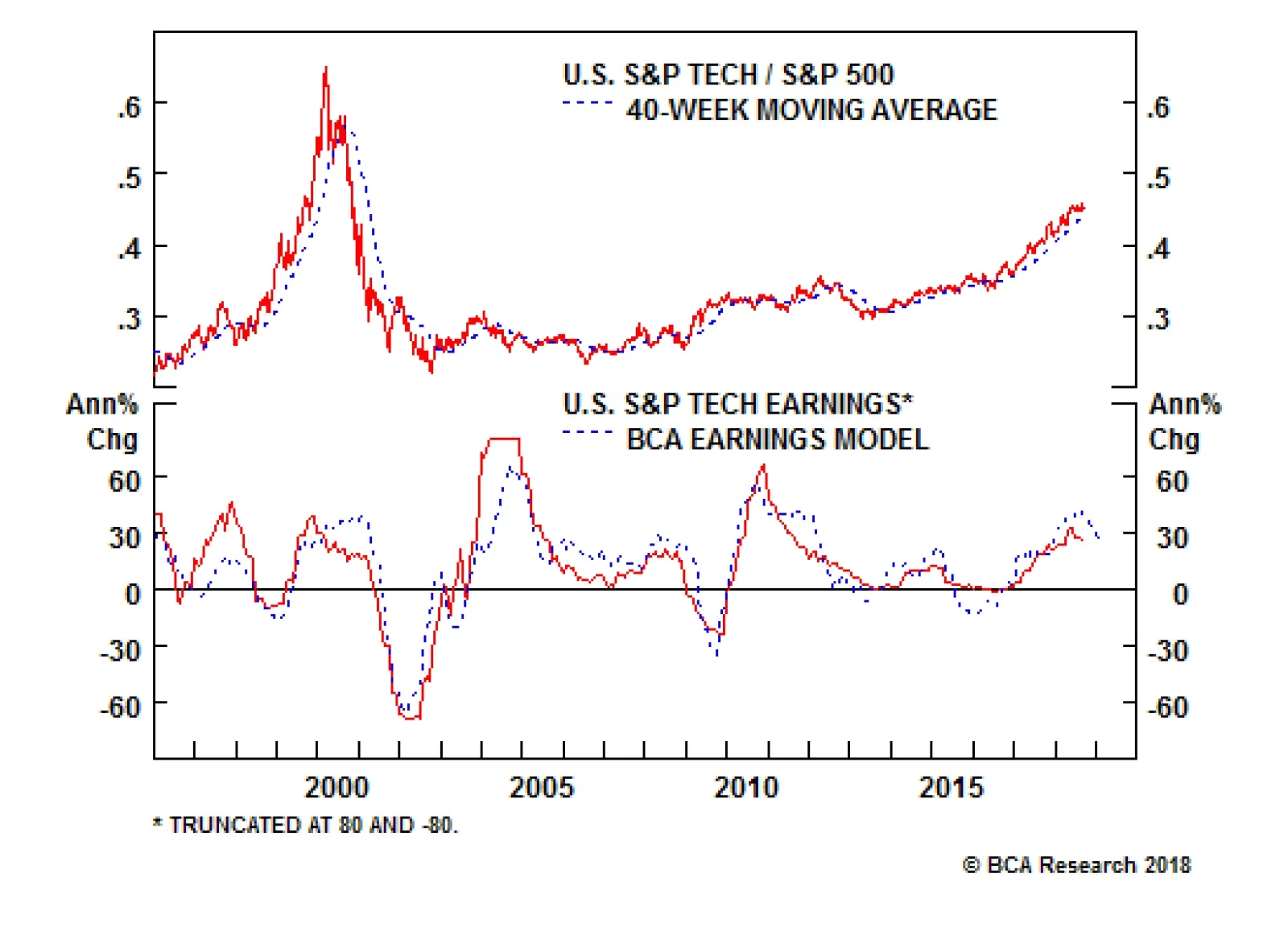
Stay Neutral S&P Tech
Stay…